
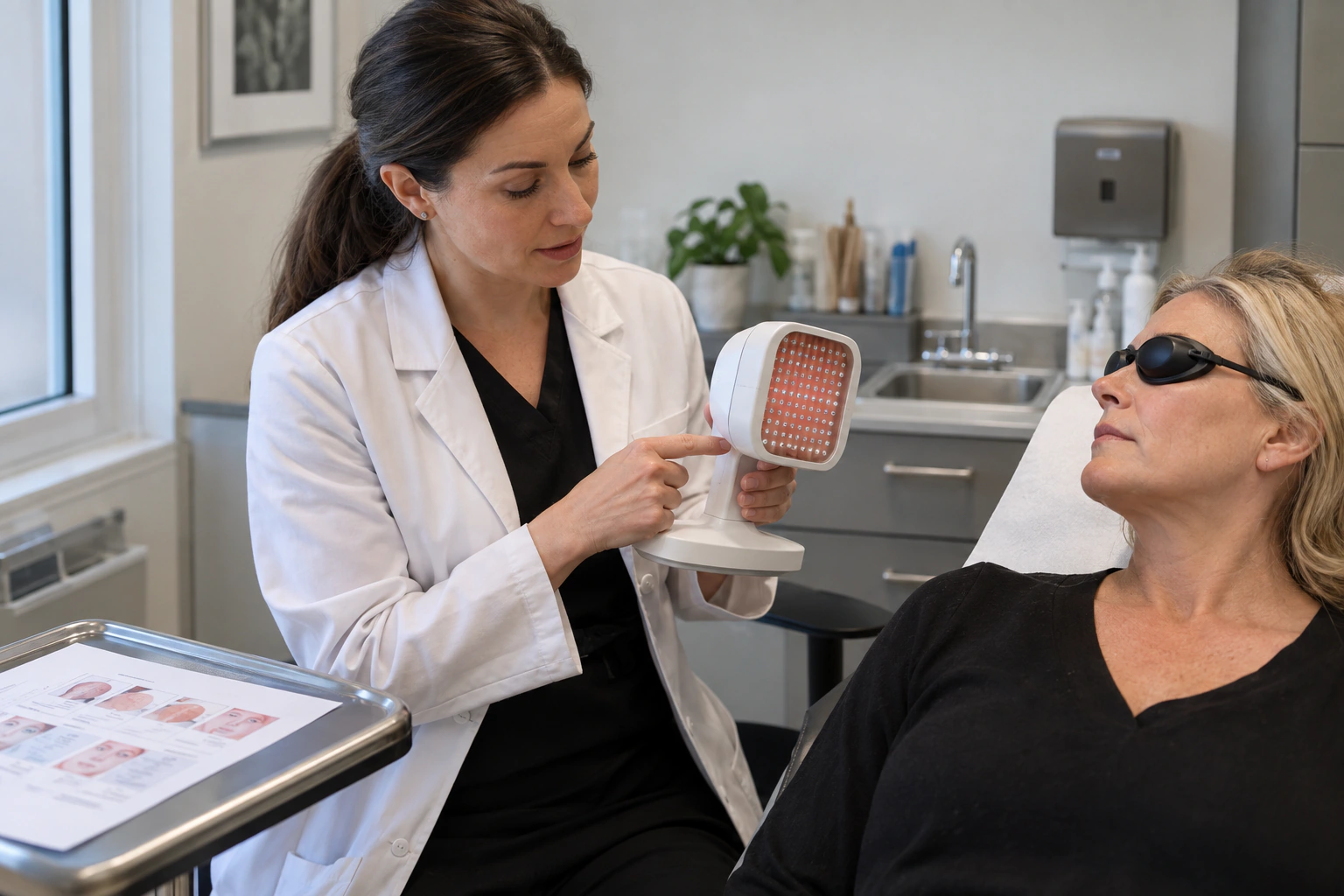
“Red light therapy” describes devices with different wavelengths, power, dose, distance, and intended uses. A study of one clinic device does not validate every home panel. The useful question is not whether red light “works”; it is whether a specific device delivers a studied dose for a specific outcome with appropriate eye and skin precautions.
Start with the treatment claim. Write down the condition, exact device, study population, intended outcome, and precautions. If the seller provides only a wavelength and a collection of testimonials, you do not yet have enough information to judge a treatment.
Photobiomodulation is not one treatment
Red and near-infrared light can interact with tissue without the ionizing radiation used in X-rays. Proposed cellular mechanisms include changes in mitochondrial signaling, inflammation, and blood flow. Mechanistic plausibility is the beginning of an evidence chain, not proof of a clinical benefit.
Hair devices, acne devices, wrinkle devices, wound-care systems, pain treatments, and whole-body panels differ. Some medical devices have FDA clearance for narrow indications. “FDA registered” only means an establishment or listing is in a regulatory system; it is not the same as FDA approval of every claim.
| Marketing phrase | Question to ask | Why it matters |
|---|---|---|
| “Clinical-grade wavelength” | What irradiance and delivered dose at the recommended distance? | Wavelength alone does not define treatment |
| “FDA registered” | Is the exact model cleared for this intended use? | Registration is not efficacy review |
| “No side effects” | Were eyes, heat, skin, and medicines assessed? | Low risk is not zero risk |
| “Whole-body benefits” | Which human outcomes were tested? | Local studies do not prove systemic claims |
| “More powerful” | Does the dose match evidence? | Excess exposure may add heat or irritation |
Where evidence is more developed
Selected devices have human evidence for improvement in androgenetic hair loss and some skin concerns, including signs of aging; dermatologists may use light as part of an acne treatment plan. Study size, blinding, comparison groups, and treatment schedules vary. The hair and skin evidence described here does not establish that a home panel treats pain or heals wounds.
Claims about testosterone, fat loss, cognition, thyroid function, immunity, or whole-body longevity are much less established. Small biomarker changes, animal research, or a study of a different wavelength do not justify a broad consumer promise.
Follow one claim from advertisement to study
Suppose a panel is advertised for hair growth and “cellular energy.” The linked study might have tested a comb that parts scalp hair and delivers light close to the follicles. A panel across the room, with hair blocking the scalp, is a different exposure even if both emit red light. That mismatch does not prove the panel cannot help; it means the cited study has not established that it will.
A 26-week randomized sham-controlled trial tested a particular low-level laser comb in men with androgenetic alopecia. Its condition, hardware, and duration define the finding’s scope. A reader can use those details to ask better questions without treating the paper as a recommendation for a brand or a guarantee of results.
Read the outcome too. A change in measured hair density is different from a patient’s satisfaction with appearance; a laboratory marker is different from pain-free walking. When a seller reports only a percentage improvement, ask what was measured, how large the absolute change was, and whether participants could notice it. A result can be statistically detectable yet too small to matter for your goal.
Check whether the exposure fits your health
Eye safety is not optional
Bright visible and near-infrared sources can expose the eye even when light does not look painfully intense. Risk depends on wavelength, power, distance, duration, optics, and eye condition. Follow the exact manufacturer’s protective-eyewear instructions for the intended use; closing the eyes is not automatically equivalent.
People with retinal disease, recent eye surgery, photosensitivity, or medicines that affect light sensitivity should ask an eye professional before facial or whole-body exposure. Do not stare at LEDs to “treat” the eyes. Devices intended for eye disease require a regulated clinical pathway.
Skin, heat, and photosensitizing treatment
Red-light devices are often described as non-thermal, but high-powered panels, close distance, long sessions, or poor ventilation can still feel warm and irritate skin. Stop for pain, marked redness that persists, blistering, or worsening pigmentation. Use extra caution over areas with reduced sensation.
Some medicines and topical products increase sensitivity to light. The relevant wavelengths and reactions vary, so do not rely on a generic “red light is safe” answer. Ask a pharmacist or dermatologist about the exact device spectrum and current treatments.
People prone to hyperpigmentation should discuss the plan with a dermatologist before facial treatment. The American Academy of Dermatology highlights that visible light can worsen pigmentation in some darker skin tones. An absence of UV does not mean every skin type responds identically. A patch or tolerance check recommended for one device also cannot clear someone for every wavelength or higher exposure.
A device evidence audit before purchase
- Write the exact outcome and body area.
- Find the model number and regulatory status—not only the company name.
- Match wavelength, irradiance, distance, session length, and total dose to human studies.
- Check whether studies used the same device or only a similar color of light.
- Look for randomized comparison, meaningful outcomes, and adverse-event reporting.
- Estimate the full time and replacement cost.
- Set a reassessment date and stop rule.
Dose is more than minutes
Light dose depends on power reaching the skin and exposure time. Distance changes irradiance, and panels may not deliver a uniform field. A ten-minute protocol from one device cannot be copied to another. More time can exceed the tested dose rather than accelerate results.
Do not combine several panels, masks, and handheld devices on the same area without understanding cumulative exposure. Document the model, distance, schedule, and other treatments so an effect or reaction can be interpreted.
For example, a seller may give electrical wattage—the power the device consumes—while the study reports irradiance at the skin. These are different quantities. Another advertisement may state peak output without explaining how pulsing changes the average exposure. Ask for the measurement at the recommended distance and the assumptions behind the proposed schedule. A professional can interpret whether those measurements are meaningful for the intended treatment.
Do not construct a new protocol by combining numbers from different papers. If a clinical trial used one source, distance, body area, and session pattern, changing all four does not preserve its evidence. Consumer instructions should be clear enough to follow without doing radiometry at home. Missing directions, inconsistent specifications, or no response from the manufacturer are practical reasons to pause a purchase.
Decide what an acceptable result would look like
Hair loss: measure months, not mirror moments
Some low-level light devices are cleared for pattern hair loss and may produce modest density improvements. Hair growth cycles are slow, and diagnosis matters. Sudden shedding, scarring, scalp pain, patchy loss, or systemic symptoms require evaluation rather than a gadget.
Use standardized photographs under the same lighting and hair arrangement. A bright red panel can make the scalp look different immediately, so do not judge progress directly after a session. See our hair-loss treatment timeline.
Skin goals: do not obscure basic care
For acne, wrinkles, or redness, sunscreen, gentle skin care, and evidence-based medicines may have clearer roles. Light can be an adjunct when the device and diagnosis fit. It should not replace evaluation of a changing lesion or delay treatment of severe acne that is scarring.
Photodynamic therapy used by clinicians combines light with a photosensitizing agent and is not the same as an ordinary home LED mask. Instructions and risks cannot be borrowed between them.
Run one treatment at a time
Starting red light, a new supplement, retinoid, minoxidil, and massage in the same week makes both benefit and harm impossible to attribute. Hold the rest of the routine stable when safe, track one meaningful outcome, and take photographs on a schedule.
If no meaningful improvement appears by the evidence-based review point, do not automatically increase power. Confirm adherence, diagnosis, and whether the device delivered the claimed dose. A bounded trial protects money and attention.
Pain and recovery claims
A pain or recovery advertisement needs evidence for the specific diagnosis and device; the hair-treatment trial cited in this guide cannot support it. “Back pain” can come from many structures and conditions, and a panel does not screen for fracture, infection, nerve compression, or cancer. New weakness, bladder or bowel dysfunction, fever, major trauma, or severe progressive pain needs clinical care.
If light is used as an adjunct, define the diagnosis, body area, dose, concurrent rehabilitation, and outcome such as function or pain during a specific task. Do not let temporary warmth or relaxation substitute for progressive loading when rehabilitation is indicated.
Home device versus clinic treatment
Clinic equipment may deliver a measured dose with trained positioning and eye protection. A home device offers convenience but transfers setup, distance, timer, maintenance, and reaction monitoring to the user. The lower purchase price is not a benefit if the device never delivers a meaningful dose or is too cumbersome to use.
Ask whether replacement LEDs, calibration, cleaning, and electrical certification are addressed. Inspect cords and housings, keep devices away from water, and do not use damaged equipment. Children should not operate high-output panels unsupervised.
Photography and outcome bias
Red illumination, camera exposure, skin moisture, hair arrangement, and time of day can create persuasive before-and-after images. Use the same neutral room light, camera distance, angle, and skin or hair preparation. Schedule photographs before treatment rather than immediately after transient redness.
Decide what change is large enough to matter before reviewing images. If only a carefully selected angle shows improvement, the clinical effect may be too small to justify the routine. Keep unsuccessful sessions in the record.
Take these questions to an appointment
Bring the exact model, wavelength range, irradiance if supplied, distance, schedule, treatment area, eye protection, and every topical or oral medicine. Describe the original diagnosis and any reaction. This is far more useful than saying only that you use “red light.”
Ask which part of the current treatment plan the device would add to, how long a fair trial should last, and what would count as failure. Discuss whether maintenance sessions are expected if it works. The total commitment includes setup, cleaning, time spent wearing goggles or a mask, and continuing expenses. A technically promising treatment that you cannot comfortably use has limited practical value.
Bring the marketing page as well as the instructions. These sometimes describe different goals: the advertisement may suggest broad wellness while the manual lists a narrow cosmetic use. Ask the clinician to evaluate the claim you actually plan to act on. Save the manual and purchase details so that a later reaction can be linked to the correct model and schedule.
Finally, ask what simpler options would address the same concern. For someone mainly troubled by unpredictable acne flares, a diagnosis and consistent skin-care plan may solve a different problem from fine lines. For a person losing hair suddenly, evaluation matters more than selecting a light source. Defining the concern makes the device decision easier and makes disappointing results less likely to trigger another purchase.
Sources and evidence scope
This guide draws on FDA draft photobiomodulation guidance—a nonbinding draft, not a patient treatment protocol—FDA information on device marketing pathways, AAD patient guidance, and a randomized hair-treatment trial. Results cannot be transferred automatically between devices, doses, or conditions. Sources checked September 8, 2026.