
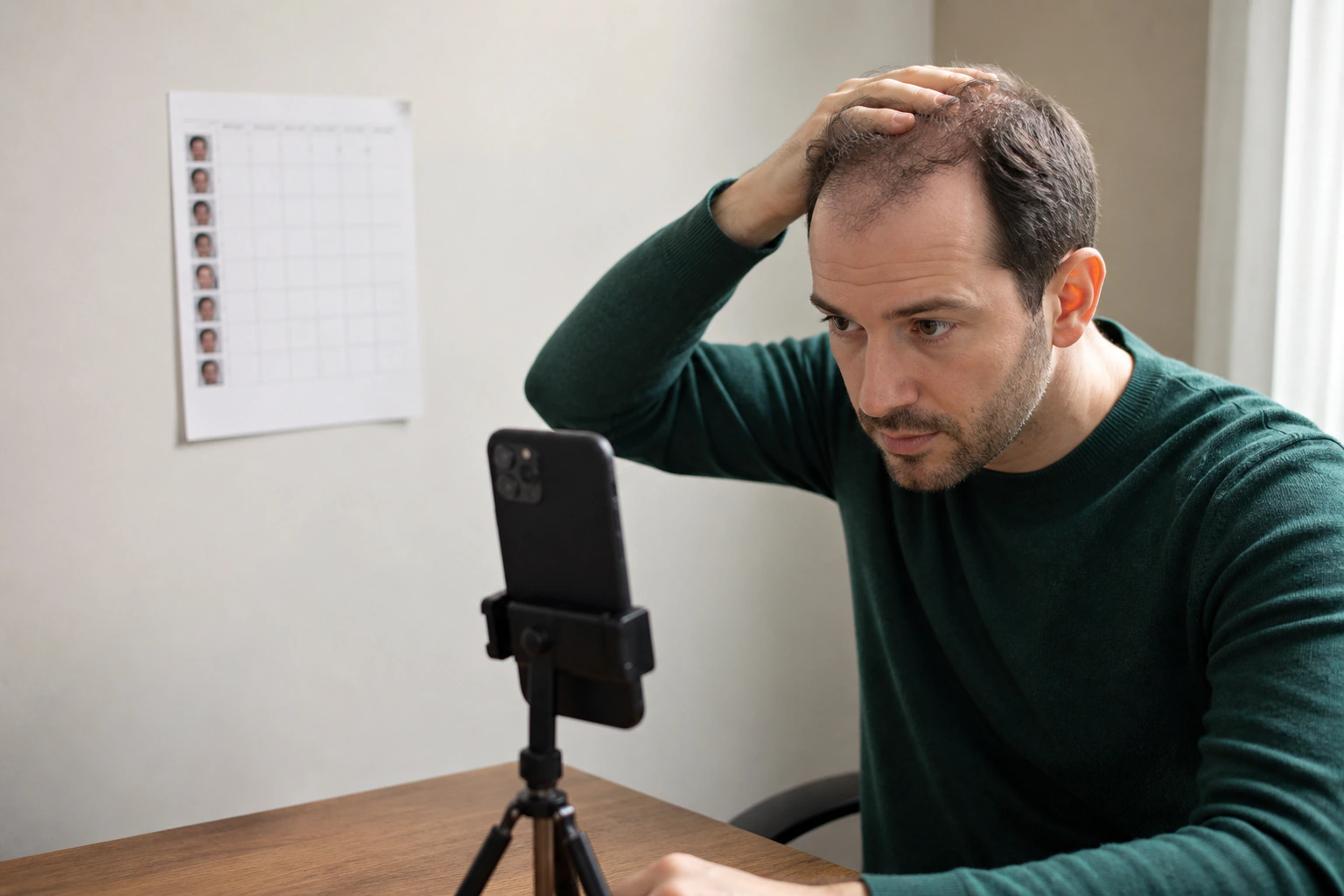
Hair grows in cycles, so treatment progress is measured in months, not days. Early shedding can occur with some therapies, photographs can mislead, and stopping too soon may erase a benefit before it becomes visible. The first job is an accurate diagnosis; the second is a consistent baseline; the third is a pre-agreed review point that separates expected delay from treatment failure or another disease.
Do not start the clock before the diagnosis
Pattern hair loss, telogen effluvium, alopecia areata, traction, infection, scarring alopecia, postpartum shedding, thyroid disease, iron deficiency, and medicine effects need different approaches. A product effective for androgenetic alopecia may be irrelevant or harmful in a scarring condition.
A clinician may examine the distribution, scalp, hair shafts, pull test, history, and family pattern and order targeted tests when indicated. Read Pattern Hair Loss for the diagnostic foundation. Sudden, inflamed, painful, or scarring change should not wait for a six-month cosmetic trial.
The timeline trap
- Hair follicles do not all grow and shed together.
- A treatment may stabilize loss before visible density improves.
- Early shedding can occur but is not proof a product is working.
- Lighting, wetness, hair length, styling, and camera angle can fake progress or decline.
- Stopping and restarting repeatedly makes the response harder to interpret.
- Not every person regrows visible hair; maintenance can be a meaningful outcome.
A realistic review calendar
| Time point | Useful task | What not to conclude |
|---|---|---|
| Day 0 | Confirm diagnosis, baseline photos, treatment and safety plan | That one photo predicts outcome |
| Weeks 2–8 | Check technique, irritation, adherence, and significant shedding | That early appearance proves failure or success |
| Month 3 | Review tolerability and directional change | That everyone should have dense regrowth |
| Months 6–12 | Compare standardized photos and clinician assessment | That internet timelines set your deadline |
| Long term | Confirm maintenance, side effects, pregnancy plans, and diagnosis if change occurs | That stable treatment can never need reassessment |
Exact review points depend on the diagnosis and treatment. Oral and topical therapies have different safety monitoring. The calendar is a framework for discussion, not a promise.
How to take photographs that tell the truth
- Use the same room, camera, distance, and lens.
- Use diffuse natural or consistent indoor light—not harsh overhead light one month and a dark room the next.
- Keep hair dry or wet consistently and avoid fibers or concealers.
- Part hair at the same landmarks; photograph front, temples, top, crown, and sides as relevant.
- Keep hair length and styling reasonably comparable.
- Take photos at planned intervals, not several times a day.
- Store originals with dates and do not judge from cropped social-media images.
Shedding: signal, side effect, or separate problem?
Some treatments that alter the hair cycle can be followed by temporary increased shedding. But shedding can also reflect illness, rapid weight change, childbirth, iron deficiency, thyroid disease, major stress, another medicine, or progression of the original condition. “It is just the shed” should not become a reason to ignore severe or persistent loss.
Record when shedding started relative to treatment, recent illness, diet change, surgery, pregnancy, and new medicines. Estimate trend using consistent wash or brush routines rather than counting every hair. Seek review if there are bald patches, scalp symptoms, body-hair change, or continued major worsening.
What common treatment pathways require
Topical minoxidil requires consistent application and can irritate the scalp; unwanted facial hair and other effects may occur. Oral minoxidil is a prescription cardiovascular medicine used off label for hair loss in some settings and needs clinical screening for blood-pressure, heart, and fluid effects.
Finasteride is used for male pattern hair loss in appropriate patients and can have sexual and other side effects. Pregnancy exposure precautions apply because of fetal risk. Other options—spironolactone, anti-inflammatory treatment, injections, light devices, surgery, or camouflage—fit different diagnoses and risk profiles. This page does not rank or combine them.
Do not let “more” destroy the experiment
Starting several treatments, supplements, shampoos, microneedling, and procedures at once makes it hard to identify benefit or harm. It may also create interactions or scalp irritation. Agree on the core plan and one change at a time when clinically reasonable.
Biotin deficiency can cause hair changes, but high-dose biotin is not a universal hair treatment and can interfere with laboratory tests. Review Supplements and Medication Interactions before adding gummies or powders.
Safety is part of cosmetic treatment
Report dizziness, faintness, palpitations, swelling, severe scalp inflammation, breast changes, sexual adverse effects, significant mood changes, or pregnancy plans according to the product and prescription. Do not buy prescription-strength hair medicine from an unverified seller or use a family member’s supply.
Use Generic and Online Pharmacy Safety and Medication Side Effects. A treatment applied to the scalp can still have systemic effects.
The six-month conversation
- Was the original diagnosis correct?
- Was the treatment used consistently and with correct technique?
- Did shedding stabilize even if density did not rise?
- Do standardized photos show maintenance, improvement, or progression?
- Are side effects acceptable and monitored?
- Did illness, pregnancy, weight change, or another medicine alter the picture?
- Should the plan continue, change, or investigate another cause?
What “no visible regrowth” can mean
The treatment may be maintaining existing hair, the diagnosis may be correct but the response limited, adherence or technique may be inconsistent, or a second cause may be active. A dermatologist can compare miniaturization, distribution, and standardized photographs rather than relying on a mirror impression.
If there is continued progression despite an adequate trial, review the diagnosis before stacking therapies. Scarring alopecia, inflammation, nutritional deficiency, thyroid disease, or telogen effluvium may need different treatment. A scalp biopsy is sometimes used when the pattern remains unclear.
Camouflage is treatment for the day you live now
Hair fibers, strategic cuts, wigs, toppers, scalp micropigmentation, and hats can improve confidence while medical treatment is being evaluated. They do not mean someone has “given up.” Choose products that do not inflame the scalp or worsen traction, and remove adhesives gently.
Hair transplantation can redistribute follicles in selected pattern-loss cases but does not stop ongoing loss. A reputable surgeon evaluates donor supply, diagnosis, age, expectations, and the long-term medical plan. Avoid guaranteed graft survival or pressure to book immediately.
Pregnancy and sexual side effects need advance planning
Some antiandrogen treatments can harm a fetus and require contraception or avoidance in people who can become pregnant. Topical exposure and handling precautions may also apply. Discuss conception plans before starting, not after a positive test.
Sexual adverse effects, breast symptoms, dizziness, swelling, or mood change should be reported precisely. They are neither inevitable nor imaginary. A benefit–risk conversation can consider dose, formulation, alternative treatment, and the importance of hair goals without dismissing either side.
A sustainable minimum routine
Choose a schedule you can repeat on workdays, weekends, and travel. Pair topical treatment with an existing habit, keep the supply in approved storage, and set a refill reminder. Record missed applications honestly; doubling later may increase irritation without restoring the schedule.
Agree on the few products that matter and remove the rest. A gentle shampoo, appropriate scalp care, and the evidence-based core treatment are often easier to evaluate than a shelf of changing oils and supplements.
When treatment fatigue becomes the main problem
Daily application, cost, residue, travel, uncertainty, and constant mirror checking can become burdensome. Tell the clinician which part is unsustainable. A simpler plan used consistently may be more informative than an elaborate routine used intermittently.
Set photo days and avoid daily comparison. Hair loss can affect self-image and social confidence; psychological support is legitimate care. Do not let shame push you toward unregulated “miracle” products or extreme diets.
What to bring to the review
Bring the treatment containers, start dates, standardized original photos, a short adherence record, recent health changes, and every supplement. Note scalp pain, itching, flaking, menstrual or pregnancy changes, and family history. This lets the clinician assess technique, diagnosis, and safety without depending on memory.
Do not cut or color hair solely to “prepare” for the appointment unless asked. The natural distribution and scalp signs may be diagnostically useful.
One-minute summary
Confirm the diagnosis, create a reproducible baseline, and judge change at an agreed interval. Early shedding is possible but does not prove success, and maintenance may be a meaningful outcome. Continued progression, scalp inflammation, systemic symptoms, or an unsustainable routine should trigger reassessment rather than uncontrolled product stacking.
Use a repeatable photo protocol
Progress photos become misleading when lighting, angle, hair length, styling, or wetness changes. Choose a fixed room, camera position, distance, part line, and dry-hair condition. Take front, temples, top, and crown views at the interval agreed with the clinician rather than every day. Label each set with the date and major treatment changes. Pair images with symptoms such as itching, scale, pain, or shedding, because appearance alone cannot identify inflammation or scarring. The goal is not constant surveillance; it is a comparable record that reduces memory bias and supports a calmer decision about continuation, adjustment, or diagnostic review.
Sources and evidence scope
This guide uses American Academy of Dermatology information on hair-loss diagnosis and treatment, AAD guidance on male pattern hair-loss treatment, and a peer-reviewed review of androgenetic alopecia treatment. Sources were checked August 31, 2026. Treatment timelines vary by diagnosis, sex, formulation, and individual response; no regrowth outcome is guaranteed.