
Guides in this topic
Pattern Hair Loss in Men and Women: Causes, Diagnosis and Options
Pattern hair loss is a common inherited condition in which susceptible scalp follicles gradually produce shorter, finer hairs. In a typical male pattern it affects the temples, hairline, and crown. In a typical female pattern it widens the central part and reduces density over the top while often preserving the frontal edge. The medical term is androgenetic alopecia.
Hair-Loss Treatment Timeline: Shedding and Progress
Hair grows in cycles, so treatment progress is measured in months, not days. Early shedding can occur with some therapies, photographs can mislead, and stopping too soon may erase a benefit before it becomes visible. The first job is an accurate diagnosis; the second is a consistent baseline; the third is a pre-agreed review point that separates expected…
Finasteride Side Effects, Fertility Questions, and Pregnancy Handling
Finasteride discussions are often distorted by two extremes: dismissing every concern as internet anxiety or treating every symptom after treatment as permanent injury. A useful consent conversation uses the approved label, the reason for treatment, baseline sexual and mood health, fertility goals, …
Finasteride Shedding and Results: A Photo Timeline Without False Promises
Hair forums turn every shed into proof that finasteride is working—or failing. Neither conclusion is reliable from a shower drain. Hair cycles, lighting, haircut length, seasonal shedding, minoxidil changes, illness, and androgenetic progression all affect what a person sees. The fair test uses stan…
Understanding this topic
Key points
- Some daily shedding is normal; visible loss can come from shedding, breakage, reduced follicle growth, or permanent scarring.
- Timeline and pattern matter: gradual thinning, sudden diffuse shedding, round patches, a receding hairline under tension, and an inflamed scalp suggest different pathways.
- Illness, childbirth, major surgery, nutritional deficiency, rapid weight change, stress, medicines, thyroid disease, and other conditions can contribute, but testing should follow the history rather than a universal panel.
- Pain, burning, pustules, heavy scale, loss of follicle openings, or a smooth shiny scalp needs timely dermatology assessment because some scarring disorders can cause permanent loss.
- Supplements only help when they correct a relevant deficiency; high-dose biotin can interfere with important laboratory tests.
Start with the hair cycle
Each follicle cycles through growth, transition, rest, and release. Different follicles are at different stages, which is why hair normally falls without the whole scalp shedding at once. The NHS notes that losing some hair each day is expected and often goes unnoticed. A change becomes visible when more follicles enter the release phase, new growth is reduced, shafts snap faster than they are replaced, or follicles are destroyed.
Scalp hair grows slowly, so the effect of a trigger may not appear immediately. A fever, operation, childbirth, major illness, or nutritional disruption can be followed by diffuse shedding weeks to months later. Likewise, improvement after the trigger is corrected may take months to become obvious. This delay is one reason a timeline is more useful than blaming the most recent shampoo.
Hair density and texture vary naturally with age, genetics, hormones, styling, and ethnicity. A wide part or a smaller ponytail may indicate change, but photographs taken with different light, hair length, moisture, or camera angle can exaggerate it. Comparable monthly photographs can be more informative than daily checking.
Shedding, breakage, and follicle loss are different
Shedding usually releases a full-length hair from the follicle. Diffuse shedding across the scalp is often called telogen effluvium when an unusually large number of follicles enter the resting and release phase. Potential triggers include acute illness, high fever, surgery, childbirth, rapid or marked weight loss, iron deficiency, major psychological stress, endocrine change, and some medicines. More than one trigger may occur together.
Breakage leaves shorter pieces and uneven lengths. Heat, bleaching, chemical straightening, repeated friction, tight ties, and handling fragile wet hair can damage the shaft. Some scalp or shaft disorders also cause breakage. A white bulb at one end is not an online diagnostic test, and the absence of one does not establish a cause.
Follicle loss can be non-scarring or scarring. In non-scarring conditions, follicle openings remain and regrowth may be possible. In scarring alopecia, inflammation damages and replaces follicles with scar tissue. Early identification matters because treatment may protect remaining hair even when it cannot restore follicles already destroyed.
Common patterns and what they can suggest
Gradual patterned thinning
Inherited pattern hair loss is common. It can produce recession and thinning over the crown, widening of the part, or reduced density over the top while the back and sides are relatively preserved. The exact distribution varies. Hormonal sensitivity and genetics influence follicle miniaturization, but a person may also have simultaneous shedding or scalp disease.
Sudden diffuse shedding
Telogen shedding tends to affect the scalp broadly rather than create one completely bare patch. The trigger may have occurred months earlier. A clinician asks about illnesses, operations, childbirth, changes in weight or diet, stress, new medicines, and systemic symptoms. The process is often temporary, but persistent or recurrent shedding needs review for an ongoing trigger or another overlapping condition.
Round or oval patches
Alopecia areata occurs when the immune system attacks hair follicles. NIAMS describes sudden round or oval patches, commonly on the scalp or face, usually without scarring. Eyebrows, eyelashes, beard, or other body hair may be affected, and some people develop nail pitting. The course is unpredictable: hair can regrow, new patches can form, or loss can become more extensive.
Not every round patch is alopecia areata. Fungal infection, traction, hair pulling, and inflammatory or scarring disease can mimic it. Scale, broken hairs, redness, tenderness, or exposure to an infected person or animal changes the assessment.
Loss where hair is pulled
Repeated tension from tight braids, extensions, weaves, buns, ponytails, rollers, or headwear attachments can cause traction alopecia, often around the hairline or points of greatest pull. Early change may improve when tension stops. Continued traction can scar follicles, so pain, bumps, broken hairs, or progressive recession should not be ignored.
Scalp clues that deserve attention
Look beyond density. Itch, heavy scale, redness, pustules, crust, sores, bleeding, tenderness, burning, or drainage suggests an active scalp problem. A smooth shiny area with few visible follicle openings can suggest scarring. Loss of eyebrows, eyelashes, or body hair, and nail changes, may add diagnostic clues.
A contagious fungal infection of the scalp is more common in children but can affect adults. It may cause scale, broken hairs, patches, and sometimes a tender swollen area. Sharing combs, hats, towels, or close contact can spread some infections. Medical treatment may be needed; cosmetic oils alone do not eradicate a follicle infection.
Book a prompt assessment for rapidly expanding loss, scalp pain or burning, pustules, thick crust, a boggy swollen patch, shiny scar-like skin, or loss involving eyelashes or eyebrows. Fever, facial swelling, rapidly spreading redness, or severe illness with a painful scalp needs urgent care. Sudden hair loss after a new medicine should be reported, but do not stop prescribed treatment without the prescriber.
What a clinical assessment includes
The history covers when the change began, whether it is shedding or breakage, the distribution, rate of progression, scalp symptoms, recent illness, pregnancy, surgery, weight change, diet, menstrual or hormonal symptoms, stress, family history, hair practices, and all medicines and supplements. Clinicians may ask how the change affects mood and daily life because hair loss can be psychologically significant.
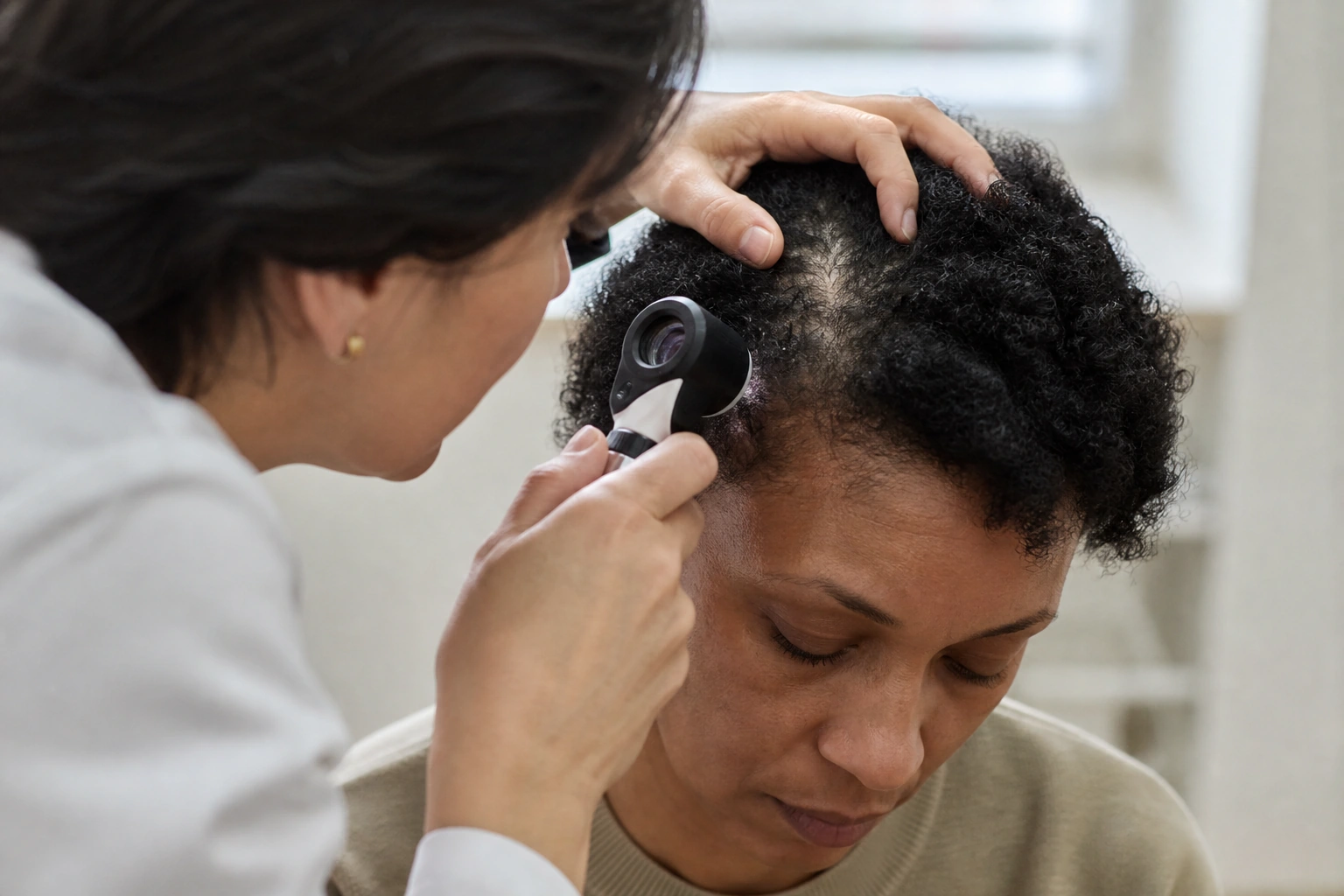
Examination includes the scalp, hair shafts, follicle openings, nails, and sometimes other skin or body-hair areas. A magnifying device can reveal features not visible in an ordinary photograph. A gentle pull test may help estimate active shedding, but technique and context matter. A single home result cannot identify the cause.
Blood tests are targeted to the story and examination. They may assess blood count, iron status, thyroid function, or other suspected conditions. Ordering every vitamin and hormone is not automatically helpful and can produce incidental results. A sample for fungal testing or a scalp biopsy may be needed when infection, inflammation, or scarring is possible. NIAMS notes that tests can also help distinguish alopecia areata from conditions with a similar pattern.
Treatment follows the cause
There is no treatment that suits every form of loss. A temporary shedding episode may recover after illness resolves, nutrition stabilizes, or another trigger is addressed. Pattern hair loss may be managed with therapies that support follicles or modify hormonal signaling, depending on sex, pregnancy potential, health history, and local licensing. Benefits usually require continued use, and realistic expectations matter.
Alopecia areata treatment depends on age, extent, duration, and personal preference. NIAMS describes local and systemic immune-modifying options for selected people, while mild disease may regrow without treatment. Regrowth does not always prevent a future episode. These treatments require clinical selection and monitoring; this page does not provide a drug or injection protocol.
Infection requires treatment directed at the organism. Inflammatory and scarring alopecias may need prompt anti-inflammatory or immune treatment to reduce further follicle damage. Traction requires removal of tension. Shaft breakage calls for changes to chemical, heat, or mechanical practices. Treating the wrong process can waste time and allow preventable loss to progress.
Hair care while the cause is investigated
Choose gentle handling: loosen styles that pull, reduce repeated high heat and chemical processing, detangle carefully, and avoid scratching or picking an inflamed scalp. Protective styling should protect rather than hurt; pain, headache, bumps, or “facelift tightness” means the style is too tight. Alternate attachment points and allow recovery time.
A normal shampoo does not reach the follicle deeply enough to reverse an autoimmune or inherited condition, but scalp cleansing can reduce oil and product buildup. Medicated scalp products are condition-specific and can irritate when used for the wrong diagnosis. “Natural” oils and essential oils can cause allergy or inflammation and are not automatically safer.
Camouflage fibres, wigs, hairpieces, scarves, or a different haircut are valid choices, not a surrender. Ensure adhesives and clips do not inflame skin or add traction. Bare scalp should be protected from sun and cold. If eyebrow or eyelash loss affects eye comfort, glasses can help shield from dust while clinical advice is arranged.
Nutrition and supplement cautions
Hair growth requires adequate energy, protein, iron, zinc, and other nutrients, but more is not always better. Restrictive diets and rapid weight loss can trigger shedding. A varied diet is preferable to a stack of hair supplements unless assessment identifies a deficiency or specific need.
Iron should not be taken simply because hair is shedding; excess iron can be harmful, and the cause may be unrelated. High intakes of some nutrients can also contribute to hair loss or toxicity. Supplements can interact with medicines and may contain different amounts from those expected.
Biotin is widely marketed for hair, skin, and nails, but the FDA warns that supplemental biotin can interfere with certain laboratory tests and produce incorrect results. Interference has included tests used in urgent heart assessment. Tell clinicians and laboratory staff about every supplement, including the amount and last dose, and follow their instructions before testing rather than guessing a stop interval.
Evaluating clinics and regrowth claims
The NHS advises finding out what is causing hair loss before going to a commercial clinic. Ask who makes the diagnosis, what qualifications they hold, whether the scalp is examined before a package is sold, and whether the treatment has evidence for your specific condition. A clinic should explain likely benefit, uncertainty, adverse effects, maintenance, total cost, and alternatives.
Be cautious with guaranteed regrowth, a diagnosis made only from an online image, “detox” explanations, secret formulas, pressure to buy same-day packages, or before-and-after photographs without standardized lighting and long-term follow-up. A transplant cannot correct every active inflammatory disease, and a procedure does not replace diagnosis or ongoing management.
Questions people often ask
Will shaving make hair grow back thicker?
No. Cutting changes the blunt edge and appearance of the shaft but does not increase the number of follicles or alter their growth cycle.
Is stress the cause of all sudden shedding?
No. Stress can contribute to some shedding episodes, but illness, childbirth, nutritional change, medicines, thyroid problems, infection, immune disease, and other causes must be considered.
Can a blood test diagnose hair loss?
Blood tests can identify selected contributing conditions, but the pattern, scalp examination, and history remain central. Some diagnoses require fungal testing, magnified examination, or biopsy.
How quickly should a treatment work?
Hair cycles are slow, so visible change usually takes months. Timing depends on the diagnosis and treatment. A seller promising dramatic universal results within days is not describing normal follicle biology.
Sources and evidence scope
This guide was researched using NIAMS information on alopecia areata and its diagnosis and treatment, the NHS overview of hair loss, the MedlinePlus hair-loss medical encyclopedia, and the FDA safety information on biotin interference with laboratory tests. Evidence and guidance were checked on August 20, 2026. Diagnosis, medicine licensing, procedure availability, supplement regulation, and referral pathways vary by country.