
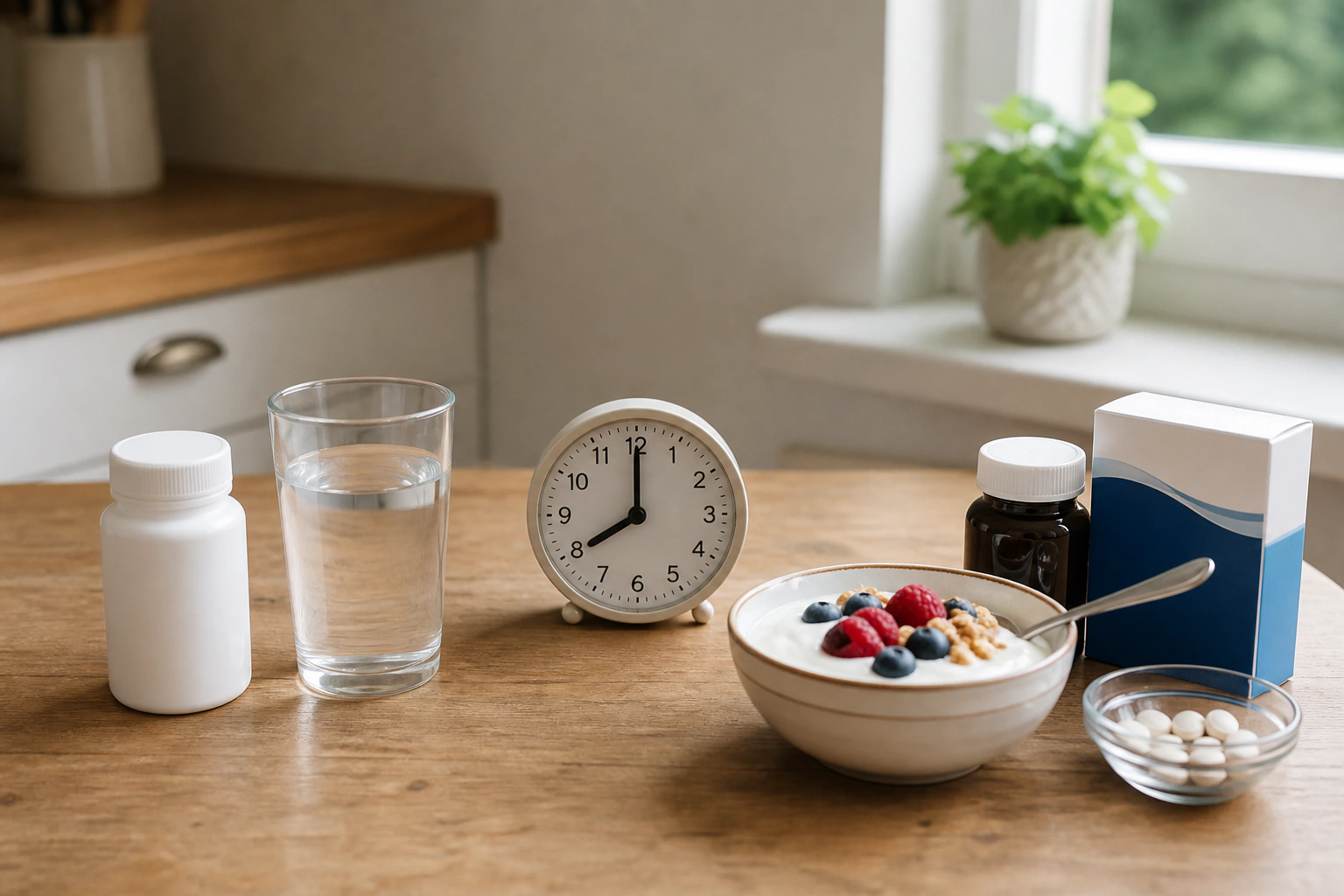
“Avoid dairy with antibiotics” is an overgeneralization. Calcium, iron, magnesium, aluminum, and zinc can reduce absorption of certain antibiotics, especially through binding in the gut, but the affected drugs and separation windows differ. Some antibiotics can be taken with milk; some are better tolerated with food; others need a tightly managed schedule.
The useful question has three parts
Instead of asking whether “antibiotics” mix with “dairy,” identify: the exact antibiotic and release form; the exact product, including minerals hidden in a multivitamin or antacid; and the time between them. A pharmacist can then apply the official label.
Doxycycline illustrates why broad rules fail. MedlinePlus notes that some doxycycline products may be taken with food or milk if the stomach is upset, while antacids, calcium or magnesium supplements, and iron preparations require product-specific separation. Another antibiotic may have different instructions. Do not transfer a schedule from a forum post or an old prescription.
Where the interacting minerals hide
- milk, yogurt, cheese, fortified plant drinks, and calcium-fortified juice;
- calcium, iron, magnesium, or zinc supplements and multivitamins;
- antacids and indigestion products;
- some laxatives, electrolyte powders, and meal replacements;
- protein shakes or nutrition drinks with added minerals;
- bismuth-containing stomach remedies.
Why minerals can lower antibiotic absorption
Certain antibiotics can form complexes with metal ions in the digestive tract. The bound complex is absorbed less well, so less active medicine may reach the bloodstream. This process is often called chelation. It is most familiar with tetracyclines and fluoroquinolones, but the exact magnitude and schedule vary by drug and formulation.
The consequence is not an immediate side effect you can feel. Reduced exposure may make treatment less reliable. That is why “I felt fine” cannot confirm that a poorly timed dose worked, and why taking an extra dose is not the solution.
| What the label says | What to clarify | Common mistake |
|---|---|---|
| “Take with food” | Whether dairy or fortified drinks are permitted | Assuming every meal is equivalent |
| “Avoid antacids” | Which ingredients and how long to separate | Checking only the antacid brand name |
| “Separate from iron” | Whether a multivitamin contains iron | Counting only a dedicated iron tablet |
| “Take on an empty stomach” | Defined fasting interval and allowed beverages | Using a universal two-hour rule |
| No pharmacy sticker | Official leaflet and pharmacist confirmation | Assuming no sticker means no interaction |
Build a schedule around the label, not around fear
Write down wake time, meals, the antibiotic schedule, mineral supplements, antacids, and bedtime. Then ask a pharmacist to place the interacting items using the exact separation intervals. Do not skip meals or supplements that are medically necessary without advice. Sometimes the antibiotic timing can move; sometimes a supplement can pause; sometimes another formulation is easier.
For general meal instructions, see Taking Medicine With Food or on an Empty Stomach. If several medicines compete for different windows, bring the whole list rather than solving one pair at a time.
If you took the dose with milk or a supplement
- Do not repeat the antibiotic.
- Record the medicine, amount, time, and food or supplement.
- Read the product-specific missed or administration instruction.
- Call the pharmacist if the combination is listed or you are unsure.
- Continue the next dose exactly as advised.
- Ask whether repeated timing errors change the follow-up plan.
One mistake is not a reason to abandon treatment. Repeated low exposure, however, may matter—especially when treating a serious infection. Use the callback guidance in How Long Do Antibiotics Take to Work? if symptoms are not improving.
Food can help tolerability without fixing every side effect
Taking an allowed antibiotic with food may reduce nausea or stomach irritation, but it does not prevent allergy, severe skin reactions, liver injury, or C. difficile. Diarrhea can also reduce absorption of an oral contraceptive even when the antibiotic itself does not; read Do Antibiotics Affect Birth Control?
For severe watery or bloody diarrhea, fever, marked abdominal pain, dehydration, or symptoms after the course ends, use Diarrhea During or After Antibiotics. Do not add an antidiarrheal product without checking whether it is appropriate.
Do not let a complicated schedule reduce adherence
A schedule with several daily doses and mineral separation can become unrealistic. Tell the pharmacist about work shifts, school, caregiving, fasting, swallowing difficulty, and the times you actually eat. A correct plan that cannot be followed is not a successful plan.
Use alarms labeled with both the antibiotic and the restriction, such as “antibiotic—water only; calcium later.” Mark the dose after taking it. Keep a written fallback instruction for a late dose from Missed a Dose? Never move doses closer together without advice.
Three schedule problems, solved without a universal formula
Breakfast contains yogurt and the antibiotic causes nausea
First determine whether the exact antibiotic permits milk. If it does, breakfast may be appropriate. If calcium separation is required, ask whether a non-dairy meal is acceptable or whether the dose can move. Do not fast unnecessarily when the label allows food, and do not add an antacid to treat nausea without checking its minerals.
An iron supplement and antibiotic are both prescribed several times a day
List every fixed event—wake time, meals, work, bedtime—and let a pharmacist construct the intervals. The solution may include temporarily changing supplement timing, but iron prescribed for a significant deficiency should not be abandoned. Ask for the plan in writing so the same narrow windows are not recalculated differently each day.
A fortified protein shake replaces a meal
Read the Nutrition Facts and ingredient list for calcium, magnesium, iron, and zinc. “Dairy free” does not mean mineral free. If the shake must be separated, choose another meal or move the dose only as the antibiotic instructions allow. Treat electrolyte powders and meal replacements as active schedule items.
The glass of water has another job
Some antibiotics can irritate the esophagus if swallowed with too little water or just before lying down. Follow the posture and fluid directions for the exact product. A tablet lodged in the esophagus can cause painful swallowing or chest discomfort; severe pain or inability to swallow needs assessment.
Water is not a universal cure for an interaction, and excessive fluid is unsafe for some heart or kidney conditions. Use the amount directed by the label or clinician.
Questions to take to the pharmacy counter
- Can this exact antibiotic be taken with food or milk?
- Which minerals bind it, and what interval does the label require?
- Do my multivitamin, antacid, laxative, shake, or fortified drink contain them?
- What should I do if nausea makes an empty-stomach dose difficult?
- What is the plan if I already combined them?
- Which symptoms mean treatment is failing or a side effect is serious?
- Could another safe formulation simplify the schedule?
The pain point behind the search
Forum questions often come after someone has already swallowed a pill with breakfast and fears they “ruined” the course. The evidence-based response is neither panic nor dismissal. Exposure depends on the exact product and timing; an extra dose can be more dangerous than the original mistake. Product-specific advice protects both safety and treatment effectiveness.
Alcohol questions are separate. Some antibiotic–alcohol combinations have direct warnings, while alcohol can also worsen nausea, dizziness, and recovery. See Antibiotics and Alcohol.
Keep the schedule after discharge or travel
A hospital medication chart may separate minerals automatically, while home routines do not. Before leaving, ask for actual clock times and whether an iron, calcium, or antacid product was paused. Reconcile old supplements with the new antibiotic rather than resuming the whole pre-hospital list.
When traveling, keep the antibiotic and written schedule in hand luggage. Time-zone changes, unfamiliar fortified foods, and late meals can collapse the planned intervals. Ask in advance whether the dose interval or local clock should take priority. Never reduce the number of daily doses simply to make the trip easier.
One-minute summary
Do not turn one antibiotic’s mineral warning into a class rule. Identify the drug, formulation, mineral product, and actual clock times. After a timing mistake, repeating the dose is usually the dangerous improvisation; document the event and ask. A written schedule that fits meals and work protects both absorption and completion of treatment.
Keep that schedule with the medicine until the course is complete.
Make the schedule survive an ordinary day
A technically perfect plan that collapses around breakfast, work, childcare, or sleep is not a safe plan. Put meals, the antibiotic, mineral supplements, antacids, and any other timed medicines on one 24-hour line. Then ask a pharmacist to resolve collisions and write the final intervals in plain language. Include what to do if breakfast runs late, a dose is forgotten, or nausea makes food necessary. Use phone alarms that name the action, such as “antibiotic with water,” instead of a generic reminder. Keep the schedule only for the duration of the course, then remove it so an obsolete rule does not migrate to a future antibiotic.
Sources and evidence scope
Sources include MedlinePlus drug information for doxycycline administration and mineral separation, NHS guidance on antibiotic interactions, and FDA advice on checking drug and food interactions. Sources were checked August 31, 2026. Because food instructions vary within antibiotic classes and between formulations, this guide does not give a universal separation interval.