
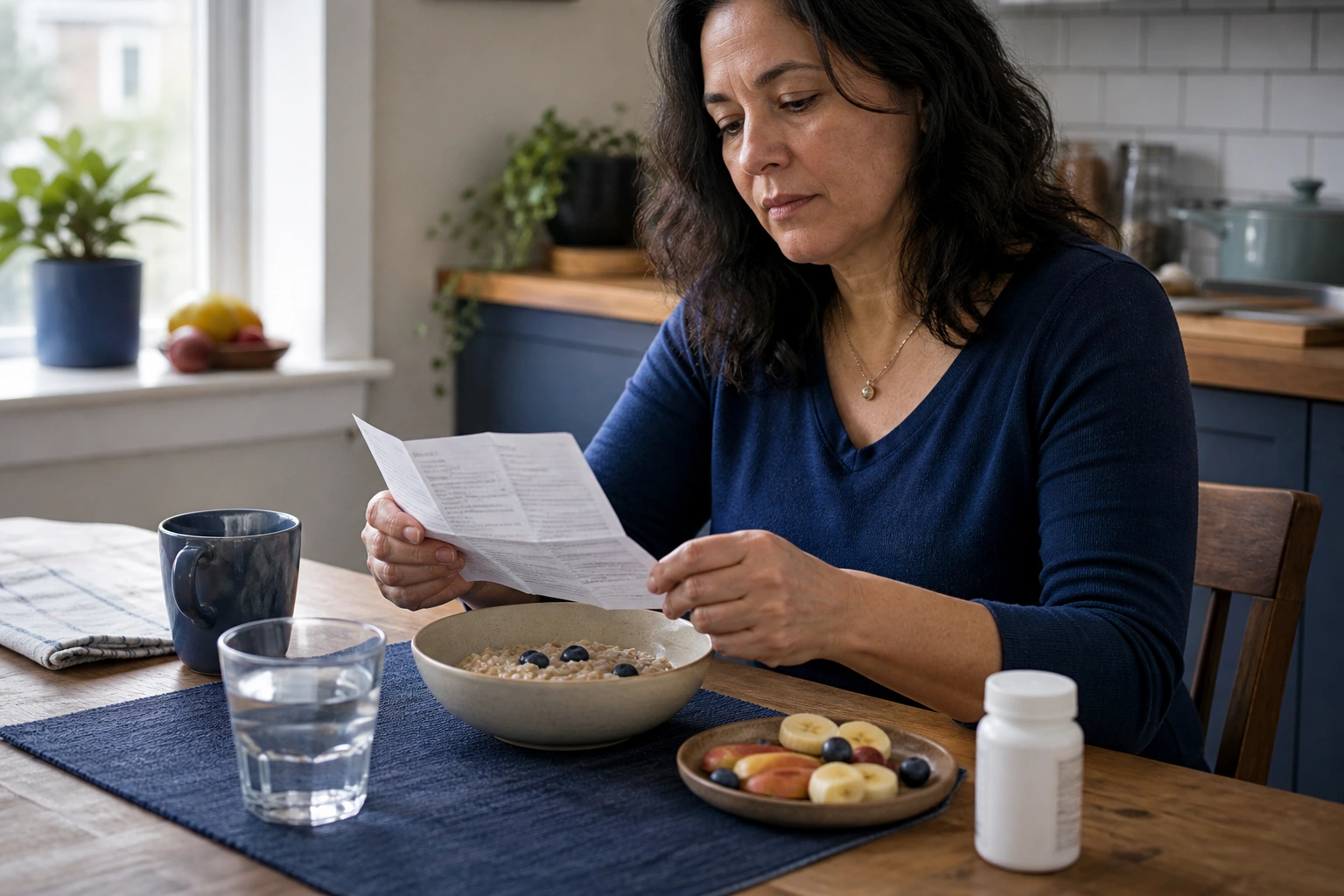
“Take with food” can mean that food improves absorption, reduces stomach irritation, or makes a dose easier to tolerate. “Take on an empty stomach” usually means food could reduce or delay absorption. The rule is specific to the medicine and sometimes to its strength or formulation—there is no safe universal meal schedule for every tablet.
Decode the label before counting minutes
- Use the directions on the current label and leaflet for the exact product.
- “With food” usually means during or close to a meal or substantial snack unless a calorie amount or timing window is specified.
- “Empty stomach” often comes with an exact interval; follow that interval instead of inventing one.
- Some rules are about absorption, others about irritation, and a few prevent a serious interaction.
- Consistency may matter as much as clock precision. Ask before moving a dose to a different part of the day.
Why food changes a medicine
A meal changes acidity, stomach emptying, bile release, intestinal movement, blood flow, and the chemical environment in which a drug dissolves. Fat can improve absorption of some poorly water-soluble medicines. Minerals such as calcium, magnesium, aluminum, or iron can bind selected drugs and reduce absorption. Food can slow the arrival of a drug in the bloodstream without changing the total amount absorbed, or it can increase or decrease the total exposure.
Food also acts as a physical buffer. For some medicines, taking a dose with food reduces nausea or irritation even when absorption is not the main reason. That distinction explains why advice from strangers often conflicts: they may be describing different drugs with different mechanisms.
A practical label decoder
| Instruction | What it usually asks you to do | What to verify |
|---|---|---|
| Take with food | Take during or close to eating so food is present | Whether a snack is enough or a calorie amount is required |
| Take after food | Take soon after eating, often to improve tolerance | Whether the leaflet gives a precise time window |
| Take on an empty stomach | Separate the dose from meals by the stated interval | How long before and after food, and whether beverages count |
| Avoid a named food or drink | Do not consume that item within the stated window | Hidden ingredients and how long the restriction lasts |
| Take consistently with or without food | Choose one pattern and keep it stable | What to do if your routine changes |
These are interpretations, not substitutions for the exact instructions. A label may require a specific number of calories, a low-fat meal, an evening meal, water only, upright posture, or separation from supplements. When the rule matters, the leaflet is usually more precise than a sticker on the bottle.
What exactly counts as “with food”?
Community forums repeatedly ask whether the pill comes before the first bite, halfway through the meal, or after the last bite. For many medicines whose label simply says “with food,” the precise bite order is less important than having food in the stomach around the dose. But it is unsafe to convert that general observation into a rule for a medicine with a defined calorie or timing requirement.
A cup of coffee, a few sips of juice, or one cracker may not meet a requirement intended to improve absorption. Conversely, forcing a large or fatty meal is not helpful unless the instructions call for it. Ask a pharmacist: “Does a normal snack count for this exact medicine, or does the label require a meal or calorie amount?”
What does “empty stomach” mean?
Many labels define it with a window such as a certain time before food and a longer time after food. The values differ, so a remembered “one hour before or two hours after” rule should not be applied automatically. Coffee, milk, juice, mineral water, supplements, antacids, and tube feeds may matter even when they do not feel like a meal.
Do not move an empty-stomach medicine to bedtime without checking. Some products require the person to remain upright, some can irritate the esophagus, and others have time-of-day considerations. A pharmacist can help find a workable routine without changing the clinical intent.
Five reasons a label mentions food
1. To improve absorption
Food—sometimes fat in particular—can help a drug dissolve or stimulate processes that increase uptake. Taking the dose while fasting may lower exposure enough to reduce effectiveness.
2. To avoid reduced absorption
Food can delay stomach emptying, alter acidity, or bind the drug. Minerals are a familiar example, but the relevant foods and separation windows are medicine-specific.
3. To reduce stomach upset
A meal or snack can reduce nausea or irritation for selected medicines. This does not make every medicine harmless to the stomach, and food does not eliminate bleeding risk.
4. To coordinate the effect with eating
Some diabetes medicines are timed around meals because their effect needs to match the rise in blood glucose. Taking them and then skipping a meal can be dangerous. Follow the individualized plan.
5. To keep exposure consistent
Even when either fed or fasted dosing is permitted, switching randomly can cause variable levels. The safest instruction may be to take each dose in the same relationship to food.
Food is not the only variable
Grapefruit can alter enzymes or transporters that affect selected medicines, but it is not relevant to every drug. Dairy, calcium, iron, magnesium, fiber, protein, vitamin K–rich foods, and tyramine-containing foods matter only in defined combinations. The correct response is not to build a long exclusion diet from internet lists; it is to check the exact medicine and maintain a nutritionally sensible pattern.
Alcohol adds another layer: it can increase sedation, bleeding, dizziness, low blood glucose, or liver stress, and it can worsen the illness being treated. Read Medicine Interactions With Drugs, Food and Alcohol rather than assuming a meal makes the combination safe.
If you took it the “wrong” way once
- Do not panic and do not redose. A timing mistake rarely tells you how much was absorbed.
- Check the leaflet’s missed-dose and administration section. Use the version for the exact strength and formulation.
- Note the dose and meal times. Include supplements, antacids, coffee, alcohol, vomiting, or diarrhea.
- Ask a pharmacist what to do next. The answer may be to continue at the next scheduled dose, but that decision is product-specific.
- Watch for symptoms named in the label. Seek urgent help for severe or rapidly worsening symptoms.
If vomiting occurred after the dose, do not guess that the medicine was lost. Absorption may already have begun, and repeating could cause an overdose. Call for tailored advice.
Build a routine that survives real life
A good schedule works on workdays, weekends, and travel days. Link the dose to a stable event—waking, breakfast, evening meal, or bedtime—only after confirming the food and posture instructions. Use a written chart or phone reminder that states more than “take pill”: include “water only,” “with evening meal,” or the required separation window.
If fasting for religious observance, surgery, laboratory testing, vomiting illness, or an eating disorder changes the routine, ask early. Some medicines must continue, some require monitoring, and some need a clinician-directed adjustment. Do not quietly compress several doses into the eating window.
Questions worth asking at the pharmacy
- Is the food instruction about absorption, stomach irritation, or coordinating an effect?
- Does a snack count? Is there a calorie or fat requirement?
- Which drinks, supplements, antacids, or minerals need separation?
- Must I take it at the same time and in the same fed or fasted state each day?
- What should I do if I vomit or miss the food window?
- Can the tablet be split or crushed, or is it modified release?
- Does pregnancy, kidney disease, liver disease, diabetes, or tube feeding change the instructions?
Common mistakes to avoid
Do not assume all medicines absorb best on an empty stomach. Do not use dairy as a universal “food” substitute. Do not avoid grapefruit for every prescription while overlooking a named interaction. Do not compensate for a light meal with an extra dose. Do not crush a tablet to make it work faster. And do not copy the timing of a person taking a different medicine, dose, or formulation.
If nausea, diarrhea, or abdominal pain is the reason you are changing the timing, use the side-effect action guide. Persistent or severe symptoms may need more than a meal adjustment.
When routines conflict
People commonly receive one medicine that must be separated from food and another that is best taken with a meal. Minerals, antacids, and several daily doses can make the chart look impossible. Do not solve this by omitting the inconvenient item or taking everything together. Bring every container to the pharmacy and ask for a single written schedule that includes meals, beverages, supplements, and the minimum safe intervals.
If the schedule is still unrealistic, say so before leaving. A perfect plan that cannot be followed is not safer than a simpler alternative the prescriber has considered. The pharmacist may identify a different formulation, time, or product-specific option, but only after checking why each instruction exists. Recheck the plan whenever a medicine is added, removed, or switched between immediate- and extended-release versions.
Sources and evidence scope
This guide uses the peer-reviewed explanation “When should I take my medicines?”, FDA advice on talking with a pharmacist, and FDA consumer information about avoiding drug interactions. Sources were checked on August 26, 2026. Exact instructions vary by drug, strength, formulation, and country; the current label and pharmacist take priority.