
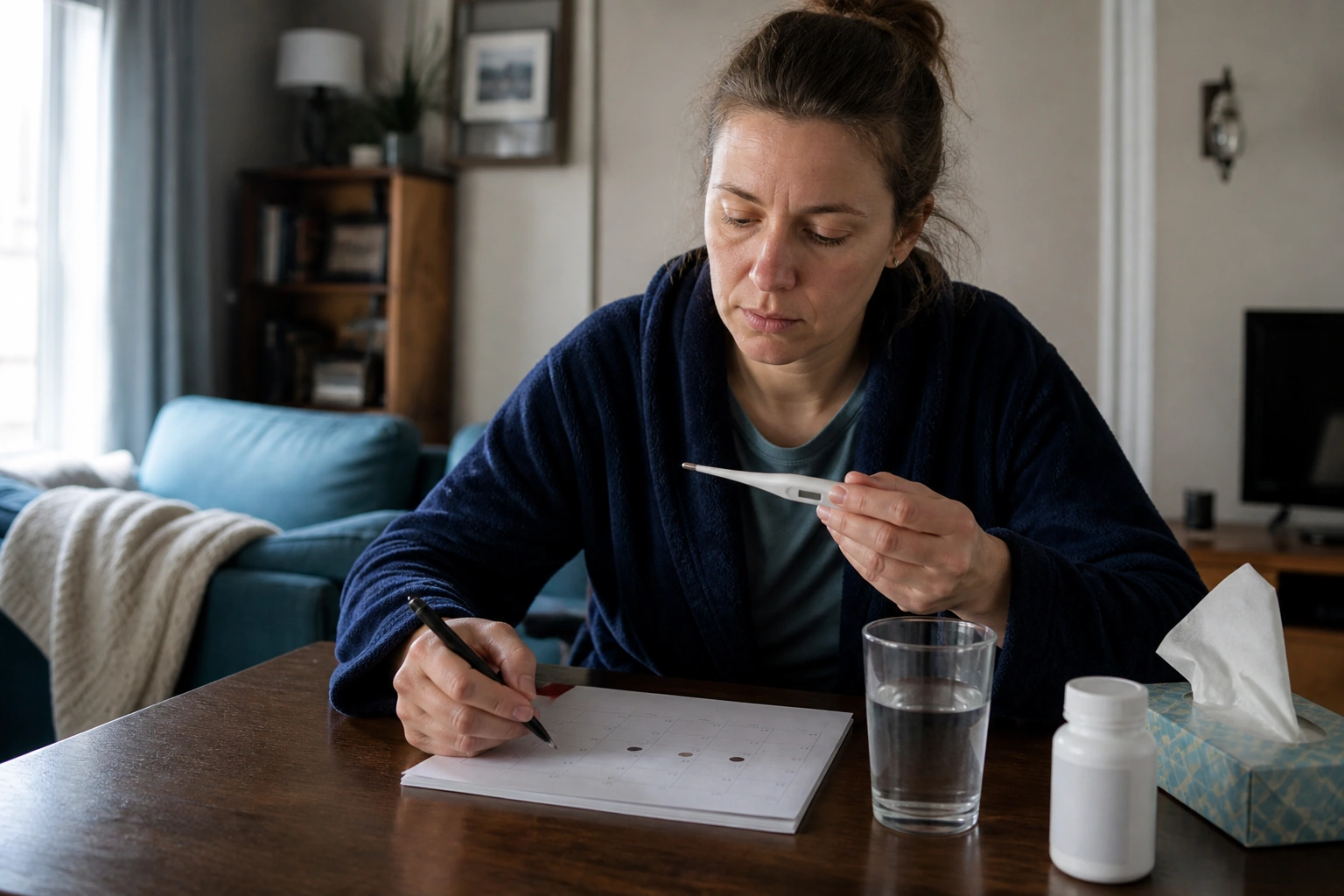
An antibiotic begins affecting susceptible bacteria after adequate drug exposure, but symptom relief is not instant and no single timeline applies to every infection. Many people are told to look for some improvement within roughly 48 to 72 hours; that is a reassessment window, not a guarantee and not a reason to ignore earlier deterioration.
The answer in one sentence
Look for a direction of travel—less fever, pain, swelling, urinary burning, or breathlessness and better drinking, sleep, or energy—rather than complete recovery by a fixed hour. If there is no improvement by the time your clinician specified, or if anything important worsens, contact them for reassessment.
“Working” has three different meanings
- Drug activity: the antibiotic reaches the infection and acts against a susceptible organism.
- Clinical response: symptoms and vital signs begin moving in the right direction.
- Recovery: inflammation, damaged tissue, cough, fatigue, and function return toward baseline.
These stages do not happen simultaneously. Bacterial killing can begin while pain and swelling remain because the immune response and tissue injury take longer to settle. A cough can linger after pneumonia improves. Bladder irritation can outlast reduction in bacteria. An abscess may require drainage because medicine alone cannot remove a closed collection.
Why “48 hours” is not a pass/fail test
The widely repeated 24-to-72-hour range is a practical checkpoint for many uncomplicated infections, not a universal pharmacologic law. The infection site, severity, organism, antibiotic susceptibility, immune status, source control, dose, absorption, adherence, and underlying conditions all matter.
At 48 hours, “not cured” is common. “No improvement at all,” a new symptom, or worsening may need review. A clinician may check the original diagnosis, culture results, resistance, complications, adherence, vomiting, interactions, or whether a procedure is needed. The correct antibiotic for a confirmed infection can still need time; the wrong diagnosis will not improve simply because the course is completed.
Track the trend, not one symptom
| Area | Possible sign of improvement | Reason to contact sooner |
|---|---|---|
| Fever and overall state | Lower peaks, longer comfortable periods, more alert | Persistent high fever with worsening illness, confusion, rigors |
| Pain | Less intense or less frequent, easier movement or swallowing | Escalating or severe localized pain, pain out of proportion |
| Breathing | Less breathless at rest, easier speech and activity | New or worsening breathlessness, chest pain, blue lips |
| Hydration | Drinking and urinating more normally | Repeated vomiting, very low urine, marked dizziness |
| Local signs | Redness or swelling stops expanding | Rapid spread, red streaks, tissue darkening, severe swelling |
| Function | Sleeping, eating, and completing basic care more easily | Increasing weakness, falls, inability to manage at home |
Fever alone may not tell the whole story. Fever-reducing medicine can mask it, and some serious infections produce little fever. Record temperature alongside breathing, alertness, hydration, pain, and local signs.
What changes the response time?
The diagnosis
Antibiotics treat susceptible bacteria, not viruses. A positive test must be interpreted in context, while some infections are diagnosed clinically. Read Antibiotics, Bacterial and Viral Infections, and Resistance.
The infection site
Blood flow, tissue penetration, foreign material, and whether pus is trapped affect treatment. Dental abscesses, infected devices, obstructed urinary systems, and collections may need a procedure or source control.
The organism and susceptibility
Culture results can show that the organism is resistant or that a narrower antibiotic is appropriate. Results may arrive after treatment starts. Do not assume that “stronger” or broader is better; unnecessary breadth causes harm and resistance pressure.
The medicine reaching the body
Vomiting, severe diarrhea, food instructions, interacting minerals, missed doses, and formulation can change exposure. Use the guide to taking medicine with food and call before repeating a vomited dose.
The person
Age, pregnancy, immune suppression, diabetes, kidney or liver function, circulation, and severity can change both risk and timeline. A threshold appropriate for a healthy adult with mild symptoms may be unsafe for a newborn, older adult, or immunocompromised person.
A simple treatment timeline
Before the first dose
Know the working diagnosis, why an antibiotic is expected to help, how to take it, the follow-up point, and the emergency signs. If a culture was collected, ask how results will be communicated. Record the starting symptom pattern so improvement can be recognized.
During the first day
Some symptoms may start easing, but lack of dramatic relief does not prove failure. Use supportive care recommended for the condition and watch for allergy or severe adverse effects. Do not double doses to accelerate the response.
Around the stated review window
Compare the whole pattern with baseline. If there is some improvement, continue exactly as prescribed unless advised otherwise. If nothing is better, symptoms are intolerable, or the diagnosis now seems wrong, contact the prescriber. They may need an examination or test, not merely a different prescription.
After the course
Some residual symptoms can be normal, but persistent, recurrent, or worsening symptoms deserve review. Do not use leftover antibiotics or repeat the same course without assessment. New diarrhea can occur during or after antibiotics; severe watery or bloody diarrhea, fever, or abdominal pain may require testing for C. difficile.
Condition-specific checkpoints
A general article cannot set the same deadline for every infection. Use the plan from the treating clinician and the relevant condition guide:
- Urinary tract infections can progress to kidney infection; fever, flank pain, vomiting, pregnancy, or systemic illness lowers the threshold for care.
- Strep throat requires test and clinical context; worsening swallowing, drooling, neck swelling, or breathing difficulty needs prompt assessment.
- Sinusitis is often viral; severe eye swelling, vision change, neurologic symptoms, or severe frontal headache is urgent.
- Skin infection with rapidly expanding redness, severe pain, blistering, tissue darkening, or systemic illness should not wait.
- Dental pain with facial or neck swelling, trouble swallowing, or breathing difficulty needs urgent dental or medical care; antibiotics do not replace drainage when required.
Do not change the course yourself
Instructions about duration differ by infection and antibiotic. Follow the prescribed plan; contact the clinician rather than stopping early because you feel better or extending treatment because you do not. Saving leftovers creates a wrong-drug, wrong-dose, and delayed-diagnosis risk.
If side effects make adherence difficult, do not silently miss doses. The Antibiotic Side Effects guide separates common problems from allergy and C. difficile. A pharmacist may suggest safe symptom management or arrange prescriber review.
What to say when calling back
A focused update speeds reassessment:
- diagnosis or suspected infection and the date symptoms began;
- exact antibiotic, strength, formulation, first dose, and doses taken;
- culture or test results you can see;
- what is better, unchanged, and worse compared with baseline;
- highest temperature and whether fever medicine was used;
- hydration, urine, breathing, alertness, pain, and swelling;
- vomiting, diarrhea, rash, allergy signs, or missed doses;
- pregnancy, immune suppression, diabetes, or other risk factors.
Do not reduce the report to “it isn’t working.” A direction-of-travel description helps the clinician decide whether you need time, a test, a procedure, a different diagnosis, or urgent care.
Common myths from search and forums
“If I am not cured at 48 hours, the antibiotic is wrong.”
Not necessarily. The checkpoint is about trend and reassessment, not complete recovery.
“A stronger antibiotic works faster.”
“Strong” is not a useful category. The drug must match the organism and site while minimizing harm.
“Fever going down proves the bacteria are gone.”
No. Fever can change because of the immune response or fever medicine, and some infection remains possible.
“Feeling better means I can save the rest.”
Follow the prescribed duration and ask if the plan is unclear. Do not create leftovers for another illness.
When tests and symptoms seem to disagree
A culture can be negative after antibiotics begin, can grow a contaminant, or can identify bacteria that are present without causing the current symptoms. A rapid test can miss disease or remain positive after infection. Imaging may lag behind clinical improvement. Test interpretation belongs with the specimen quality, timing, examination, and pre-test probability.
Do not demand a broader antibiotic solely because one result is abnormal, and do not dismiss worsening symptoms solely because a test was negative. Ask: “What diagnosis best explains the whole picture now, and what would change the plan?”
Recovery can continue after bacteria are controlled
Inflamed tissue, mucus, cough sensitivity, fatigue, and disrupted sleep can take longer to settle than bacterial growth. This is why complete symptom disappearance is a poor universal endpoint. A clinician may recommend supportive care, a staged return to activity, or further evaluation when recovery stalls.
The opposite pattern is more concerning: new fever after initial improvement, expanding swelling, declining hydration, increasing oxygen needs, or a fresh focal symptom. That can reflect complication, a second infection, treatment failure, or another diagnosis and should prompt reassessment.
Plan the follow-up before leaving the visit
Ask for a concrete safety net: which symptoms should improve first, by approximately when, how culture results will reach you, who to contact at night or on weekends, and which signs require emergency care. For a child, confirm weight-based dosing and the measuring device. For liquid medicine, ask about storage, shaking, and expiration. Clear follow-up instructions are part of antibiotic treatment, not an optional extra.
Sources and evidence scope
This guide uses CDC resources on appropriate antibiotic use, MedlinePlus information about antibiotics, and Cleveland Clinic’s clinical overview of antibiotic treatment. Sources were checked on August 26, 2026. Response times and follow-up thresholds vary by infection, severity, patient risk, and local practice; the treating clinician’s instructions take priority.