
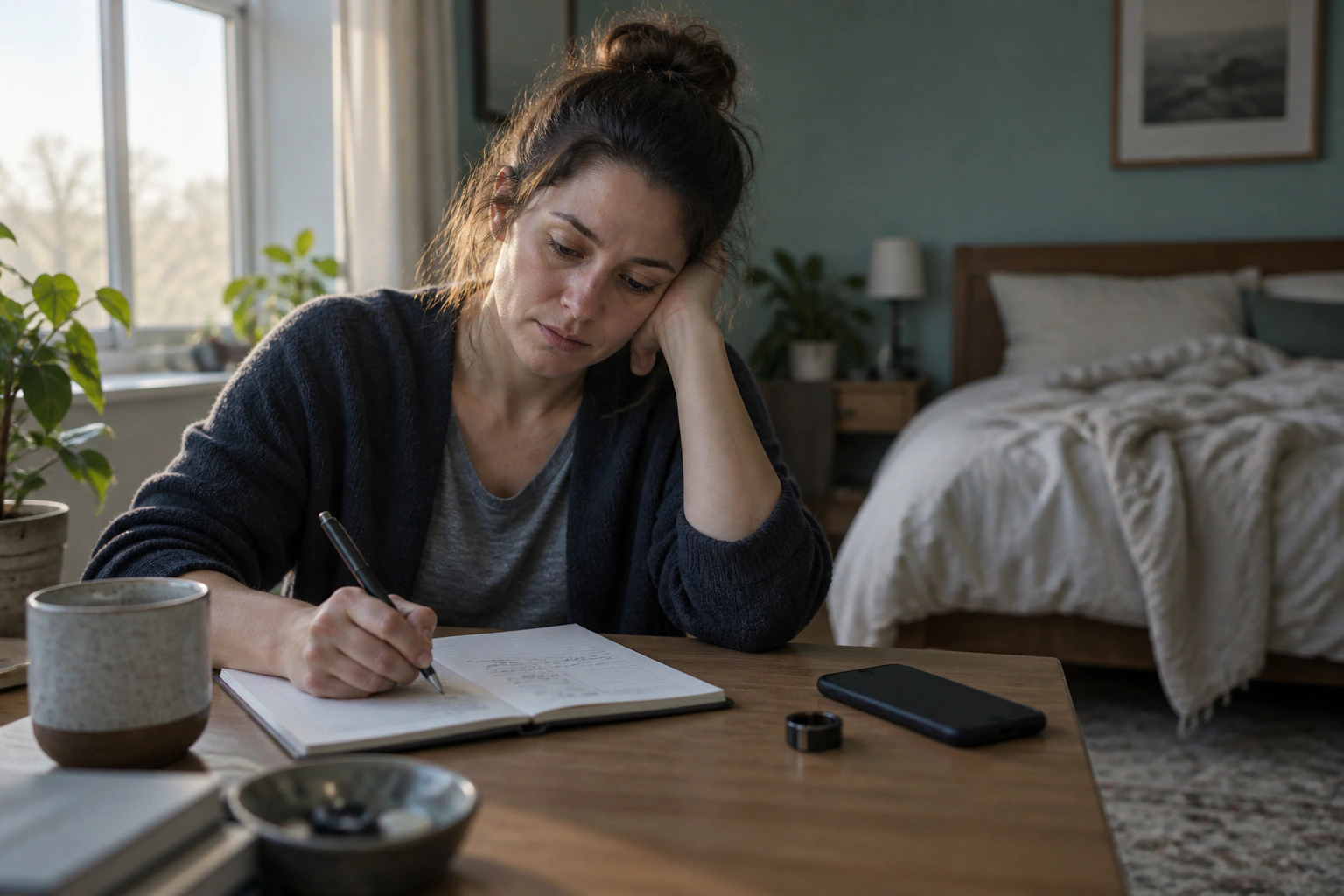
A sleep tracker can be a useful diary and a poor judge. It may estimate when you slept, display stages with impressive precision, and still disagree with how you feel. The practical question is not whether the device is “good” or “bad.” It is whether a particular number changes a decision that matters—and whether checking it is helping you sleep or making sleep feel like a test.
Start with the decision, not the score
- Use trends in bedtime, wake time, and total sleep as clues, not diagnoses.
- Treat one unusual night as noise unless symptoms or safety concerns say otherwise.
- Do not use consumer sleep stages to rule a disorder in or out.
- If the score changes your mood or behavior, try a two-week data boundary.
- Persistent symptoms deserve clinical assessment even when the app says “optimal.”
What a wearable actually measures
Clinical sleep staging uses signals such as brain activity, eye movement, muscle activity, breathing, oxygen, and heart rhythm. Most consumer devices do not measure all of those signals. A wrist or finger device usually infers sleep from movement and optical pulse data, sometimes adding temperature or oxygen-related estimates. Its software then converts those indirect signals into sleep, wake, stages, and a proprietary score.
That distinction explains a common contradiction: a device can be reasonably useful for broad sleep–wake patterns while being less reliable for the exact number of minutes in deep or REM sleep. Quiet wakefulness may look like sleep. Restless sleep may look like wakefulness. Algorithms, sensor fit, skin contact, movement, illness, alcohol, irregular schedules, and firmware updates can all alter the result.
Bedtime, wake time, and broad total-sleep trends can show whether you consistently leave enough opportunity to sleep. They do not establish why insomnia occurs. Sleep-stage estimates answer a narrower curiosity and should not decide whether you need care. Oxygen-related signals can prompt a discussion when repeatedly concerning, but a normal graph cannot rule out sleep apnea. A readiness score combines several inputs chosen by the manufacturer; it is neither a diagnosis nor medical clearance for an activity.
Why one bad night is weak evidence
Sleep varies naturally. Travel, a warm room, alcohol, pain, stress, exercise, a late meal, caring for a child, and simply waking at a different point in a sleep cycle can change both perception and sensor data. A single low score has no reliable power to predict illness or the quality of the entire day. The same is true of a surprisingly high score when you feel exhausted.
Before interpreting a number, ask three questions: Was the device worn and fitted normally? Was the night unusual for an obvious reason? Is the result part of a repeated pattern that matches symptoms? This short pause prevents an isolated estimate from becoming a medical conclusion.
Orthosomnia: when tracking becomes the sleep problem
Sleep clinicians use “orthosomnia” to describe an unhealthy preoccupation with obtaining perfect wearable sleep data. It is not a formal diagnosis, but it names a recognizable loop: a person checks the score, worries about imperfect sleep, works harder to force sleep, and becomes more alert in bed. The next morning’s number then feels like a grade.
Examples in community discussions include a low score ruining the morning, a high score conflicting with exhaustion, and plans being reconsidered because “recovery” looks poor. Awakening can also feel stressful when it will appear in the record. Such accounts identify questions to address; they do not establish how common these experiences are or prove that a device caused a medical problem. If monitoring increases worry, that effect belongs in the decision about continued use.
A two-week tracker reset
- Choose one purpose. Examples include checking schedule consistency or preparing a symptom history. “Optimize everything” is not a measurable purpose.
- Hide stages and composite scores. If possible, keep only bedtime, wake time, and total sleep visible.
- Delay checking. Rate how rested and alert you feel before opening the app, or review data only once a week.
- Set a stop rule. Pause for two weeks if checking causes dread, repeated reassurance seeking, or extra time awake.
- Keep behavior stable. Use a consistent wake time and ordinary wind-down routine rather than changing five variables at once.
- Review the outcome. Ask whether sleep, mood, and daytime function improved—not whether the score rose.
How to compare data without fooling yourself
If you want to test a habit, define it before looking at the result. Change one realistic factor, keep it for long enough to observe several nights, and record subjective sleep and daytime alertness alongside the device. Do not discard nights because they weaken the story you hoped to see. Avoid treating tiny nightly differences as meaningful when the device’s own error may be larger.
A simple record can include bedtime, estimated time to fall asleep, wake time, number of remembered awakenings, caffeine and alcohol timing, illness, and a morning alertness rating. This often yields more actionable information than a composite score whose weighting is proprietary.
When symptoms matter more than the dashboard
Discuss repeated loud snoring, witnessed breathing pauses, gasping, morning headaches, restless legs, unusual movements, persistent insomnia, or daytime sleepiness with a clinician. Falling asleep while driving or working with machinery is a safety issue. A normal-looking consumer report does not cancel these symptoms.
Bring a concise history rather than hundreds of screenshots: when the problem began, work and sleep schedule, medicines and supplements, caffeine and alcohol timing, naps, symptoms noticed by a bed partner, and two weeks of a basic sleep diary. A clinician may decide that no test is needed, that insomnia-focused treatment is appropriate, or that a validated home or laboratory sleep study is warranted.
What consumer sleep technology can do well
Wearables can make invisible routines visible. They may reveal that bedtime shifts by three hours across a week, that time in bed is consistently short, or that travel disrupts the schedule. Reminders can support a regular wind-down. Long-term resting pulse trends can prompt reflection, provided they are interpreted in context.
The value comes from supporting a behavior you can act on—not from producing a more detailed label. A device is successful when it helps you build a stable opportunity for sleep and then recedes into the background. If it repeatedly increases vigilance, the healthiest use may be less use.
Five misleading conclusions to avoid
“My deep sleep is low, so my brain is not recovering”
Consumer stage estimates are not direct measurements of brain activity. Look first at sleep opportunity, symptoms, and function.
“The oxygen graph is normal, so I cannot have apnea”
Consumer sensing and clinical testing are different. Apnea assessment also considers breathing effort, airflow, arousals, symptoms, and risk factors.
“The score fell after exercise, so exercise harmed me”
Training, heat, hydration, timing, and normal recovery can shift pulse-derived metrics. One association does not establish harm.
“My wearable detected a disorder”
An alert may justify a conversation, but diagnosis requires the appropriate clinical pathway. Do not start treatment from an app label alone.
“I feel fine, but the app says I am unready”
Use judgment and safety rules for the activity. A proprietary score is not a medical clearance or prohibition.
Questions to ask before buying or upgrading
- Which signals are measured directly and which are inferred?
- Has the exact device and algorithm been validated against an appropriate reference?
- Was validation performed in people like me, including my age and health conditions?
- Can I export raw trends and hide scores that cause anxiety?
- What happens to my health data, and can I delete it?
- Will this answer a decision I cannot answer with a diary?
A practical case: the score and the sleepy driver
Imagine that a tracker reports excellent sleep for ten nights, but the wearer repeatedly fights sleep during a morning commute. The correct conclusion is not that the person needs a more accurate ring. Daytime sleepiness is the safety outcome, and it overrules the reassuring dashboard. The useful record is when drowsiness occurs, total sleep opportunity, snoring or breathing reports, medicines, shift schedule, and near-misses while driving. That information supports a clinical assessment.
Now reverse the case: the score is poor after travel, but the person feels alert and functions normally. With no warning symptoms, the first response can be observation rather than a diagnostic cascade. Re-establish the usual schedule, avoid making several “recovery” changes, and review a longer trend. The same number can therefore lead to different actions because the person and the decision come first.
Make a sleep record you can actually use
Consider a week when the tracker reports eight hours every night, but the wearer remembers lying awake for long periods. Start by separating three times: getting into bed, trying to sleep, and finally getting out of bed. A device may count quiet reading or a motionless period of worry as sleep. A diary lets the clinician see that uncertainty instead of treating eight hours as an established fact. You do not need to watch the clock repeatedly overnight; a rough morning estimate is sufficient for a basic record.
Keep the record short enough to complete on a difficult morning. One line per day can contain the date, attempted bedtime, estimated time awake, final wake time, naps, and daytime function. Add a brief note for a shift change, illness, alcohol, or a new medicine. If a partner observes gasping, record the observation in their own plain words. Preserve the original device export separately rather than copying every graph into the diary.
For a consultation, write a one-sentence question at the top: “I am sleepy despite allowing enough time for sleep,” or “I cannot fall asleep until late even when I try earlier.” Those questions lead to different assessments. Include a concrete consequence, such as missing work, needing frequent naps, or struggling to remain awake in traffic. The number of consequences is less useful than their severity and pattern. Our guide to medication-related fatigue and drowsiness can help organize the medicine part of that history.
At the review date, compare your original purpose with what happened. Did a consistent wake time become easier? Did hiding scores reduce morning worry? Did the diary reveal symptoms that need assessment? If none of these occurred, collecting more nights may add workload without answering the question. You can keep a useful reminder function while disabling the sleep score, or take the device off at night.
Privacy deserves the same practical approach. Check whether exporting a report also exposes location, contacts, or unrelated health measurements. Send only the relevant record through the clinic’s preferred channel. A screenshot shared in a public forum can contain a name, date of birth, or account identifier; crop personal details before sharing. Community interpretation may suggest questions, but it cannot establish the accuracy of a particular night’s result.
Sources and evidence scope
This guide draws on the American Academy of Sleep Medicine position statement on consumer sleep technology, the original case reports describing orthosomnia, and the NHLBI overview of clinical sleep studies. The 2018 position statement provides historical context, not a current clearance list for individual products. Devices and algorithms change; a specific authorized screening feature must be interpreted according to its own intended use. Orthosomnia was described in case reports, which cannot establish its population prevalence or prove that tracking causes insomnia.