
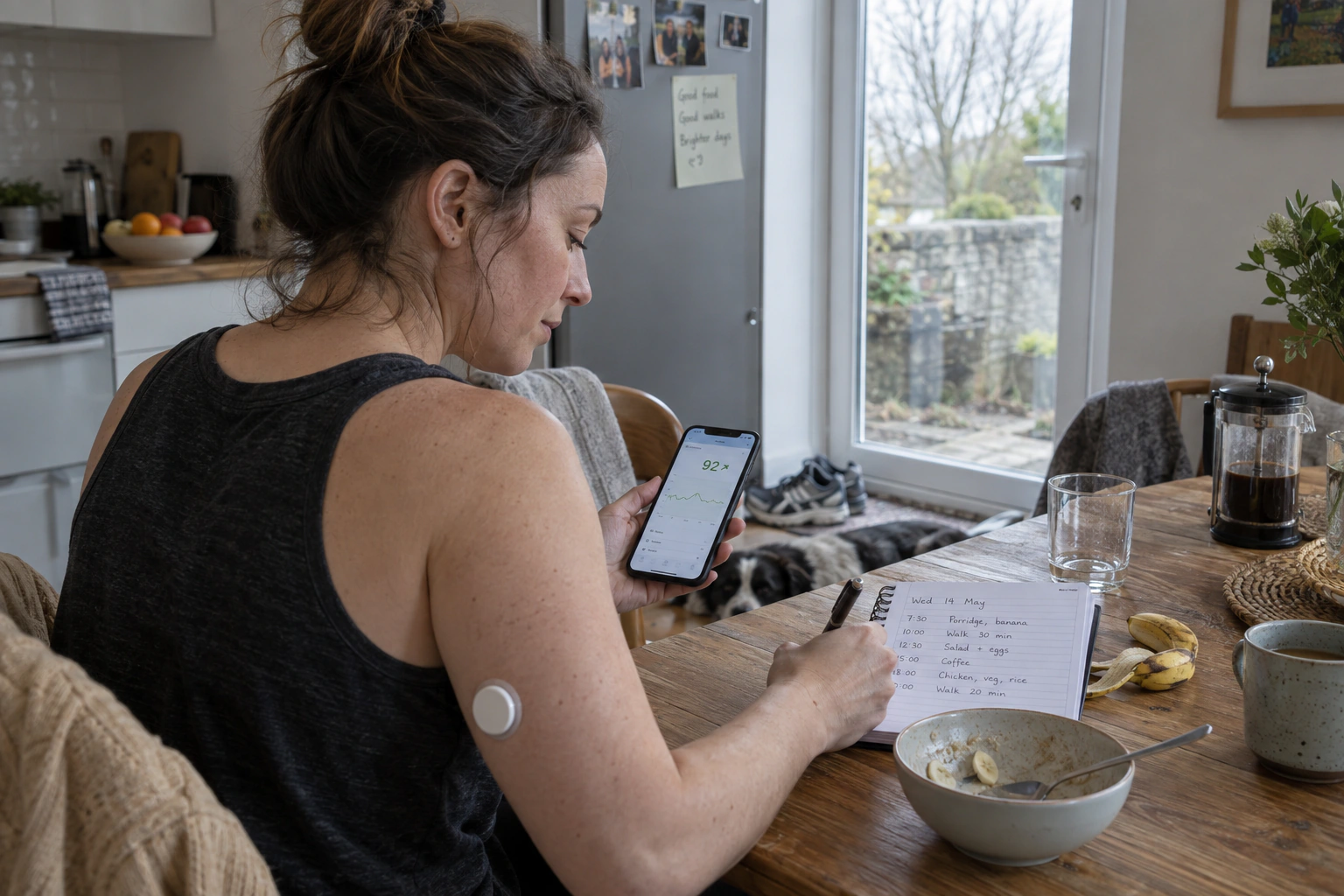
A continuous glucose monitor can make ordinary physiology look dramatic. The line rises after food, moves during exercise, and sometimes alarms while you sleep. In people without diagnosed diabetes, more data does not automatically mean better health. A useful experiment begins with a question, understands sensor limits, and ends without turning every meal into a verdict.
The bottom line
- CGMs measure glucose in interstitial fluid, not directly in a vein.
- Short delays, compression, sensor error, and normal variation can create surprising values.
- There is no universally accepted “perfect” CGM pattern for healthy people.
- Diagnosis still uses validated clinical criteria and laboratory testing.
- If the data causes restriction, fear, or repeated checking, the experiment is not neutral.
What a CGM measures—and why the line lags
A CGM sensor samples glucose in the fluid between cells. Blood glucose and interstitial glucose usually move in the same direction, but not at exactly the same moment. During a rapid rise or fall, the sensor may lag behind blood. The device also applies an algorithm to convert an electrical signal into a displayed value and trend arrow.
Pressure on a sensor during sleep can produce an apparent low. A new sensor may behave differently during its first day. Dehydration, placement, temperature, medication interference listed by the manufacturer, and a partly detached sensor can affect readings. This is why authorized systems include instructions for confirming values when symptoms and the display do not match.
A spike is a shape, not a diagnosis
Glucose normally rises after carbohydrate-containing food. The size and timing depend on the meal, gastric emptying, recent exercise, sleep, stress, illness, and individual biology. A colorful peak does not by itself mean that the food was harmful or that diabetes is developing. Nor does a flat graph prove that a meal was nutritionally balanced.
A graph can become a moral label: rice is “bad,” a dessert is a “failure,” or a walk is used to erase a meal. Those interpretations are not validated diagnostic conclusions. If you begin replacing varied meals with a narrow list of foods to optimize the display, pause and reconsider the goal. One sensor trace cannot assess the nutritional value of an entire eating pattern.
| Question | CGM may contribute | What it cannot settle alone |
|---|---|---|
| Does a walk change my post-meal curve? | A repeated within-person pattern | Whether the meal is “healthy” overall |
| Why do I feel shaky? | A time-linked estimate and trend | The cause of symptoms |
| Do I have diabetes? | A reason to seek formal testing | A diagnosis |
| Which breakfast keeps me satisfied? | One physiological signal | Satiety, nutrition, cost, and sustainability |
| Am I metabolically healthy? | Context for a clinician | A complete risk assessment |
What evidence in people without diabetes can show
CGM research can describe glucose variability and test behavioral interventions. It has also shown that people can respond differently to similar meals. But consumer marketing often leaps from those observations to promises of personalized disease prevention, effortless weight loss, or exact food rankings. Those outcomes require direct trials, not just appealing graphs.
For a person without diabetes, the clinical benefit of routine CGM use remains uncertain. The device may support a short, well-defined behavior experiment, but it can also create false alarms, unnecessary testing, skin irritation, cost, and disordered eating. Benefits and burdens depend on the person and the question.
Before attaching a sensor, write the protocol
- Name one decision. “I want to compare a usual breakfast with the same breakfast followed by a ten-minute walk” is testable. “I want perfect glucose” is not.
- Choose a short period. One sensor cycle may be enough to answer a simple question. Open-ended monitoring invites endless optimization.
- Keep meals recognizable. Do not engineer extreme challenges or eliminate foods from one trace.
- Record context. Sleep, illness, exercise, alcohol, and sensor problems can explain patterns.
- Define a stop rule. Stop if the adhesive reaction is significant, data repeatedly conflicts with symptoms, or checking changes eating in a fearful way.
- Decide what happens next. A concerning repeated pattern should lead to a clinician and validated testing, not a supplement stack.
When a reading is unexpectedly low or high
Low readings without glucose-lowering medicine
Unexpected nighttime lows are a common source of alarm. First consider sensor pressure, poor contact, and whether the reading matches symptoms. Follow the manufacturer’s instructions about confirmation. Recurrent symptoms such as sweating, tremor, palpitations, confusion, or fainting deserve clinical assessment; a screenshot alone cannot identify the cause.
If you feel well, confirm an unexpected low as directed by the device instructions before assuming that it reflects blood glucose. If you have symptoms of low glucose, act according to an existing treatment plan and seek medical advice; do not wait for a graph to become convincing. Confusion, fainting, seizure, or inability to swallow needs emergency help. A person who cannot swallow safely should not be given food or drink by mouth.
High readings and diabetes testing
Diabetes and prediabetes are diagnosed using validated criteria such as laboratory A1C, fasting plasma glucose, or an oral glucose tolerance test in the appropriate setting. A clinician interprets results alongside symptoms, pregnancy status, medicines, anemia or other conditions that can affect testing, and whether confirmation is required.
If CGM patterns worry you, bring a short summary: dates, meals, symptoms, relevant family history, medicines, and any confirmed readings. Ask which standard test would answer the question. Avoid ordering a large panel simply because a consumer platform produced an “outlier.”
When the device helps behavior—and when it hijacks it
A constructive use produces a modest, durable change: taking a walk, pairing carbohydrate with a satisfying meal, sleeping more consistently, or recognizing symptoms worth discussing. The person can stop monitoring and keep the habit. The graph is a temporary feedback tool.
A harmful use narrows food choices, creates guilt after normal variation, leads to repeated scanning, or makes social eating feel unsafe. People with a history of an eating disorder, obsessive checking, or health anxiety should consider whether this form of monitoring is appropriate before starting. A dietitian or clinician can help choose a less intrusive method.
Seven interpretation traps
- Ranking foods by a single peak. A meal also matters for protein, fiber, micronutrients, pleasure, and total pattern.
- Comparing two different days. Sleep, prior exercise, and sensor age can change the result.
- Using someone else’s threshold. A social-media target may not be a clinical target.
- Chasing a flat line. Normal eating does not require a motionless trace.
- Ignoring uncertainty. Display precision does not equal measurement certainty.
- Diagnosing reactive hypoglycemia. Symptoms require a structured clinical evaluation.
- Treating data with products. A supplement response does not validate the original interpretation.
Questions for a clinician or dietitian
Ask: What medical question are we answering? Is CGM validated for this purpose? What result would change care? How should an unexpected reading be confirmed? Which symptoms require action? When should monitoring stop? A clear answer protects you from collecting data without a decision pathway.
If you already have diabetes, pregnancy-related glucose concerns, or take a medicine that can lower glucose, do not apply this wellness framework. Follow your own treatment plan and device instructions. Alarms, targets, and confirmation rules may be essential parts of your care.
A three-meal comparison that avoids food fear
Suppose you want to know whether a short walk after lunch is realistic and useful. Keep lunch broadly similar on three nonconsecutive days, use the same sensor, and walk at an ordinary pace after two of the meals. Record hunger, enjoyment, symptoms, and ability to continue the habit as well as the glucose trace. Do not select the most flattering curve or change the meal midway to force a result.
The outcome is not “bread passed” or “rice failed.” It is whether a feasible walk repeatedly changed the pattern and helped another outcome you value. If a low appeared while you were lying on the sensor, record possible pressure interference and follow the confirmation instructions. Do not label it an artifact solely because that explanation is reassuring. Symptoms or a confirmed low require the appropriate care response.
How to talk about CGM data without overclaiming
Use language such as “the sensor estimated,” “the pattern repeated,” and “this may be worth confirming.” Avoid “my pancreas cannot handle this,” “I am insulin resistant,” or “this food causes inflammation” unless appropriate clinical testing establishes the claim. Precise language protects both medical accuracy and your relationship with food.
A clinician may decide that standard screening is already up to date and no further test is needed. That is a valid result. The value of a measurement system is not the number of interventions it triggers; it is whether it improves an important decision with acceptable burden.
What a healthy-population study adds
A Framingham Heart Study analysis included 560 participants classified as having normal glucose regulation, 463 with prediabetes, and 152 with diabetes. They wore a blinded CGM for at least seven complete days. Among the normal-glucose group, an average of 87% of time fell between 70 and 140 mg/dL, and readings exceeded 180 mg/dL for an average of more than fifteen minutes a day. These are descriptive observations from a particular population and device, not treatment targets for everyone.
The distinction matters when an app makes every reading outside a narrow band look alarming. People who meet conventional criteria for normal glucose regulation can still have excursions. Conversely, an apparently reassuring week cannot exclude diabetes, because a sensor trace is not the validated diagnostic test. The cohort was predominantly White and middle-aged, which also limits automatic application to younger people, other populations, pregnancy, or a different sensor.
Monitoring was blinded, so this study does not show that looking at the numbers changes behavior or prevents disease. To answer that question, a trial needs to compare useful outcomes between people who receive CGM feedback and people who receive another approach. The outcome might be a sustained improvement in eating, activity, laboratory markers, or quality of life. More time inside a chosen display band is not sufficient proof on its own.
Check what your particular device is cleared to do
Over-the-counter availability does not mean all CGMs serve the same purpose. Some wellness-oriented systems do not provide low-glucose alarms and are unsuitable for people with problematic hypoglycemia. The FDA expanded the Stelo system’s indication to children aged two and older in June 2026, with adult caregiver supervision; that clearance also excludes insulin users and people on dialysis. These details belong to that system’s labeling and must not be generalized to another device.
For an adult considering a sensor, check the current instructions for age, medicines that can interfere, warm-up, confirmation, alarm behavior, and skin care. Look for a clear answer to what happens when the number and symptoms disagree. If you need a device to warn of dangerous lows, a product designed primarily for wellness feedback is the wrong category. Discuss the clinical need before making the purchase.
Sources and evidence scope
This guide uses the FDA’s June 2026 OTC CGM clearance announcement, NIDDK guidance on diabetes testing, and the original Framingham study of CGM ranges in people without diabetes. The cohort describes observed patterns; it does not prove a wellness benefit from routine monitoring. Indications and instructions are device-specific.