
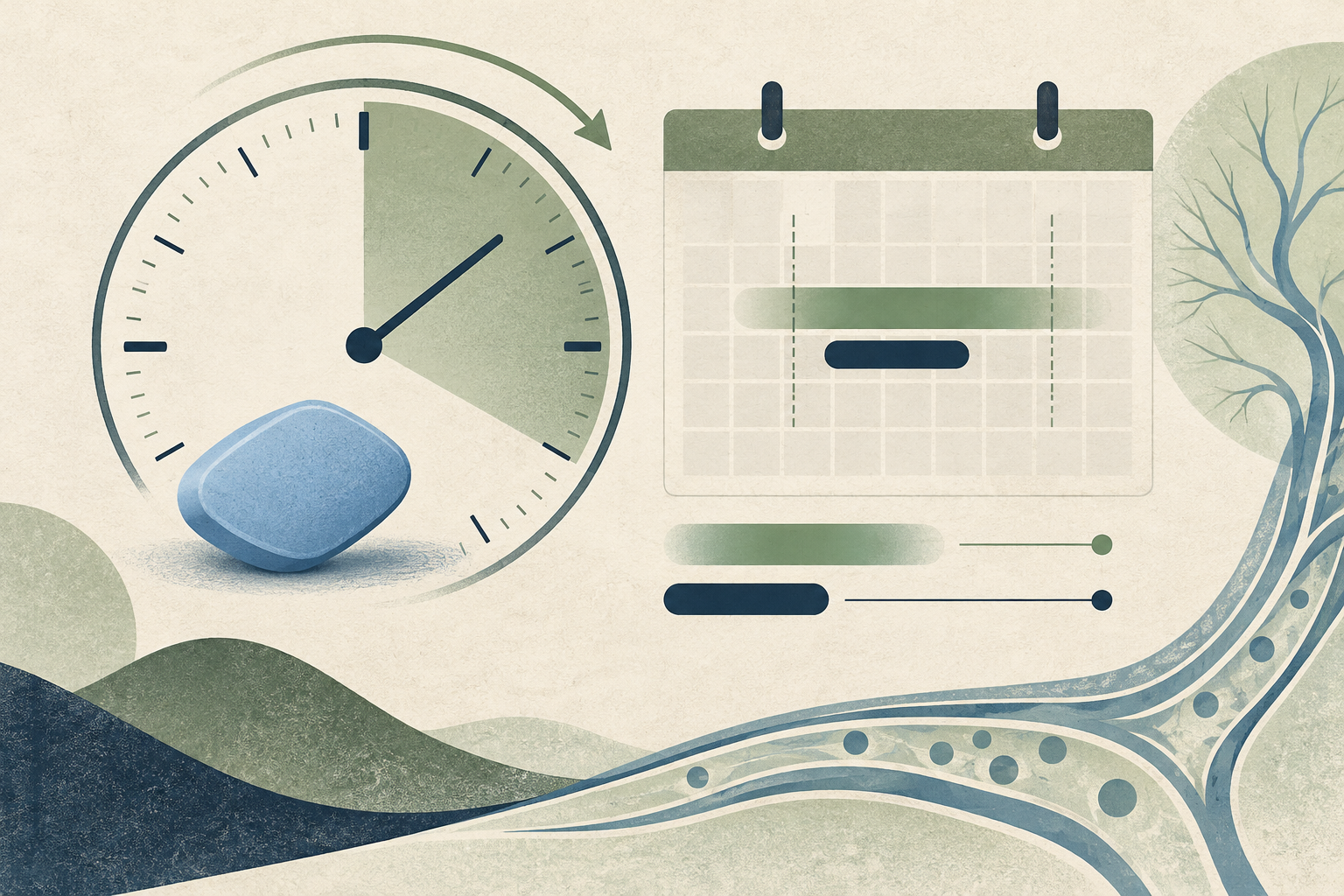
Short answer: sildenafil (Viagra) is generally taken 30 minutes to 4 hours before sex, and its effect may make it easier to get an erection during that period when sexual stimulation is present. That does not mean an erection should last four hours. An erection lasting four hours or longer is a medical emergency.
The phrase “how long does Viagra last?” sounds simple, but it can mean three different things: how long the drug remains in the body, how long it can help with erections, or how long an erection itself lasts. Those are not interchangeable measurements. Knowing the difference can prevent both unnecessary worry and unsafe decisions such as taking another dose too soon.
At a glance
- The prescribing information allows a 30-minute-to-4-hour window before sexual activity; many people are advised to plan for about an hour.
- Sildenafil does not create a continuous erection and does not increase sexual desire. Sexual stimulation is still needed.
- A high-fat meal can delay absorption; individual response and other medicines also matter.
- Never combine sildenafil with nitrates, including nitroglycerin or recreational “poppers.”
- Seek emergency care for an erection that lasts 4 hours or more, or for serious symptoms such as chest pain, fainting, or sudden vision or hearing loss.
What “lasts” means: three different clocks
People often use “duration” as if it were a single number. For sildenafil, it helps to separate the medication’s timing into three concepts.
| Question | What it describes | Why it matters |
|---|---|---|
| When might it start working? | Absorption and the time before sexual activity | Food and individual factors can shift timing. |
| How long can it help? | A period when an erection may be easier to achieve with sexual stimulation | It is not a guaranteed timer or a continuous erection. |
| How long does an erection last? | The duration of a particular erection | An erection at or beyond four hours needs urgent medical care. |
The FDA-approved product information says Viagra may be taken 30 minutes to 4 hours before sexual activity. It also reports that sildenafil and its active metabolite have terminal half-lives of about four hours. A half-life is a pharmacology measure: it describes how the amount of drug in the body declines over time. It is not a promise that an erection will last four hours, nor does it define exactly when an individual will stop noticing an effect.
How quickly does sildenafil work?
For erectile dysfunction, the official patient information says sildenafil is often taken about one hour before sex, while allowing a broader 30-minute-to-4-hour window. These are planning instructions, not a stopwatch guarantee. Some people notice an effect sooner or later, and a particular attempt may not work as expected even when the medicine was taken as prescribed.
Sildenafil helps increase blood flow to the penis during sexual stimulation. It does not automatically cause an erection, create sexual desire, or treat every cause of erectile dysfunction. Anxiety, relationship context, underlying health conditions, alcohol, and other medicines can all affect the experience. One unsuccessful attempt does not establish that the medicine has “worn off” or that a higher dose is needed.
Why a heavy meal can change the timing
Sildenafil can be taken with or without food, but a high-fat meal can make it take longer to start working. In the Viagra label, a high-fat meal delayed the average time to peak concentration by about 60 minutes and reduced the peak concentration by about 29%. In ordinary terms, a large, rich meal may shift the timing and make the onset feel less predictable; it does not mean that a person should compensate by taking more.
Alcohol can also complicate the picture. It may contribute to dizziness or low blood pressure and can make sexual performance less reliable for some people. If you are unsure how a meal, alcohol, or another medicine interacts with your prescription, ask the prescriber or pharmacist rather than experimenting with the dose.
What can make the experience differ?
There is no single “normal” response that applies to everyone. The dose prescribed, how the medicine is taken, age, liver or kidney health, cardiovascular conditions, and medicines that affect sildenafil metabolism can change exposure or side effects. A clinician may choose a different plan based on a person’s health history. Do not adjust a prescribed dose based on a forum post or on someone else’s experience.
It can also be misleading to judge duration by the clock alone. Sildenafil may remain in the body after the most noticeable effect has faded. Conversely, a person may feel an effect but still need stimulation and the right context to get an erection. These differences are one reason that the word “lasts” cannot be translated into a guaranteed number of hours for every patient.
Important safety rules people miss
- Take it only as prescribed. Do not take an extra tablet because the first one seems slow, and do not combine it with another erectile-dysfunction medicine unless the prescriber specifically directs you.
- Tell the prescriber about prescriptions, over-the-counter drugs, supplements, and recreational substances. Interactions can change the amount of sildenafil in the body or increase side effects.
- If chest pain occurs during sexual activity after taking sildenafil, seek urgent help and tell emergency responders when you took it. Do not self-administer a nitrate.
- Sudden vision loss, sudden hearing loss, fainting, or severe allergic symptoms need immediate medical attention.
When a prolonged erection is an emergency
An erection lasting four hours or longer—whether painful or not—needs emergency medical evaluation. Do not wait for it to resolve on its own or go to sleep hoping it will pass. Delayed treatment can cause lasting tissue damage. Contact emergency services or go to an emergency department, and tell the care team what medicine was taken and when.
This warning is different from the “up to four hours before sex” instruction. The latter is a timing window for taking the medicine; the emergency threshold concerns one continuous erection. Confusing those statements is a common source of fear online, but the distinction is important.
If it seems to wear off too soon—or not work
First, do not repeat the dose or increase it without medical advice. Check the instructions you were given, including timing, food, and any restrictions specific to your health. If the effect is repeatedly inadequate, a clinician can review whether the diagnosis, dose, timing, interacting medicines, or an underlying condition needs attention. The right response is an assessment, not a guess.
Erectile dysfunction can be associated with diabetes, cardiovascular or blood-vessel disease, medication effects, hormonal issues, stress, and other factors. A clinician may ask about medical and sexual history, current medicines, and emotional health, and may recommend an examination or tests. If erection problems are new, persistent, or worsening, discussing them is worthwhile even if sildenafil helps sometimes. For more background, see our guides to what a medicine’s half-life means and why doubling a dose is not a safe universal fix.
Questions people commonly ask
Does Viagra keep you erect for four hours?
No. The four-hour figure commonly refers to the allowed time before sexual activity and to a separate emergency warning for an erection that continues for four hours. Sildenafil supports the body’s response to sexual stimulation; it does not normally cause an uninterrupted erection for that whole period.
Does sildenafil stop working exactly after four hours?
No exact cutoff applies to everyone. The half-life describes drug concentration declining, not a precise moment when benefit disappears. Follow the prescription instructions and ask the prescriber about your own response rather than taking an extra dose.
Will food make it ineffective?
Not necessarily. The medicine may be taken with or without food, but a high-fat meal can delay absorption. If timing has been a repeated issue, discuss it with a clinician or pharmacist.
What should I do if I took it and now have chest pain?
Get urgent medical help. Tell responders you took sildenafil and when. Do not take nitroglycerin or another nitrate unless emergency clinicians who know about the sildenafil specifically direct you.
Bottom line
Sildenafil’s practical timing window is not the same thing as the duration of an erection. It is commonly taken about an hour before sexual activity, within the approved 30-minute-to-4-hour window, and it works in the context of sexual stimulation. Food and personal health factors can alter the experience. Use it only as prescribed, avoid nitrates and poppers, do not redose to chase an effect, and treat a four-hour erection as an emergency.