
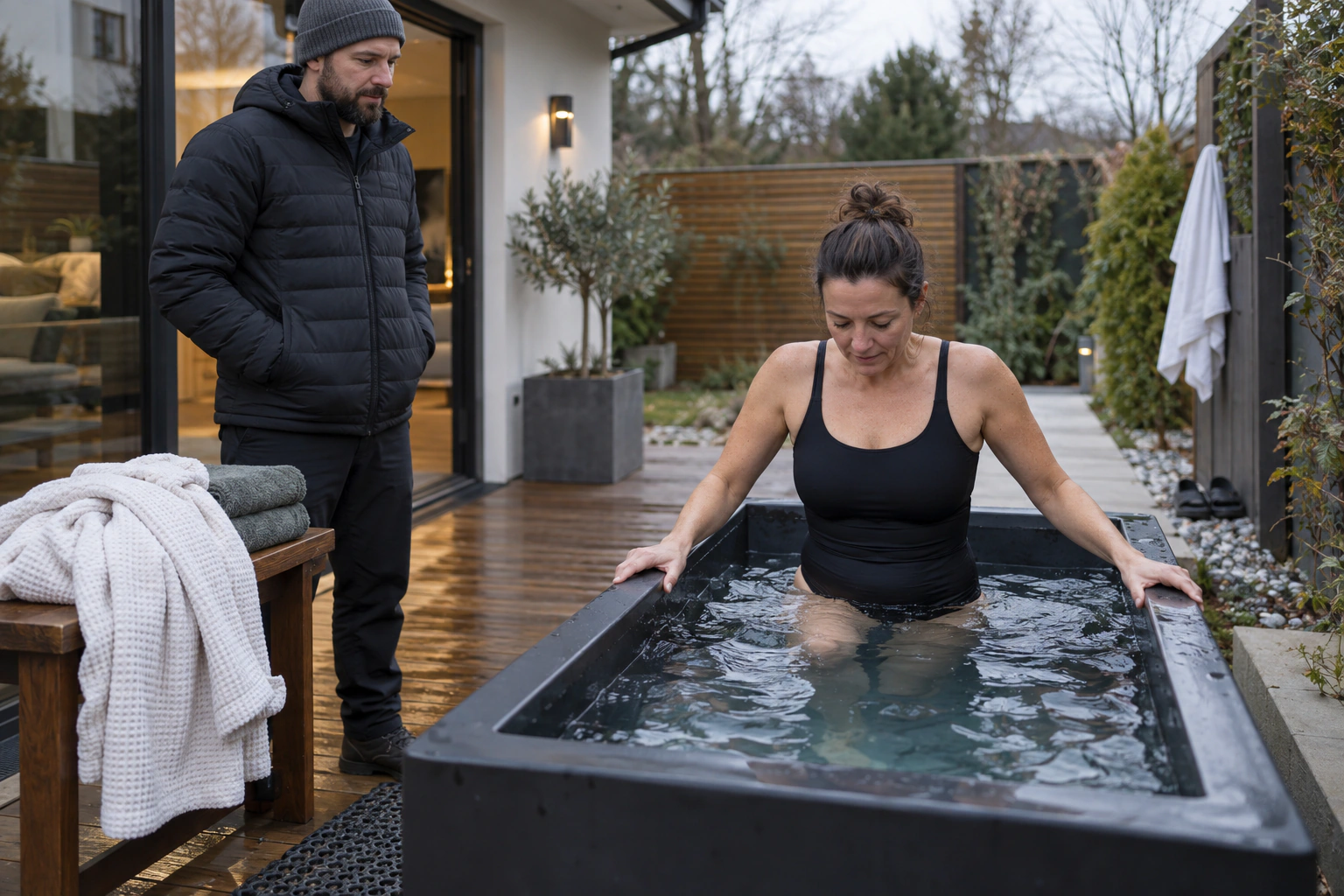
The first danger in a cold plunge is not “staying in too long.” It is the first involuntary gasp, rapid breathing, blood-pressure surge, and loss of control. Benefits for soreness or alertness need to be weighed against a real cold-shock response, especially when exposure happens alone, after a sauna, or in open water.
Before entering: Arrange a sober observer, an easy exit, and dry clothing. Keep your head above water throughout a beginner immersion. Never combine immersion with hyperventilation or breath holds. Being fit does not rule out a dangerous response.
Cold shock arrives before hypothermia
Sudden skin cooling triggers an involuntary gasp, rapid ventilation, faster heart rate, and higher blood pressure. Water near the face can also activate a diving response that slows the heart. The competing autonomic signals may increase rhythm instability in susceptible people. Panic and loss of breathing control raise drowning risk.
Hypothermia develops over a longer exposure, but useful movement can deteriorate earlier as hands and muscles cool. After leaving, core temperature may continue to fall. Feeling triumphant is not proof that coordination and judgment are intact.
| Stage | What can happen | Safety response |
|---|---|---|
| Entry | Gasp, hyperventilation, blood-pressure surge | Controlled entry, head above water, immediate exit option |
| Short immersion | Rapid cooling, numbness, reduced dexterity | Keep duration conservative and supervised |
| Prolonged exposure | Weakness, impaired swimming, hypothermia | Do not chase a time record |
| Exit | Dizziness and continued cooling | Dry, shelter, warm gradually, monitor |
| Emergency | Confusion, collapse, severe breathing problem | Emergency services and first aid |
What benefits have some support?
Cold-water immersion after strenuous exercise can reduce perceived muscle soreness in some settings. It is a tool for short-term recovery, not proof of faster tissue repair or superior long-term training adaptation. Effects depend on water temperature, duration, exercise type, timing, and comparison treatment.
People often report alertness, improved mood, or a sense of mastery. These experiences are real to the person, but they do not establish treatment for depression, immune disease, or metabolic illness. Expectation, ritual, social connection, and exercise around the plunge may contribute.
The strength-training tradeoff
Repeated cold-water immersion immediately after resistance training may blunt some signals and long-term adaptations involved in muscle growth. An athlete prioritizing hypertrophy may choose a different time or reserve cold for competitions and very demanding recovery periods.
This does not mean one cool shower erases a workout. It means the goal determines the protocol. Short-term soreness relief and maximum long-term adaptation are not always the same outcome.
A randomized strength-training study compared regular post-exercise cold immersion with active recovery over twelve weeks. It found smaller gains in some muscle and strength outcomes in the immersion group, alongside differences in cellular responses. The sample and protocol were specific, so this does not determine what every athlete should do. It does provide a reason to question the automatic habit of an ice bath after every lifting session.
For someone competing again tomorrow, reducing soreness may matter more than maximizing long-term muscle growth. For a recreational lifter with several recovery days, food, sleep, and planned training may better serve the goal. Ask a coach or clinician to explain that tradeoff explicitly. “Recovery” is too broad a word to identify whether an intervention improves performance, comfort, tissue repair, or simply the feeling of having completed a routine.
Before the session: assess the person and place
Get medical advice before deliberate cold immersion if you have coronary disease, rhythm problems, uncontrolled blood pressure, heart failure, fainting, asthma triggered by cold, Raynaud phenomenon, cold urticaria, seizure disorder, neuropathy that limits sensation, pregnancy, or medicines that alter heart rate, blood pressure, alertness, or temperature regulation.
A normal fitness level does not screen for every risk. Family history of sudden unexplained death, exertional fainting, or chest symptoms deserves assessment before extreme exposure. Do not use cold to test whether the heart is healthy.
A beginner checklist centered on exit
- Use a controlled tub or supervised setting, not moving open water.
- Have a sober observer and a dry, warm exit route.
- Start with cool rather than near-freezing water.
- Enter slowly while keeping the head and neck out.
- Leave if breathing cannot be controlled within moments.
- Keep the first exposure brief; do not use an influencer’s record.
- Dry immediately and dress warmly.
- Review symptoms later, including prolonged numbness or dizziness.
During immersion: protect breathing and movement
Breathwork near water
Hyperventilation lowers carbon dioxide and can delay the urge to breathe without increasing usable oxygen enough to prevent blackout. Breath holding after hyperventilation in water can cause sudden loss of consciousness and drowning. This is dangerous even in a shallow tub.
Use ordinary controlled breathing and keep the airway above water. Never combine a breath-hold challenge with immersion, and do not treat an observer as a guarantee; rescue from cold water is hazardous.
Cold after sauna or exercise
Heat dilates blood vessels and promotes sweating; cold constricts vessels and provokes a stress response. Abrupt contrast can intensify blood-pressure and heart-rate changes. Dehydration, alcohol, and post-exercise fatigue reduce the safety margin.
Cool down, assess dizziness, and rehydrate before deciding whether to enter. People with cardiovascular conditions should discuss contrast therapy specifically rather than assuming separate clearance for exercise or sauna covers the combination.
Open water is a different activity
Current, waves, depth, weather, poor visibility, and distance from an exit turn cold exposure into a drowning problem. A person can lose hand function before recognizing danger. Wear appropriate flotation and thermal protection, swim with an organized group, and know local conditions.
Do not dive into unknown water or use alcohol. A warm car parked far away is not an immediate rewarming plan. Tell someone the route and return time, and carry communication suitable for the setting.
A home tub also deserves inspection. Check whether you can step out without pulling your full body weight on a loose rim, whether the surface is slippery, and whether the lid could close. Keep powered equipment and extension leads away from water according to the manufacturer’s electrical instructions. An improvised chest freezer is not made safe merely by unplugging it; its design, access, sharp edges, and trapped-water hazards still need consideration.
The observer’s role should be agreed before entry. They should be able to call for help, open the exit, and notice that the person has stopped answering clearly. They should not be occupied filming a challenge or encourage another minute. If a rescue would require the observer to enter dangerous water, that is a reason to choose a more controlled setting. Never turn an avoidable single-person emergency into a two-person rescue.
How to evaluate your own outcome
Choose a measurable purpose such as soreness after a specific training session. Compare it with an easier alternative: active cool-down, sleep, food, hydration, or a normal cool shower. Record adverse effects and time cost as well as the hoped-for benefit.
If you need progressively colder water to feel successful, the metric has become exposure rather than health. There is no established consumer temperature–minute score that predicts longevity, immunity, or mental resilience.
Cold urticaria and skin reactions
Cold exposure can trigger hives, swelling, and in some people a severe whole-body allergic reaction. A history of hives after cold air, swimming, ice, or chilled food deserves medical assessment before immersion. Whole-body exposure creates a larger trigger than a small ice cube.
Do not perform an unsupervised “ice-cube test” to clear yourself. If hives, throat tightness, dizziness, or breathing trouble occurs, leave the water and seek emergency care. An antihistamine taken beforehand does not make an uncontrolled plunge safe.
After the session: recovery continues on land
Move to shelter, remove wet clothing, dry gently, and use warm dry layers. Warm the trunk before aggressively heating hands and feet. Avoid alcohol. A person who is confused, very drowsy, uncoordinated, or no longer shivering despite being cold needs emergency care.
Handle a severely cold person gently because the heart may be irritable. Do not assume that walking them around or putting them in a very hot shower is safe. Follow emergency instructions while monitoring breathing.
Separate an uncomfortable but improving response from signs of deterioration. Someone who remains coherent, can dress without help, and is steadily warming still needs observation until comfortable. Confusion, unusual drowsiness, worsening weakness, slurred speech, or failure to warm calls for urgent assessment. In an emergency, do not give food or drink to a person who is not fully alert and able to swallow.
Plan the journey home as part of the session. Numb hands may be unable to operate a phone, fasten clothing, or steer safely. Leave time to dry, warm, and regain normal coordination. Driving while shivering, dizzy, or mentally slowed is a poor exit plan even if the water exposure lasted only a short time. A friend providing a lift can be more useful than another piece of recovery equipment.
Pregnancy and fertility claims
Evidence for deliberate extreme cold during pregnancy is insufficient for generic reassurance. Blood-pressure changes, fall risk, and loss of breathing control matter. Obtain obstetric advice and avoid using pregnancy as a time for first extreme exposures.
Claims that cold immersion raises testosterone, improves sperm, or “balances hormones” are not established treatment pathways. Fertility concerns deserve targeted assessment rather than repeated thermal stress based on short-lived hormone measurements.
Decide whether the habit is earning its place
The ritual can feel energizing and confidence-building. It can also become a daily test where skipping creates guilt or progressively extreme temperatures are needed for achievement. Evaluate whether mood improves across the day and whether the routine remains safe, flexible, and enjoyable.
Cold immersion is not a substitute for evidence-based treatment of depression, anxiety, trauma, or suicidal thoughts. If distress is severe or safety is at risk, seek professional and emergency support rather than using a plunge as crisis management.
A useful review asks what changed away from the water. Did soreness interfere less with normal movement? Did the routine fit your day without losing sleep? Was mood better for hours, or was the main effect a brief rush followed by exhaustion? Record uncomfortable sessions and skipped days as well as positive ones. You do not need to keep a practice simply because friends enjoy it or equipment has already been purchased.
There is no universal evidence-based temperature and duration that every reader should copy. Body size, moving water, weather, illness, medication, and prior heat alter the exposure. This uncertainty supports a conservative decision, including choosing a normal shower or no deliberate cold exposure at all. The absence of a record-setting session is not a missed essential health treatment.
Sources and evidence scope
Sources include a systematic review of habituation of the cold-shock response, the physiological review Cold Water Immersion: Kill or Cure?, a randomized training study, and an American Heart Association News discussion of cold-water cardiovascular risks. The news article is expert commentary, not a formal AHA guideline. Evidence for many wellness outcomes remains limited. Sources checked September 8, 2026.