
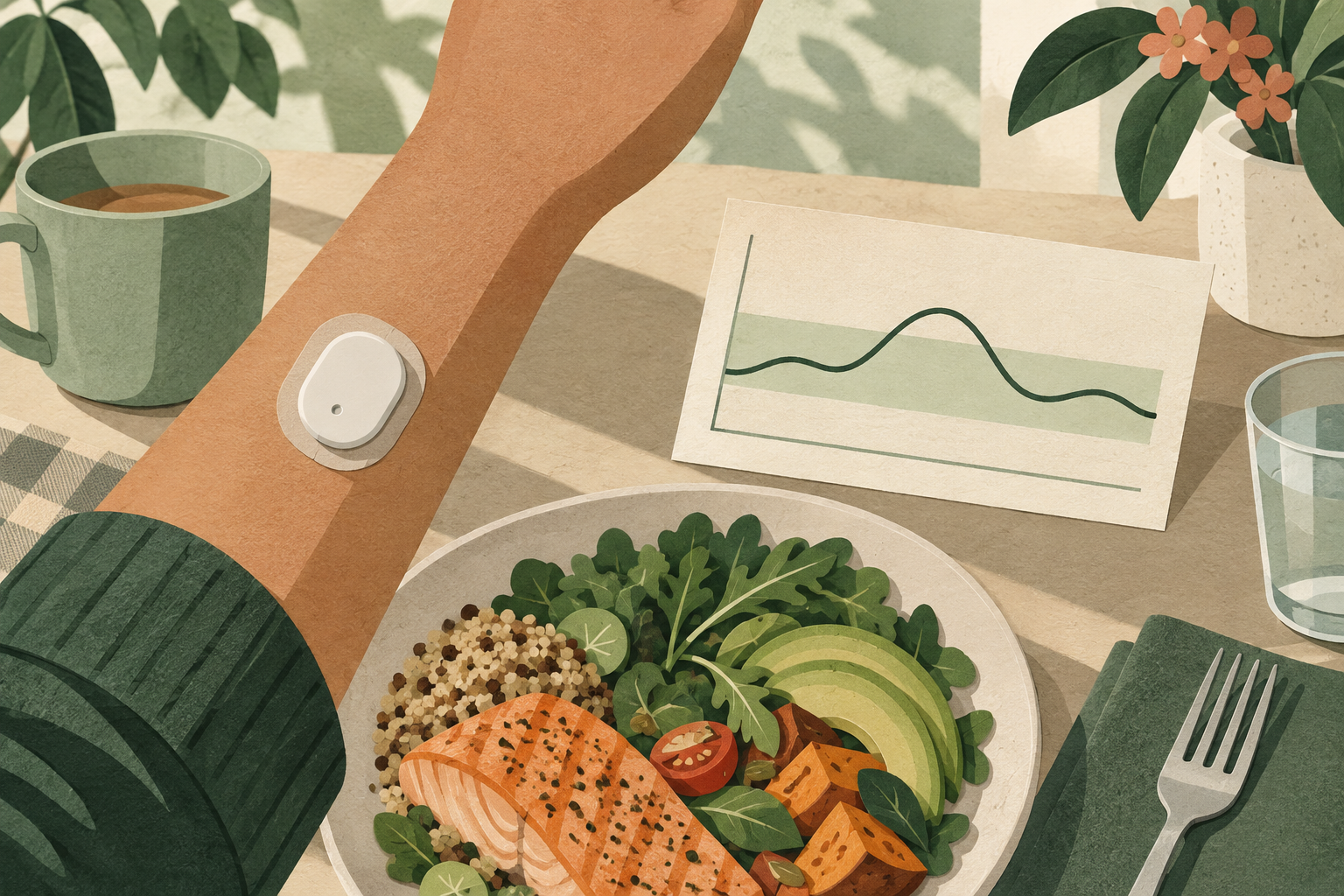
A continuous glucose monitor can turn meals, exercise, stress and sleep into a moving graph. For people without diabetes, that stream can feel like a personal metabolic report card—but a sensor spike is not a diagnosis, and a normal-looking curve cannot rule out disease. Here is how to interpret the signal without letting one number dictate your diet.
CGMs were developed to help people manage diabetes with ongoing glucose information. Now over-the-counter devices and wellness programs have made them appealing to people who want to improve nutrition, weight, exercise or “metabolic health.” Recent Reddit discussions reflect the common questions: Why did glucose rise when I did not eat? Is a post-meal peak dangerous? Does one high number mean prediabetes? Those threads reveal real confusion, but personal graphs and comments are not diagnostic evidence.
There is also new research. A 2026 study of over-the-counter CGMs in 39 young adults without diabetes compared sensor readings with finger-stick meter readings during rest, exercise and drink challenges. The devices broadly followed trends, but exact-value agreement was imperfect and became worse under some conditions. The study was small and used a meter comparison rather than establishing that a given person has disease. It is a useful reminder: a smooth line can look precise while still being an estimate.
What a CGM is measuring
A sensor filament sits just under the skin and estimates glucose in interstitial fluid. That is not the same sample as blood drawn for a laboratory test. The value displayed in an app can lag behind a fast change in blood glucose, and readings can be affected by sensor placement, pressure on the sensor, temperature, activity, signal processing and device-specific algorithms. The exact behavior depends on the model and its instructions.
This distinction matters when a user sees a sharp “spike” or overnight low. A sensor value is a measurement from one device under its intended conditions; it is not automatically a clinical result. Even cleared over-the-counter products have defined intended users and warnings. FDA information for the first OTC CGM, for example, describes adults who do not use insulin and who do not have problematic hypoglycemia. That clearance is not blanket permission to use any CGM for self-diagnosis or to make treatment decisions.
Why glucose may rise when you are not eating
Glucose is not controlled only by the last bite of food. The body releases glucose between meals and overnight, and hormones help regulate its availability. Exercise, illness, stress, poor sleep, caffeine, a delayed meal, and the timing of activity can change the pattern. A small rise does not point to one cause. Nor does it prove that a particular food is harmful or that your body is “failing.”
After a meal, glucose usually rises and later moves back toward baseline. The size and timing of that curve vary with the meal, mixed nutrients, activity, individual physiology, and measurement method. A single dramatic peak can prompt questions, but without a validated diagnostic framework it cannot tell whether you have normal variation, prediabetes, diabetes, or a sensor artifact.
| What the app shows | What it may mean | What it cannot establish by itself |
|---|---|---|
| A rise after a meal | Glucose changed after eating; the shape can vary with food, timing and activity. | That the food is “toxic,” that you have insulin resistance, or that you need to cut out an entire food group. |
| A brief overnight dip | A real change, a sensor artifact, pressure on the sensor, or a lagged estimate are all possible. | That you had clinical hypoglycemia. Symptoms, device instructions and appropriate confirmatory steps matter. |
| A higher reading after exercise | Activity and hormones can alter glucose; the direction and timing vary. | That exercise is harmful or that you should avoid it. |
| A normal average or “time in range” score | The device summarized measurements against its selected range. | That diabetes has been ruled out. CGM range metrics are not substitutes for diagnostic testing. |
| A repeated concerning pattern | A reason to discuss symptoms, risk factors and appropriate tests. | A diagnosis. A clinician decides which lab test and follow-up fit your situation. |
Do not use a CGM graph to diagnose diabetes
In the United States, NIDDK describes established blood tests used to diagnose diabetes and prediabetes: A1C, fasting plasma glucose, oral glucose tolerance testing and, in certain situations with symptoms, a random plasma glucose test. These tests have defined collection methods and thresholds. A diagnosis may require confirmation with a second result, depending on the clinical situation.
A CGM’s graph, app score, “spike” threshold or wellness target is not interchangeable with those tests. A finger-stick meter is also not a general diagnostic substitute for the lab pathway. If a sensor repeatedly alarms or a number worries you, do not try to “prove” or disprove disease by wearing the device longer and changing meals. Bring the concern to a clinician and ask which blood test, if any, is appropriate.
Symptoms matter as well. Increased thirst and urination, unexplained weight loss, blurred vision or unusual fatigue can have many causes, but they deserve medical attention—especially if persistent or worsening. Seek urgent care for vomiting, severe abdominal pain, deep or rapid breathing, confusion, fainting, severe dehydration or difficulty staying awake. Do not wait for a wearable to confirm an emergency.
When a CGM can be useful—and when it may not be
A defined short-term question may make monitoring useful: for example, helping a person with a clinician-guided plan notice how a routine affects readings. But evidence for using CGMs to improve long-term outcomes in healthy people without diabetes is still developing. A 2026 systematic review included 23 studies and 1,074 participants without diabetes. It found changes in some short-term glucose and behavior measures, but no significant BMI difference, and the authors noted that accuracy and variability evidence remain limited. That does not mean a CGM can never help; it means the purpose should be specific and claims should stay proportionate.
It may be a poor fit if you find yourself checking the app after every bite, fearing ordinary foods, skipping meals, or feeling that a good day requires a perfect graph. A small 2026 online discussion from people with diabetes and prediabetes described anxiety and constant checking. Forum posts are not prevalence data, but they show a genuine user experience: continuous feedback can inform, and it can also intensify worry. Our guide to sleep trackers and data-related worry covers a similar problem with another type of consumer health score.
If you decide to use one, set guardrails first
1. Write down the question before you put on the sensor
“I want to see whether a short walk after dinner fits my routine” is a bounded question. “I want to optimize every glucose value” has no finish line. If you have a diabetes diagnosis, symptoms, pregnancy, a history of disordered eating, problematic hypoglycemia or medicines that affect glucose, ask a clinician whether self-monitoring is appropriate before using a consumer device.
2. Follow that device’s labeling
Use the sensor only for the intended population and according to its instructions. Do not treat it as a replacement for prescribed testing or use an app’s interpretation to change medication. If the display conflicts with symptoms or a clinical plan, follow the device’s safety instructions and contact the clinician or support service responsible for your care.
3. Observe patterns, not isolated peaks
One meal, one workout or one night is a poor experiment. If a clinician or structured program has asked you to observe a trend, note the context: meal timing, approximate activity, sleep, illness, stress, medication and sensor fit. Avoid changing several habits at once. The goal is to learn something reliable enough to guide a modest behavior—not to eliminate normal variation.
4. Do not punish yourself for a graph
Do not skip medication, exercise, meals or whole food groups because of one reading. Restrictive eating can carry its own risks, especially for people with a current or past eating disorder, pregnancy, intensive training, or medicines that require consistent intake. If the data causes distress or compulsive checking, pause the device and discuss the effect with a healthcare professional.
5. Keep costs and data privacy in view
Sensor cost, replacement supplies, phone compatibility, app subscriptions and data sharing can change the real cost of “trying it for a month.” Read what the app collects and how to delete an account or export data. A consumer wellness device is not automatically part of your medical record, and a chart shared publicly can expose dates, routines, health details or account identifiers.
How to prepare for a clinician conversation
If your concern is diabetes risk, bring the question rather than treating the sensor graph as the answer. Mention symptoms, family history, pregnancy history where relevant, medicines, prior lab results and the reason you started monitoring. If you have screenshots, select a few that illustrate the pattern and include device model and timing; avoid handing over a hundred unexplained graphs. Ask which validated test is suitable, when it should be done, and whether any result needs confirmation.
Useful questions: “Does my risk profile call for testing?” “Would an A1C or fasting glucose answer my question?” “Could any medicine or condition affect the result?” “What should I do if a sensor number looks very different from how I feel?”
For people already treated for diabetes, do not use generic wellness guidance to override your diabetes care plan. Your clinician may use CGM trends for treatment decisions within the device’s intended use. Ask what alerts mean for you, when to confirm with another method, and whom to contact after hours. The advice in this article is about people considering CGM as a wellness experiment without a diabetes diagnosis; it is not a reason to stop prescribed monitoring.
A practical example: the “spike” that changes lunch
Suppose a person sees a high post-lunch peak and immediately deletes bread, fruit and rice from the week. The next few days also include better sleep, less stress and a lunchtime walk, so the graph improves. It is impossible to know which change mattered, whether the sensor behaved consistently, or whether the peak had clinical meaning. The person has learned that a multi-variable experiment produces an appealing story, not a reliable answer.
A more useful approach is to keep ordinary meals, observe a pattern only if there is a clear purpose, and discuss persistent concern with a clinician. If a small, sustainable change—such as a walk that is comfortable and medically appropriate—improves energy or fits the routine, it may be worth keeping regardless of the graph. No one needs a sensor to justify a balanced meal or regular movement.
The bottom line
CGMs can display patterns, but their numbers are estimates and their role depends on the device, intended user and clinical context. For someone without diabetes, a post-meal rise is not automatically a problem, a normal score does not rule out disease, and one graph cannot diagnose either. If you have symptoms or risk concerns, ask about established blood tests. If you use a sensor for curiosity, set a narrow question, follow labeling, and stop if the data starts driving fear or restrictive behavior.
Related reading: our guides explain when electrolyte drinks are useful and how consumer health tracking can become a source of stress.
Sources
- National Institute of Diabetes and Digestive and Kidney Diseases: Diabetes Tests & Diagnosis — laboratory tests and diagnostic thresholds.
- U.S. Food and Drug Administration: first over-the-counter continuous glucose monitor — intended use and limits for the cleared product.
- 2026 study: OTC CGM agreement with capillary-meter glucose in young adults without diabetes — small study; sensor/meter comparison, not diagnostic validation.
- 2026 systematic review: continuous glucose monitoring in non-diabetic populations — short-term outcomes and evidence limitations.
- r/prediabetes discussion, September 2026 — user questions about readings without eating; anecdotal context, not clinical evidence.
- r/prediabetes discussion, June 2026 — one user’s report of anxiety and frequent checking; not evidence of prevalence or causation.