
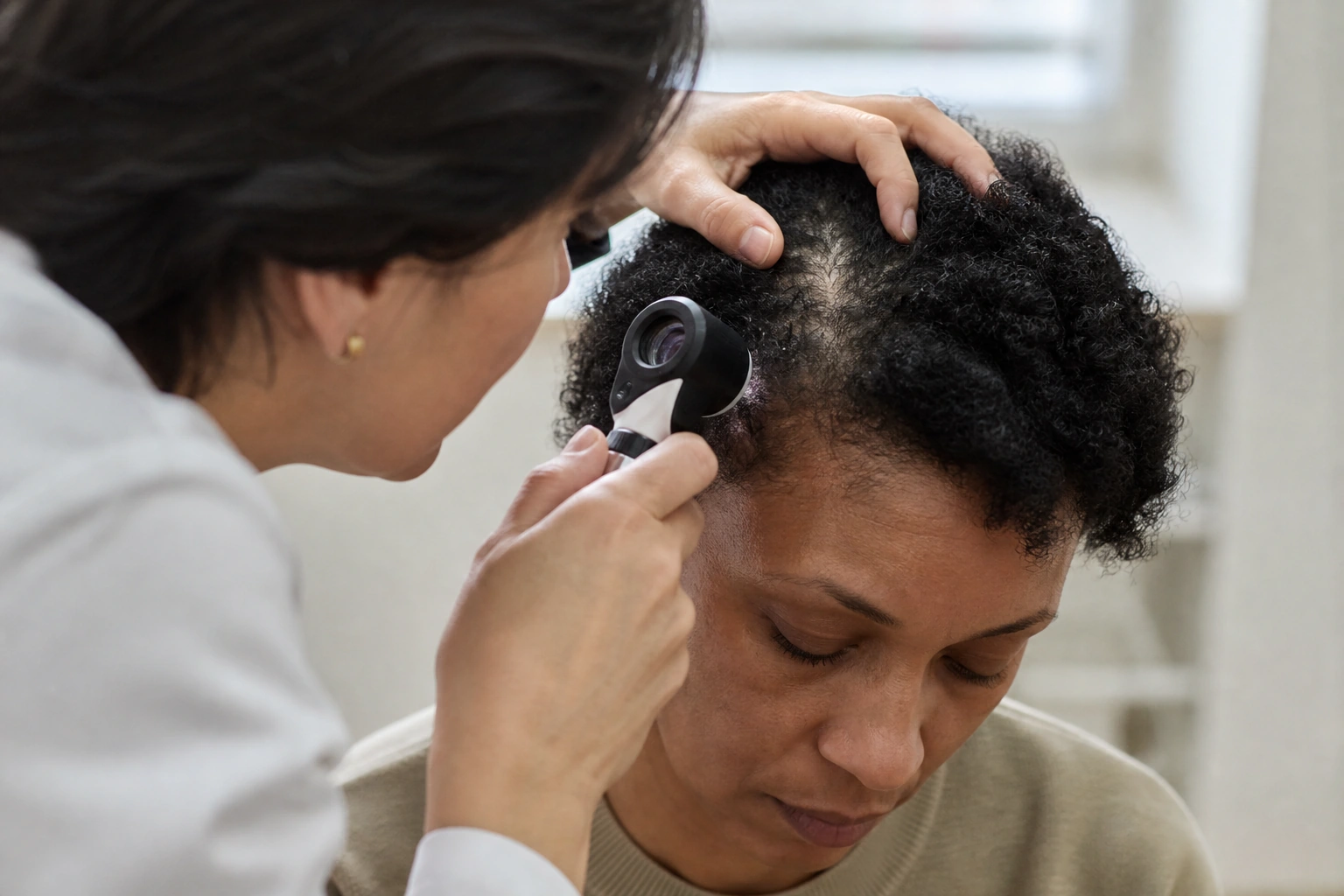
Pattern hair loss is a common inherited condition in which susceptible scalp follicles gradually produce shorter, finer hairs. In a typical male pattern it affects the temples, hairline, and crown. In a typical female pattern it widens the central part and reduces density over the top while often preserving the frontal edge. The medical term is androgenetic alopecia.
Key points
- Pattern loss is gradual and non-scarring; sudden, patchy, painful, or inflamed loss suggests another cause.
- A person can have pattern loss and excessive shedding at the same time.
- Early diagnosis preserves more miniaturizing follicles, but no treatment guarantees regrowth.
- Most effective medical options require continued use to maintain benefit.
- Pregnancy plans, mood history, sexual effects, blood pressure, and other medicines change the safety decision.
How pattern hair loss develops
Hair grows in repeated cycles. In genetically susceptible follicles, androgen signaling progressively shortens the growth phase and miniaturizes the follicle. Each replacement hair may be finer, shorter, and less pigmented until scalp coverage decreases. Follicles remain visible in non-scarring pattern loss.
Genes can come from either side of the family, and absence of an affected parent does not rule it out. Hormones play a role, but most women with female-pattern loss do not have an androgen-producing disorder. Age increases prevalence, although the process can begin in the teens or twenties.
Common male and female distributions
A male pattern often starts with symmetrical recession at the temples, a changing frontal hairline, thinning at the crown, or a combination. The sides and back are relatively preserved. Progression varies greatly: an early start does not predict an exact final pattern.
A female pattern usually appears as a wider central part, a thinner ponytail, or diffuse reduction across the top and crown. The front edge is commonly retained, although temple thinning can occur. Complete baldness is uncommon in this pattern.
These names describe frequent distributions, not identity. Anyone can present with either pattern, and hormone therapy or an endocrine condition may alter it. A clinician evaluates the scalp and the person rather than deciding from gender alone.
Hair shedding is different
Telogen effluvium is increased shedding when many follicles enter a resting phase together, often two to three months after fever, surgery, childbirth, rapid weight change, severe stress, nutritional deficiency, or a medicine change. Hairs come from across the scalp rather than one patterned zone. The trigger may have resolved by the time shedding begins.
This process is often temporary, but recovery is slow because hair cycles take months. It can also uncover previously subtle pattern loss. Pulling out handfuls of hair does not prove the follicle is dying, and seeing the white club at the end of a shed hair does not mean the root was permanently removed.
Other conditions that can look similar
Round or oval smooth patches suggest alopecia areata, an autoimmune disease. Broken hairs, scalp scale, or swollen neck nodes can indicate scalp ringworm, especially in children. Tight braids, extensions, buns, chemical processing, and repeated heat can cause traction or breakage; long-standing traction can become permanent.
Frontal fibrosing alopecia often causes a band-like receding hairline and eyebrow loss. Central centrifugal cicatricial alopecia may begin at the crown, especially in women of African ancestry, with tenderness, itch, or breakage. Both are scarring diseases requiring early treatment. Lupus and other inflammatory disorders can also scar follicles.
Diffuse thinning can accompany iron deficiency, thyroid disease, major illness, undernutrition, eating disorders, or selected medicines. New acne, increased facial or body hair, irregular periods, infertility, or voice change may prompt assessment for androgen excess, including polycystic ovary syndrome or rarer causes.
How a dermatologist makes the diagnosis
The history covers speed, distribution, shedding, scalp symptoms, hair practices, illness, childbirth, diet, weight change, periods, menopause, medicines, supplements, family history, and previous photos. The examination compares density across scalp regions and checks follicle openings, shaft diameter, breakage, scale, redness, pustules, and nails.
Trichoscopy—a magnified scalp examination—can show variation in hair diameter and miniaturization. A gentle pull test helps identify active shedding. Standardized photographs and measurements provide a more reliable baseline than bathroom lighting or a wet-hair selfie.
Blood tests are selected when the story suggests another cause, such as anemia or low iron stores, thyroid disease, nutritional deficiency, or androgen excess. Routine panels and commercial hormone packages are not required for every typical case. A small scalp biopsy can distinguish scarring disease or overlapping diagnoses when examination is not conclusive.
Set realistic treatment goals
The first goal is often stabilization: keeping more existing hair. Thickening miniaturized hairs is possible for some people, while completely bare long-standing areas are less likely to respond. Results take months and are best judged with standardized photographs, not daily mirror checks.
Discuss the amount of effort, cost, side effects, pregnancy plans, and cosmetic importance before starting. Choosing no medical treatment is valid. A haircut, fibers, scalp concealer, hairpiece, wig, or head covering can provide immediate control while a medicine is being evaluated.
Topical hair-growth treatment
Topical minoxidil is an established option for male and female pattern loss and is available without prescription in some countries. Concentrations, formulations, labels, and approved populations differ. Use on a diagnosed pattern and follow the local label rather than copying an online schedule.
Early temporary shedding can occur as follicles change cycle. Scalp irritation, flaking, and unwanted facial hair are possible. Stop and obtain medical advice for chest pain, rapid heartbeat, faintness, dizziness, sudden unexplained weight gain, or swelling of hands or feet. Keep it away from children and pets; accidental ingestion needs urgent poison advice.
Benefit is assessed over months and is maintained only while treatment continues. More product or more frequent application does not accelerate growth. Topical minoxidil should be avoided in pregnancy and breastfeeding unless a qualified clinician has given condition- and jurisdiction-specific advice.
Prescription hormone-modifying treatment
For selected men, an oral 5-alpha-reductase inhibitor can slow androgen-driven miniaturization. It requires a discussion of fertility concerns, sexual adverse effects, mood history, interactions, and the need for ongoing use. A lower prostate blood-test result can affect interpretation, so every clinician involved should know it is being taken.
Regulators have strengthened psychiatric warnings. EMA confirmed suicidal ideation as an adverse effect of finasteride tablets in 2025, with frequency unknown, while concluding that benefits continue to outweigh risks for approved uses. UK MHRA warnings cover depressed mood, depression, suicidal thoughts, and sexual dysfunction that may persist after stopping in some reports.
Follow the current patient leaflet and local regulator instructions. New mood change or suicidal thoughts needs immediate action according to that guidance and urgent mental-health help if safety is at risk. Sexual symptoms should be discussed with the prescriber rather than hidden or managed with an online product.
Hormone-modifying tablets used for male pattern loss are not interchangeable with treatment for female-pattern loss and can harm a developing fetus. In selected women, dermatologists may consider anti-androgen approaches off label after assessing kidney function, blood pressure, other medicines, and reliable pregnancy prevention. They are not appropriate in pregnancy.
Oral minoxidil and other off-label options
Low-dose oral minoxidil is increasingly prescribed off label for some hair disorders, but a tablet has whole-body cardiovascular effects. Blood pressure, heart disease, fluid retention, interacting medicines, pregnancy, and unwanted body-hair growth require review. It should not be converted from a topical dose or bought through an unmonitored cosmetic service.
Other prescription combinations differ by diagnosis and country. Off-label means a regulator has not approved that exact condition, dose, route, or population; it does not mean there is no evidence, but it makes informed consent and monitoring especially important.
Procedures and devices
Low-level light devices, platelet-rich plasma injections, and microneedling are marketed widely. Evidence, protocols, device clearance, operator training, cost, and durability vary. “FDA-cleared” for a device is not the same as a guarantee of regrowth, and combining procedures can make it hard to know what helped.
Hair transplantation redistributes resistant follicles, usually from the back or sides, into thinner areas. It does not stop loss in untreated native hair. A suitable candidate needs adequate donor density, a stable diagnosis, realistic expectations, and no active scarring inflammation. Discuss scarring, infection, shock loss, future progression, repeat procedures, and the surgeon’s credentials.
Hair care that prevents additional damage
Gentle care cannot reverse genetic miniaturization but can reduce breakage and traction. Loosen painful styles, vary attachment points, limit repeated chemical relaxing and high heat, detangle carefully, and avoid heavy extensions on fragile edges. Pain or bumps from a hairstyle are warning signs, not proof that it is “protective.”
Use supplements only when diet history or testing identifies a need. Excess iron, selenium, vitamin A, and other nutrients can cause harm or hair loss, and high-dose biotin can interfere with laboratory tests. A marketing label that says DHT blocker or clinically tested does not establish effectiveness.
The emotional impact is medical too
Hair loss can affect identity, cultural expression, relationships, and confidence. Distress is not vanity. A clinician can include cosmetic support and mental-health care in the plan. Repetitive checking, social withdrawal, severe depression, or thoughts of self-harm deserve direct support regardless of how much hair has been lost.
Questions people often ask
Can pattern hair loss be cured?
No permanent cure is established. Treatment can slow progression and improve density for some people, but benefit usually requires continued use.
Does wearing a hat cause baldness?
No. Ordinary hats do not cause androgenetic alopecia. Constant traction, friction, or an untreated inflammatory scalp condition is different.
Should everyone with thinning have hormone tests?
No. Testing is guided by the pattern and symptoms such as irregular periods, acne, increased facial hair, or rapid progression.
Will biotin regrow pattern loss?
Not when biotin status is normal. Supplements do not reverse follicle miniaturization and can create toxicity or interfere with tests.
Sources and evidence scope
This guide was researched using American Academy of Dermatology information on causes, diagnosis and treatment, and female pattern loss; 2024 British Association of Dermatologists leaflets for male and female pattern loss; the 2025 EMA safety review; 2024 MHRA finasteride warning; and FDA topical minoxidil labeling. Sources were checked on August 21, 2026. Approved treatments, strengths, warning instructions, and procedure regulation vary by country.