
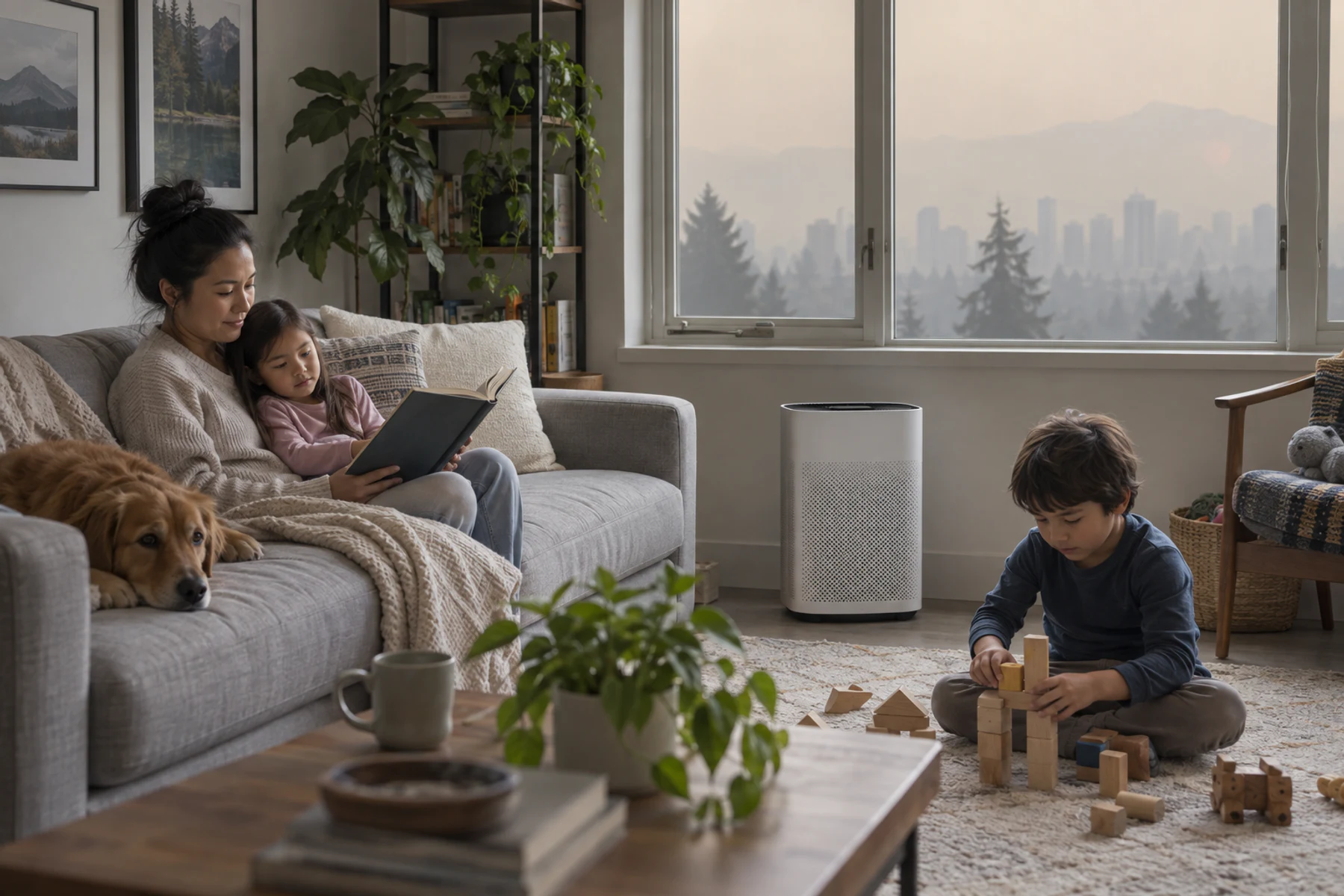
During wildfire smoke, the realistic goal is not perfectly pure indoor air. It is reducing the dose of fine particles while keeping the home safe from heat and other hazards. A clean room, properly sized portable air cleaner, upgraded HVAC filter when the system can handle it, and fewer indoor particle sources can make a meaningful difference. The plan should be prepared before smoke arrives because filters and safe spaces become harder to find during an event.
Decision points
- Choose one room that can be closed off and kept comfortable.
- Match a portable cleaner’s smoke CADR to room size and run it continuously at the highest tolerable speed.
- Avoid ozone-generating devices and products that market ionization without clear safety evidence.
- A DIY box-fan filter can be a temporary option when built and operated safely.
- If indoor heat or symptoms become dangerous, relocation may be safer than sealing the home.
Create the room before the plume
Select a bedroom or living room with few windows and doors. Weather-strip obvious leaks if safe, close windows during smoke, and bring medicines, water, chargers, and quiet activities inside. The room still needs temperature control; sealing a dangerously hot space can create a different emergency.
For create the room before the plume, document the setting, timing, and response before changing more than one variable. That record keeps the decision about wildfire smoke air cleaner tied to something observable and makes it easier to separate a useful adjustment from a coincidence or short-lived impression.
Size the cleaner using smoke CADR
Clean-air delivery rate combines airflow and particle removal. Use the smoke CADR and the actual room area, not only a marketing phrase such as “covers large spaces.” Higher fan speeds clean more air but add noise. Continuous operation is usually more effective than brief bursts on an automatic mode.
The limit matters as much as the finding. EPA: strategies to reduce exposure indoors supports the general boundary, but it does not turn size the cleaner using smoke cadr into a universal rule. Dose, duration, baseline risk, local conditions, and the available alternatives can change what a reasonable next step looks like.
Use HVAC filtration within system limits
If the home has central forced air, a higher-efficiency filter can reduce recirculated particles when compatible with the equipment. Set the fan to recirculate where appropriate and close outdoor-air intakes if safe and allowed. A filter that is too restrictive for the system can reduce airflow, so consult the manual or a qualified technician.
A practical record for use hvac filtration within system limits should be brief: what was used or observed, when it happened, what changed, and whether daily function or safety improved. That is more informative at follow-up than a general feeling that wildfire smoke air cleaner was healthy, advanced, natural, or disappointing.
Reduce indoor particle sources
Do not smoke, burn candles or incense, fry or broil heavily, or vacuum without effective filtration during a smoke event. Cooking and cleaning can briefly create more particles than the outdoor air. Damp wiping and a lower-emission meal plan reduce the load the cleaner must handle.
If reduce indoor particle sources still leaves uncertainty, choose a reversible next step and set a review point. Avoid stacking several new changes at once. That approach protects the option of professional assessment and prevents an open question about wildfire smoke air cleaner from becoming an indefinite commitment.
DIY filters are a backup tool
EPA research indicates that well-built box-fan filters can reduce particles. Use a newer certified fan, secure the filter correctly, prevent tipping, keep children and pets away, and do not use an extension arrangement that overheats. Replace a visibly dirty filter and never leave a questionable setup unattended.
Claims about diy filters are a backup tool often highlight a mechanism while hiding the comparator. Ask what would happen with no purchase, a simpler behavior change, or ordinary care. The best next move for wildfire smoke air cleaner may be consistency, assessment, or follow-up rather than a featured product.
Decide when to leave
Air quality, indoor particle readings, temperature, power reliability, medical vulnerability, and symptoms all matter. A low-cost sensor can show trends but is not a medical device. Identify a cleaner-air shelter, public building, or friend’s home in advance and plan transport, medicines, and pet needs.
Individual variation in decide when to leave is real, but it cannot validate every marketing claim. Personalization starts with history, constraints, goals, and monitored outcomes. It does not start with a seller treating normal uncertainty about wildfire smoke air cleaner as proof that a premium test, device, or subscription is necessary.
A comparison that prevents the common mistake
| Option or signal | What it can tell you | What it cannot settle |
|---|---|---|
| Portable HEPA cleaner | Reliable particle reduction when correctly sized | Filter cost, noise, and no removal of every gas |
| Central HVAC filter | Treats air throughout served rooms | Depends on system compatibility and runtime |
| DIY box-fan filter | Lower-cost temporary particle reduction | Requires careful construction and fire/electrical safety |
| Ionizer or ozone generator | May be marketed for smoke | Ozone can harm lungs; avoid ozone-generating devices |
The rows are not a ranking. They separate what each option measures or provides from the larger conclusion people often attach to it. For wildfire smoke air cleaner, a tool is useful only when its result is reliable enough and connected to an action that improves safety, symptoms, function, or a defined clinical outcome.
Claims that sound simple but are not
“Any air purifier works for any room.”
Capacity and smoke CADR must match the room and operating speed. For wildfire smoke air cleaner, test that claim against this boundary: If indoor heat or symptoms become dangerous, relocation may be safer than sealing the home. Decide beforehand what result would justify continuing and what warning sign would end the experiment.
“If I cannot smell smoke, particles are gone.”
Odor and particle concentration are different measures. For wildfire smoke air cleaner, test that claim against this boundary: Avoid ozone-generating devices and products that market ionization without clear safety evidence. Decide beforehand what result would justify continuing and what warning sign would end the experiment.
“Sealing the house is always safest.”
Extreme heat and carbon-monoxide risks can outweigh particle reduction. For wildfire smoke air cleaner, test that claim against this boundary: A DIY box-fan filter can be a temporary option when built and operated safely. Decide beforehand what result would justify continuing and what warning sign would end the experiment.
“One hour on turbo cleans the whole day.”
Particles continue entering and being generated; continuous filtration is usually needed. For wildfire smoke air cleaner, test that claim against this boundary: Avoid ozone-generating devices and products that market ionization without clear safety evidence. Decide beforehand what result would justify continuing and what warning sign would end the experiment.
A six-step decision plan
- 1. Choose and prepare a clean room. Keep the first attempt small enough to review before adding another change.
- 2. Size a cleaner using smoke CADR and room area. Record what happened in ordinary language rather than relying on a proprietary score.
- 3. Stock replacement filters and check HVAC compatibility. Pause here if a warning sign appears or the basic assumption no longer fits.
- 4. Reduce indoor combustion and high-particle cooking. Do not let money already spent become a reason to continue an ineffective plan.
- 5. Set symptom and heat thresholds for relocation. Include the schedule, people, and resources that determine whether this is realistic.
- 6. Replace filters and review the plan after the event. At review, choose explicitly to continue, modify, stop, or investigate further.
How to judge whether the plan is working
For wildfire smoke air cleaner, useful outcomes follow the article’s actual decision points: Choose one room that can be closed off and kept comfortable. Match a portable cleaner’s smoke CADR to room size and run it continuously at the highest tolerable speed. Avoid ozone-generating devices and products that market ionization without clear safety evidence. Choose a date to compare symptoms, function, cost, burden, and adverse effects. A short-term signal can be genuine without proving a durable benefit. If the target is unchanged, revisit create the room before the plume and size the cleaner using smoke cadr before increasing intensity or expense.
The safety boundary is equally concrete: Call emergency services for severe trouble breathing, chest pain, blue lips, confusion, fainting, or signs of a heart attack or stroke. People with asthma, COPD, heart disease, pregnancy, or worsening symptoms should follow their action plan and seek care early. Keep any relevant packaging, lot details, readings, or instructions. Tell clinicians about the exact supplement, device, exposure, or self-directed protocol rather than using only a category name, because formulation and use can change the assessment.
Questions worth taking to an appointment
- How should I choose and prepare a clean room, and how will we know it helped?
- What could prevent me from completing the step “size a cleaner using smoke cadr and room area”?
- Which finding would change the plan to stock replacement filters and check hvac compatibility?
- What is the safest practical way to reduce indoor combustion and high-particle cooking?
- What lower-burden alternatives are there to the step “set symptom and heat thresholds for relocation”?
- When should I stop or revise the plan to replace filters and review the plan after the event?
Bring a short record organized around create the room before the plume, size the cleaner using smoke cadr, use hvac filtration within system limits. Include the actual product, device, report, or schedule when relevant. The purpose is to turn a broad concern about wildfire smoke air cleaner into a decision with an explanation, alternatives, monitoring, and a review point.
Sources and evidence scope
This guide uses regulatory, public-health, clinical-guideline, and peer-reviewed sources relevant to wildfire smoke air cleaner. It does not turn a population average into an individual diagnosis or guarantee. Evidence and links were checked on 2026-09-17.