
Radon is an invisible radioactive gas that can enter buildings from soil. You cannot smell it, and a neighbor’s result cannot predict yours. Testing is the only way to know the level in a specific home. The measurement is simple, but placement, closed-house conditions, unusual weather, device instructions, and follow-up after a high result all influence whether the number leads to a sound decision.
Choose the correct room
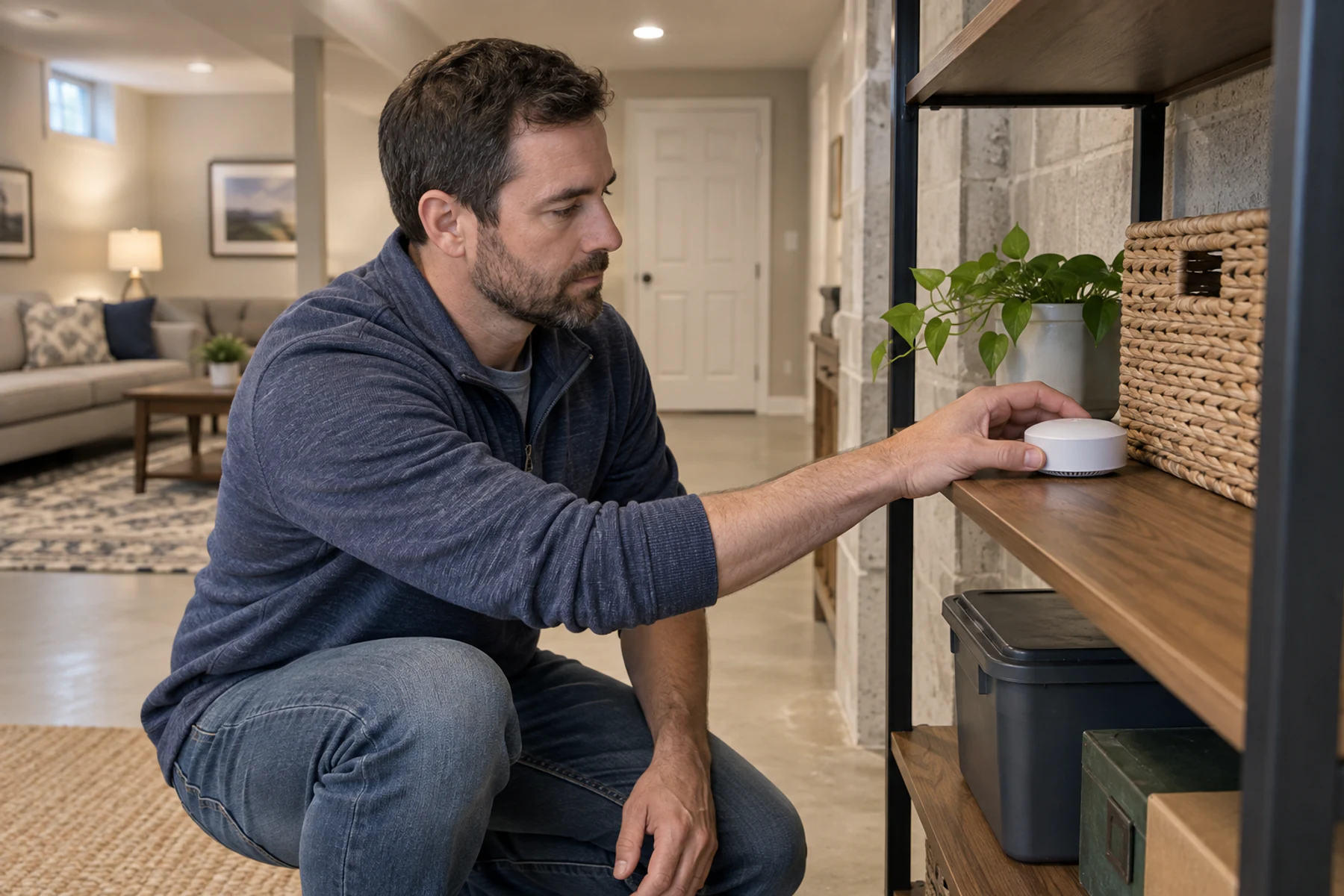
Place the kit on the lowest lived-in level, not a crawlspace unless the instructions specify otherwise. Use a room where people spend time, away from kitchens, bathrooms, laundry, open windows, exterior doors, fans, and strong heat. The device should be above the floor and left undisturbed.
For choose the correct room, document the setting, timing, and response before changing more than one variable. That record keeps the decision about radon testing at home tied to something observable and makes it easier to separate a useful adjustment from a coincidence or short-lived impression.
Follow closed-house conditions
For many short-term tests, windows and exterior doors should remain closed except for normal entry and exit for a defined period before and during testing. Avoid starting during severe storms or unusually high winds when instructions warn against it. Heating and cooling can operate normally unless the kit says otherwise.
The limit matters as much as the finding. EPA: radon units and interpretation supports the general boundary, but it does not turn follow closed-house conditions into a universal rule. Dose, duration, baseline risk, local conditions, and the available alternatives can change what a reasonable next step looks like.
Short term versus long term
A short-term kit can screen quickly and is useful during a home transaction, but radon varies by season and weather. A long-term test, commonly more than ninety days, better estimates the annual average. The right follow-up depends on the initial value, urgency, and the protocol supplied with the device.
A practical record for short term versus long term should be brief: what was used or observed, when it happened, what changed, and whether daily function or safety improved. That is more informative at follow-up than a general feeling that radon testing at home was healthy, advanced, natural, or disappointing.
Interpret the action level correctly
The EPA action level of 4 picocuries per liter is a risk-management threshold, not a line between safe and poisonous air. Risk does not become zero below it. The agency advises considering mitigation for levels between 2 and 4 pCi/L, especially when exposure will be long term.
If interpret the action level correctly still leaves uncertainty, choose a reversible next step and set a review point. Avoid stacking several new changes at once. That approach protects the option of professional assessment and prevents an open question about radon testing at home from becoming an indefinite commitment.
Mitigation is a building intervention
A qualified radon professional can design soil suction or another system for the building. Opening windows is not a durable year-round solution. Sealing cracks may support a system but usually is not sufficient alone. Obtain clear scope, fan and alarm details, discharge placement, and warranty information.
Claims about mitigation is a building intervention often highlight a mechanism while hiding the comparator. Ask what would happen with no purchase, a simpler behavior change, or ordinary care. The best next move for radon testing at home may be consistency, assessment, or follow-up rather than a featured product.
Retest at meaningful times
Test after mitigation to confirm performance, and periodically afterward according to guidance. Retest after major renovation, foundation work, HVAC changes, or converting a lower level into living space. A monitor can show trends, but it should be used and calibrated according to its instructions.
Individual variation in retest at meaningful times is real, but it cannot validate every marketing claim. Personalization starts with history, constraints, goals, and monitored outcomes. It does not start with a seller treating normal uncertainty about radon testing at home as proof that a premium test, device, or subscription is necessary.
The short version
- Test the lowest level that is regularly occupied or could be used as living space.
- Keep the device away from drafts, exterior walls, heat, humidity, and direct sunlight.
- Short-term tests answer quickly; long-term tests better reflect variation.
- The EPA recommends action at 4 pCi/L and considering action between 2 and 4 pCi/L.
- Mitigation should be followed by another test.
A comparison that prevents the common mistake
| Option or signal | What it can tell you | What it cannot settle |
|---|---|---|
| Short-term charcoal kit | Low-cost result in days | Sensitive to conditions and short-term variability |
| Long-term alpha-track test | Better estimate of average exposure | Takes months |
| Continuous monitor | Shows patterns and repeated readings | Higher cost and device quality varies |
| Professional measurement | Useful for transactions or complex cases | Check credentials, protocol, and conflict of interest |
The rows are not a ranking. They separate what each option measures or provides from the larger conclusion people often attach to it. For radon testing at home, a tool is useful only when its result is reliable enough and connected to an action that improves safety, symptoms, function, or a defined clinical outcome.
Claims that sound simple but are not
“New homes do not have radon.”
Any home can have elevated levels depending on geology and construction. For radon testing at home, test that claim against this boundary: Keep the device away from drafts, exterior walls, heat, humidity, and direct sunlight. Decide beforehand what result would justify continuing and what warning sign would end the experiment.
“My neighbor tested low, so I am safe.”
Levels can differ substantially between nearby buildings. For radon testing at home, test that claim against this boundary: Test the lowest level that is regularly occupied or could be used as living space. Decide beforehand what result would justify continuing and what warning sign would end the experiment.
“A reading below 4 means zero risk.”
The action level is not a biological zero-risk threshold. For radon testing at home, test that claim against this boundary: Short-term tests answer quickly; long-term tests better reflect variation. Decide beforehand what result would justify continuing and what warning sign would end the experiment.
“One open window fixes the problem.”
Ventilation is temporary and weather-dependent; durable mitigation addresses entry. For radon testing at home, test that claim against this boundary: Short-term tests answer quickly; long-term tests better reflect variation. Decide beforehand what result would justify continuing and what warning sign would end the experiment.
A six-step decision plan
- 1. Choose a listed kit or qualified measurement provider. Keep the first attempt small enough to review before adding another change.
- 2. Place it on the lowest occupied level exactly as instructed. Record what happened in ordinary language rather than relying on a proprietary score.
- 3. Record start and stop times and unusual weather. Pause here if a warning sign appears or the basic assumption no longer fits.
- 4. Send or close the device promptly. Do not let money already spent become a reason to continue an ineffective plan.
- 5. Follow the recommended confirmation or mitigation path. Include the schedule, people, and resources that determine whether this is realistic.
- 6. Retest after mitigation and relevant building changes. At review, choose explicitly to continue, modify, stop, or investigate further.
How to judge whether the plan is working
For radon testing at home, useful outcomes follow the article’s actual decision points: Test the lowest level that is regularly occupied or could be used as living space. Keep the device away from drafts, exterior walls, heat, humidity, and direct sunlight. Short-term tests answer quickly; long-term tests better reflect variation. Choose a date to compare symptoms, function, cost, burden, and adverse effects. A short-term signal can be genuine without proving a durable benefit. If the target is unchanged, revisit choose the correct room and follow closed-house conditions before increasing intensity or expense.
The safety boundary is equally concrete: Radon does not cause immediate symptoms, so headache or dizziness in a home should not be attributed to radon without checking urgent causes such as carbon monoxide. If a carbon-monoxide alarm sounds or several people become suddenly ill, leave and contact emergency services. Keep any relevant packaging, lot details, readings, or instructions. Tell clinicians about the exact supplement, device, exposure, or self-directed protocol rather than using only a category name, because formulation and use can change the assessment.
Questions worth taking to an appointment
- How should I choose a listed kit or qualified measurement provider, and how will we know it helped?
- What could prevent me from completing the step “place it on the lowest occupied level exactly as instructed”?
- Which finding would change the plan to record start and stop times and unusual weather?
- What is the safest practical way to send or close the device promptly?
- What lower-burden alternatives are there to the step “follow the recommended confirmation or mitigation path”?
- When should I stop or revise the plan to retest after mitigation and relevant building changes?
Bring a short record organized around choose the correct room, follow closed-house conditions, short term versus long term. Include the actual product, device, report, or schedule when relevant. The purpose is to turn a broad concern about radon testing at home into a decision with an explanation, alternatives, monitoring, and a review point.
Sources and evidence scope
This guide uses regulatory, public-health, clinical-guideline, and peer-reviewed sources relevant to radon testing at home. It does not turn a population average into an individual diagnosis or guarantee. Evidence and links were checked on 2026-09-17.