
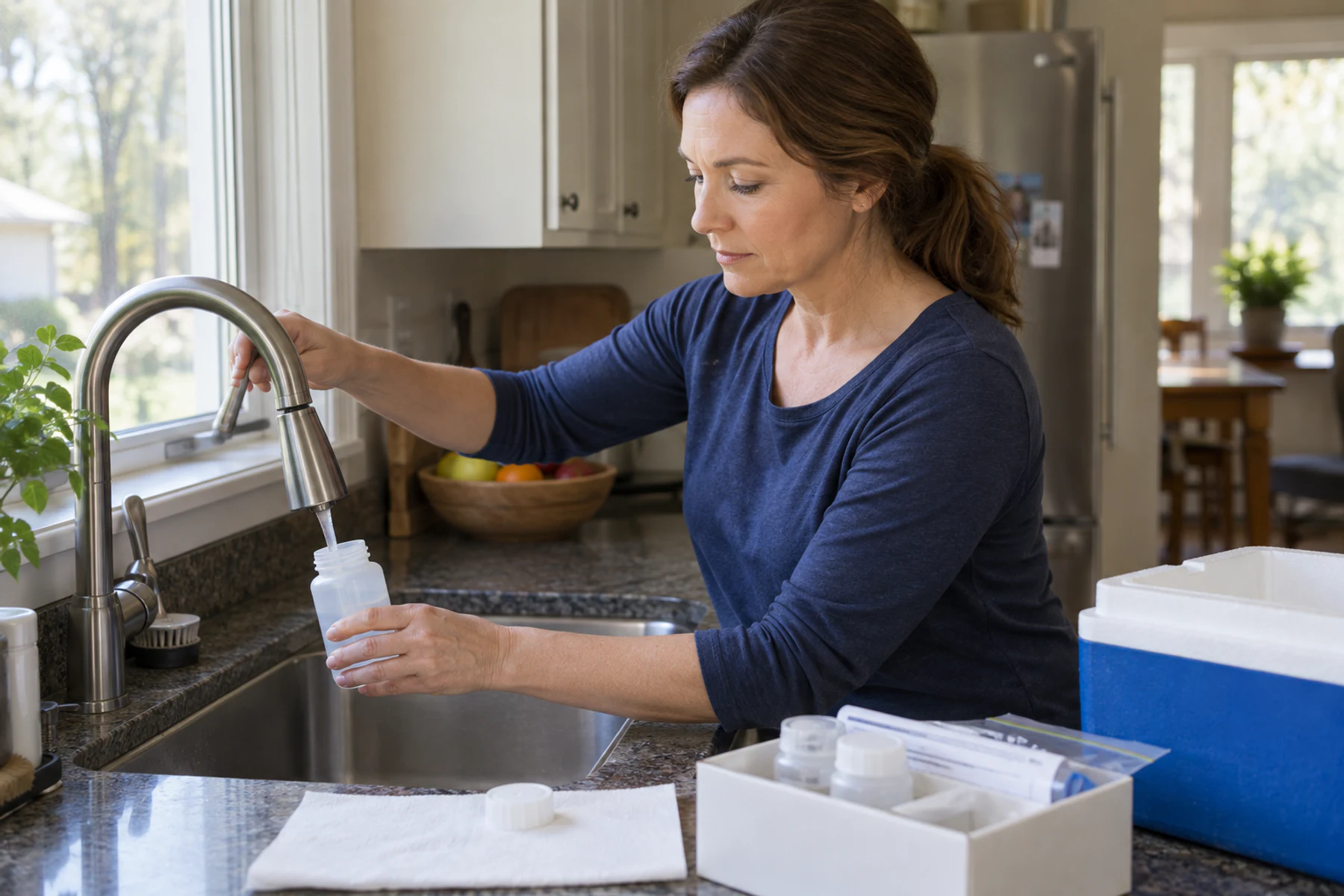
A home water test should start with a specific water source and question. Public water systems are monitored under regulations and publish consumer reports; private-well owners are responsible for their own testing. A strip that checks pH and hardness cannot rule out bacteria, nitrate, lead, arsenic, pesticides, or local industrial contaminants. The useful plan combines annual baseline testing, event-triggered testing, local geology and land use, correct sample collection, and a certified laboratory.
Public water and private wells differ
A utility’s consumer confidence report describes the regulated system, but plumbing can still affect water at a particular tap. Private wells lack routine utility oversight. The well owner should keep construction records, prior results, treatment maintenance, and information about nearby septic systems, farms, mines, fuel tanks, or industrial sites.
For public water and private wells differ, document the setting, timing, and response before changing more than one variable. That record keeps the decision about home water testing tied to something observable and makes it easier to separate a useful adjustment from a coincidence or short-lived impression.
Build the test panel from local risk
EPA recommends annual private-well testing for total coliform bacteria, nitrate, total dissolved solids, and pH, with additional contaminants based on local conditions. Arsenic, uranium, pesticides, volatile chemicals, or other substances may be relevant in particular regions. The local health department or extension service can help prioritize.
The limit matters as much as the finding. EPA: home water testing facts supports the general boundary, but it does not turn build the test panel from local risk into a universal rule. Dose, duration, baseline risk, local conditions, and the available alternatives can change what a reasonable next step looks like.
Lead requires a sampling plan
Lead often comes from service lines, solder, fixtures, or brass rather than the source water. A first-draw sample after water has stood answers a different question from a flushed sample. Follow the laboratory’s bottles, stagnation time, and instructions; do not rinse a preserved sample container.
A practical record for lead requires a sampling plan should be brief: what was used or observed, when it happened, what changed, and whether daily function or safety improved. That is more informative at follow-up than a general feeling that home water testing was healthy, advanced, natural, or disappointing.
Bacteria samples are easy to contaminate
Use the sterile bottle, avoid touching the cap or bottle interior, follow disinfection instructions for the faucet when provided, and deliver the sample within the required holding time, often chilled. A positive result should trigger guidance about immediate precautions, well inspection, disinfection, and repeat testing.
If bacteria samples are easy to contaminate still leaves uncertainty, choose a reversible next step and set a review point. Avoid stacking several new changes at once. That approach protects the option of professional assessment and prevents an open question about home water testing from becoming an indefinite commitment.
What consumer strips can do
Strips may help monitor hardness, chlorine, or a known treatment process. They are poor universal screens because each analyte has its own detection limit and chemistry. A result of “not detected” only means below that method’s capability, not that every hazard is absent.
Claims about what consumer strips can do often highlight a mechanism while hiding the comparator. Ask what would happen with no purchase, a simpler behavior change, or ordinary care. The best next move for home water testing may be consistency, assessment, or follow-up rather than a featured product.
Treatment is not one-size-fits-all
Activated carbon, reverse osmosis, ion exchange, distillation, disinfection, and aeration solve different problems and create maintenance needs. Obtain the concentration, choose a certified device for that contaminant, install it correctly, and retest. A neglected filter can fail silently or become a microbial source.
Individual variation in treatment is not one-size-fits-all is real, but it cannot validate every marketing claim. Personalization starts with history, constraints, goals, and monitored outcomes. It does not start with a seller treating normal uncertainty about home water testing as proof that a premium test, device, or subscription is necessary.
A comparison that prevents the common mistake
| Option or signal | What it can tell you | What it cannot settle |
|---|---|---|
| Utility report | Good system-level regulated data | May not reflect building plumbing or a private well |
| Home strip | Fast screen for selected parameters | Limited analytes and sensitivity |
| Certified-lab panel | Defensible result with defined methods | Costs more and needs correct sampling |
| Salesperson “free test” | May show hardness or basic chemistry | Can be designed to sell equipment rather than assess health risk |
The rows are not a ranking. They separate what each option measures or provides from the larger conclusion people often attach to it. For home water testing, a tool is useful only when its result is reliable enough and connected to an action that improves safety, symptoms, function, or a defined clinical outcome.
Claims that sound simple but are not
“Clear, good-tasting water is safe.”
Many important contaminants have no taste, color, or odor. For home water testing, test that claim against this boundary: Treatment equipment must be matched to the result and verified with post-treatment testing. Decide beforehand what result would justify continuing and what warning sign would end the experiment.
“Boiling removes all contamination.”
Boiling does not remove metals or nitrate and may concentrate them. For home water testing, test that claim against this boundary: Treatment equipment must be matched to the result and verified with post-treatment testing. Decide beforehand what result would justify continuing and what warning sign would end the experiment.
“One comprehensive panel lasts forever.”
Wells and plumbing change, and events create new risks. For home water testing, test that claim against this boundary: Sample location and collection technique depend on the contaminant. Decide beforehand what result would justify continuing and what warning sign would end the experiment.
“A filter pitcher fixes every result.”
Treatment technology must match the contaminant and concentration. For home water testing, test that claim against this boundary: Use a state-certified drinking-water laboratory for health decisions. Decide beforehand what result would justify continuing and what warning sign would end the experiment.
A six-step decision plan
- 1. Identify whether the source is public water or a private well. Keep the first attempt small enough to review before adding another change.
- 2. Check local reports, geology, and contamination advisories. Record what happened in ordinary language rather than relying on a proprietary score.
- 3. Choose a certified lab and a targeted panel. Pause here if a warning sign appears or the basic assumption no longer fits.
- 4. Follow bottles, timing, and collection instructions exactly. Do not let money already spent become a reason to continue an ineffective plan.
- 5. Interpret results with the lab or health department. Include the schedule, people, and resources that determine whether this is realistic.
- 6. Treat the specific problem and confirm performance by retesting. At review, choose explicitly to continue, modify, stop, or investigate further.
How to judge whether the plan is working
For home water testing, useful outcomes follow the article’s actual decision points: Private wells should be tested at least annually for core indicators recommended by the EPA. Use a state-certified drinking-water laboratory for health decisions. Test after floods, repairs, changes in taste or color, pregnancy, and known local contamination. Choose a date to compare symptoms, function, cost, burden, and adverse effects. A short-term signal can be genuine without proving a durable benefit. If the target is unchanged, revisit public water and private wells differ and build the test panel from local risk before increasing intensity or expense.
The safety boundary is equally concrete: Do not drink water after a known chemical spill, sewage intrusion, flood contamination, official do-not-drink notice, or sudden illness cluster until authorities advise it is safe. Boiling kills many microbes but can concentrate nitrate, metals, salts, and some chemicals. Keep any relevant packaging, lot details, readings, or instructions. Tell clinicians about the exact supplement, device, exposure, or self-directed protocol rather than using only a category name, because formulation and use can change the assessment.
Questions worth taking to an appointment
- How should I identify whether the source is public water or a private well, and how will we know it helped?
- What could prevent me from completing the step “check local reports, geology, and contamination advisories”?
- Which finding would change the plan to choose a certified lab and a targeted panel?
- What is the safest practical way to follow bottles, timing, and collection instructions exactly?
- What lower-burden alternatives are there to the step “interpret results with the lab or health department”?
- When should I stop or revise the plan to treat the specific problem and confirm performance by retesting?
Bring a short record organized around public water and private wells differ, build the test panel from local risk, lead requires a sampling plan. Include the actual product, device, report, or schedule when relevant. The purpose is to turn a broad concern about home water testing into a decision with an explanation, alternatives, monitoring, and a review point.
Sources and evidence scope
This guide uses regulatory, public-health, clinical-guideline, and peer-reviewed sources relevant to home water testing. It does not turn a population average into an individual diagnosis or guarantee. Evidence and links were checked on 2026-09-17.