
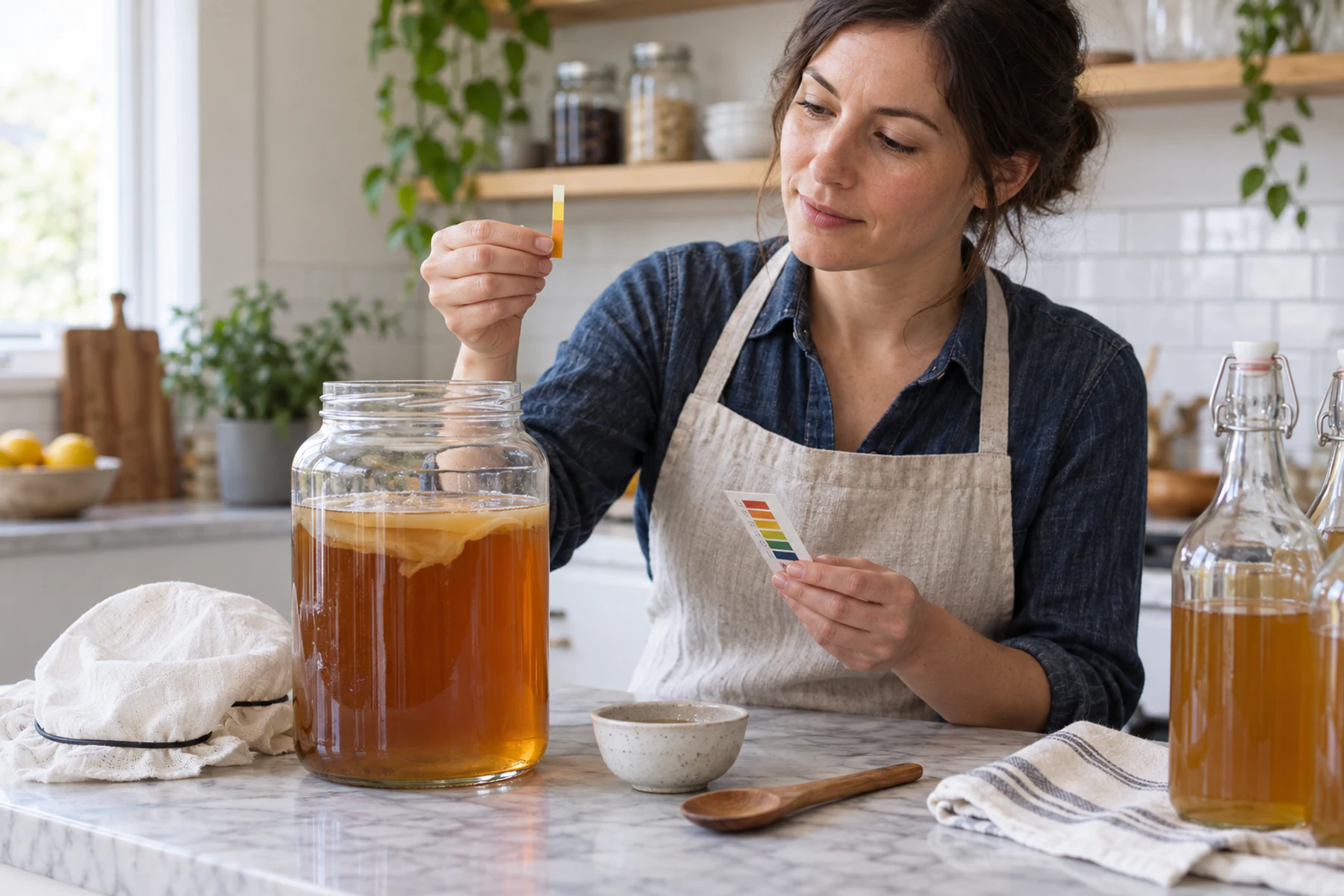
Home fermentation is controlled microbial growth, not kitchen magic. A healthy culture acidifies sweetened tea and can suppress many unwanted organisms, but safety depends on clean equipment, a reliable starter, enough acidity, suitable containers, and temperature and time. The biggest mistake is trusting appearance or folklore while skipping measurable controls. A simple written batch record and food-safe pH method make the process easier to repeat and safer to troubleshoot.
Build a clean process
Wash hands, clean and sanitize equipment appropriately, use potable water, and protect the vessel with a breathable cover that excludes insects. Soap or sanitizer residues should not remain in the drink. Keep raw foods, pets, soil, and dirty dishcloths away from the fermentation area.
For build a clean process, document the setting, timing, and response before changing more than one variable. That record keeps the decision about home brewed kombucha safety tied to something observable and makes it easier to separate a useful adjustment from a coincidence or short-lived impression.
Use a dependable starter
A mature, acidic starter liquid is more important than the cellulose mat often called the SCOBY. Starting with too little acidified liquid leaves sweet tea at a pH where unwanted organisms have a better opportunity to grow. Follow a validated recipe rather than repeatedly stretching a weak culture.
The limit matters as much as the finding. Pennsylvania guidance for brewing and bottling kombucha supports the general boundary, but it does not turn use a dependable starter into a universal rule. Dose, duration, baseline risk, local conditions, and the available alternatives can change what a reasonable next step looks like.
Measure pH correctly
Use fresh narrow-range strips or a calibrated food-safe meter, sample cleanly, and record the result. Guidance commonly uses a final pH range that is acidic enough for safety but not excessively acidic for consumption. pH is one control, not proof that every contaminant or toxin is absent.
A practical record for measure ph correctly should be brief: what was used or observed, when it happened, what changed, and whether daily function or safety improved. That is more informative at follow-up than a general feeling that home brewed kombucha safety was healthy, advanced, natural, or disappointing.
Choose the vessel carefully
Food-grade glass is easy to inspect. Some ceramic glazes and metal vessels can leach or react with acid. Cracks, chips, and hard-to-clean spigots harbor residue. The primary fermentation needs gas exchange; a sealed vessel during active fermentation can build dangerous pressure.
If choose the vessel carefully still leaves uncertainty, choose a reversible next step and set a review point. Avoid stacking several new changes at once. That approach protects the option of professional assessment and prevents an open question about home brewed kombucha safety from becoming an indefinite commitment.
Understand second fermentation
Adding fruit or sugar before sealing can restart vigorous fermentation. Use pressure-rated bottles, leave appropriate headspace, control time and temperature, refrigerate promptly, and open carefully. Alcohol can rise unpredictably, which matters for children, pregnancy, medicines, liver disease, recovery from alcohol use disorder, and driving.
Claims about understand second fermentation often highlight a mechanism while hiding the comparator. Ask what would happen with no purchase, a simpler behavior change, or ordinary care. The best next move for home brewed kombucha safety may be consistency, assessment, or follow-up rather than a featured product.
Know normal versus mold
A new pale cellulose layer, yeast strands, and sediment can be normal. Dry, fuzzy, raised patches in blue, green, black, or white suggest mold. Do not scrape the surface and save the rest; discard the liquid and culture, then clean the equipment before starting again.
Individual variation in know normal versus mold is real, but it cannot validate every marketing claim. Personalization starts with history, constraints, goals, and monitored outcomes. It does not start with a seller treating normal uncertainty about home brewed kombucha safety as proof that a premium test, device, or subscription is necessary.
A comparison that prevents the common mistake
| Option or signal | What it can tell you | What it cannot settle |
|---|---|---|
| Smell and taste | Can reveal obvious spoilage or over-acidity | Cannot prove microbiological safety |
| pH strip | Inexpensive check within a useful range | Color reading and storage affect accuracy |
| Calibrated pH meter | More precise and recordable | Needs calibration, cleaning, and correct probe care |
| Commercial bottle | Produced under controlled food rules | Still contains acid, sugar, possible alcohol, and pressure |
The rows are not a ranking. They separate what each option measures or provides from the larger conclusion people often attach to it. For home brewed kombucha safety, a tool is useful only when its result is reliable enough and connected to an action that improves safety, symptoms, function, or a defined clinical outcome.
Claims that sound simple but are not
“Fermentation kills everything harmful.”
Acidification reduces risks but does not excuse poor ingredients, hygiene, or mold. For home brewed kombucha safety, test that claim against this boundary: Measure acidity with a suitable method rather than guessing by taste. Decide beforehand what result would justify continuing and what warning sign would end the experiment.
“The SCOBY alone makes a safe batch.”
Adequate acidic starter liquid and process controls are essential. For home brewed kombucha safety, test that claim against this boundary: When mold or contamination is suspected, discard the whole batch and culture. Decide beforehand what result would justify continuing and what warning sign would end the experiment.
“More sour is always healthier.”
Excessively acidic drinks can damage teeth and irritate the gastrointestinal tract. For home brewed kombucha safety, test that claim against this boundary: When mold or contamination is suspected, discard the whole batch and culture. Decide beforehand what result would justify continuing and what warning sign would end the experiment.
“Homemade kombucha is alcohol-free.”
Alcohol content varies and may increase in a sealed second fermentation. For home brewed kombucha safety, test that claim against this boundary: Bottling adds pressure and can increase alcohol, so refrigeration and handling matter. Decide beforehand what result would justify continuing and what warning sign would end the experiment.
A six-step decision plan
- 1. Use a validated recipe and potable water. Keep the first attempt small enough to review before adding another change.
- 2. Clean equipment and choose a food-grade vessel. Record what happened in ordinary language rather than relying on a proprietary score.
- 3. Add adequate mature starter liquid. Pause here if a warning sign appears or the basic assumption no longer fits.
- 4. Measure and record pH with a suitable tool. Do not let money already spent become a reason to continue an ineffective plan.
- 5. Control bottle pressure, time, temperature, and refrigeration. Include the schedule, people, and resources that determine whether this is realistic.
- 6. Discard the entire batch when contamination is uncertain. At review, choose explicitly to continue, modify, stop, or investigate further.
How to judge whether the plan is working
For home brewed kombucha safety, useful outcomes follow the article’s actual decision points: Start with a reliable culture and enough mature starter liquid. Use food-grade equipment and avoid reactive or lead-glazed vessels. Measure acidity with a suitable method rather than guessing by taste. Choose a date to compare symptoms, function, cost, burden, and adverse effects. A short-term signal can be genuine without proving a durable benefit. If the target is unchanged, revisit build a clean process and use a dependable starter before increasing intensity or expense.
The safety boundary is equally concrete: Discard kombucha with fuzzy or colored surface growth, a rotten odor, a damaged container, or uncertain contamination; tasting is not a safety test. Severe vomiting, confusion, trouble breathing, jaundice, or illness after drinking a home ferment needs medical advice. Keep any relevant packaging, lot details, readings, or instructions. Tell clinicians about the exact supplement, device, exposure, or self-directed protocol rather than using only a category name, because formulation and use can change the assessment.
Questions worth taking to an appointment
- How should I use a validated recipe and potable water, and how will we know it helped?
- What could prevent me from completing the step “clean equipment and choose a food-grade vessel”?
- Which finding would change the plan to add adequate mature starter liquid?
- What is the safest practical way to measure and record ph with a suitable tool?
- What lower-burden alternatives are there to the step “control bottle pressure, time, temperature, and refrigeration”?
- When should I stop or revise the plan to discard the entire batch when contamination is uncertain?
Bring a short record organized around build a clean process, use a dependable starter, measure ph correctly. Include the actual product, device, report, or schedule when relevant. The purpose is to turn a broad concern about home brewed kombucha safety into a decision with an explanation, alternatives, monitoring, and a review point.
Sources and evidence scope
This guide uses regulatory, public-health, clinical-guideline, and peer-reviewed sources relevant to home brewed kombucha safety. It does not turn a population average into an individual diagnosis or guarantee. Evidence and links were checked on 2026-09-17.