
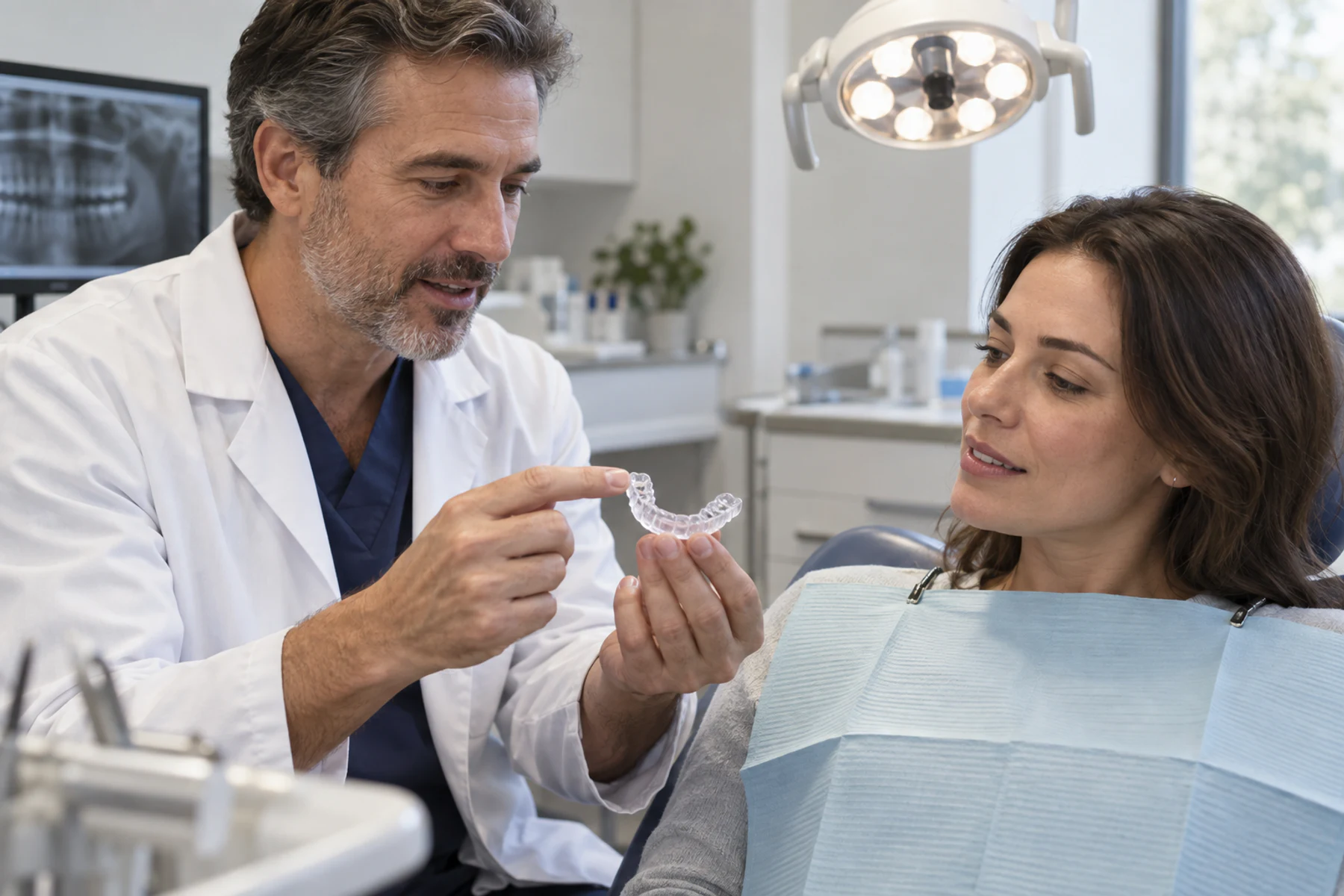
A night guard can separate teeth and reduce wear, but it does not necessarily switch off the brain and muscle activity of sleep bruxism. That distinction explains why some people protect enamel yet still wake with jaw fatigue, and why an appliance that fits poorly can create new discomfort. The useful plan begins with evidence of damage or symptoms, checks contributors such as sleep apnea and medicines, and matches the appliance to the actual problem.
What matters most
- Grinding sounds alone do not reveal how much damage is occurring.
- A guard mainly protects teeth and restorations; symptom relief varies.
- Jaw pain can come from muscles, joints, teeth, headache disorders, or other causes.
- A dentist should review an appliance that changes the bite or worsens pain.
- Sleep symptoms and medication changes deserve attention alongside dental care.
How bruxism is recognized
A partner may hear grinding, while a dentist may see unusual wear, fractures, tongue or cheek marks, or damaged restorations. Morning jaw fatigue and headaches can support the history but are not specific. Tooth wear also reflects age, acid erosion, and past behavior, so a single photograph cannot prove active sleep bruxism.
For how bruxism is recognized, document the setting, timing, and response before changing more than one variable. That record keeps the decision about bruxism mouth guard tied to something observable and makes it easier to separate a useful adjustment from a coincidence or short-lived impression.
What an occlusal splint does
A well-designed splint creates a protective surface and distributes contact. It may reduce strain for some people, but trials do not show that every splint cures sleep bruxism. The outcome should be defined: fewer fractures, less morning pain, better function, or protection of an expensive restoration.
The limit matters as much as the finding. NIDCR: temporomandibular disorders supports the general boundary, but it does not turn what an occlusal splint does into a universal rule. Dose, duration, baseline risk, local conditions, and the available alternatives can change what a reasonable next step looks like.
Custom versus over the counter
Custom appliances cost more but allow a dentist to choose material, coverage, and bite contacts, then adjust the fit. Boil-and-bite guards are accessible and may be reasonable for short-term protection, yet bulk, retention, and uneven contact can be problems. Soft guards are not automatically more comfortable or appropriate for every pattern.
A practical record for custom versus over the counter should be brief: what was used or observed, when it happened, what changed, and whether daily function or safety improved. That is more informative at follow-up than a general feeling that bruxism mouth guard was healthy, advanced, natural, or disappointing.
Look beyond stress
Stress can increase clenching, but it is not the only contributor. Bruxism may be associated with arousals during sleep, obstructive sleep apnea, smoking, alcohol, caffeine, and certain psychiatric medicines. Never stop a medicine abruptly; discuss the timing and alternatives with the prescriber and dentist.
If look beyond stress still leaves uncertainty, choose a reversible next step and set a review point. Avoid stacking several new changes at once. That approach protects the option of professional assessment and prevents an open question about bruxism mouth guard from becoming an indefinite commitment.
Daytime clenching is a different target
Awake bruxism often involves sustained tooth contact during concentration or stress. Teeth should usually be apart when not chewing or swallowing. Phone reminders, posture changes, jaw relaxation, and addressing task-related tension can help more than wearing a bulky appliance all day.
Claims about daytime clenching is a different target often highlight a mechanism while hiding the comparator. Ask what would happen with no purchase, a simpler behavior change, or ordinary care. The best next move for bruxism mouth guard may be consistency, assessment, or follow-up rather than a featured product.
Follow-up prevents a small problem becoming larger
A new guard should be checked for pressure points, retention, and stable contacts. Bring it to dental visits. Replace it when cracked, distorted, or no longer fitting after dental work. Persistent pain, locking, limited opening, or one-sided symptoms require reassessment rather than repeated self-adjustment.
Individual variation in follow-up prevents a small problem becoming larger is real, but it cannot validate every marketing claim. Personalization starts with history, constraints, goals, and monitored outcomes. It does not start with a seller treating normal uncertainty about bruxism mouth guard as proof that a premium test, device, or subscription is necessary.
A comparison that prevents the common mistake
| Option or signal | What it can tell you | What it cannot settle |
|---|---|---|
| Custom hard splint | Precise fit, adjustable contacts, durable | Higher cost and requires dental follow-up |
| Boil-and-bite guard | Quick and inexpensive trial | Bulk and uneven fit can reduce comfort |
| Soft guard | May feel gentler initially | Can wear quickly and is not ideal for every bite |
| No appliance | Avoids cost when there is no damage or symptom target | Needs monitoring if wear, fractures, or pain are present |
The rows are not a ranking. They separate what each option measures or provides from the larger conclusion people often attach to it. For bruxism mouth guard, a tool is useful only when its result is reliable enough and connected to an action that improves safety, symptoms, function, or a defined clinical outcome.
Claims that sound simple but are not
“A guard stops the brain from grinding.”
Its most predictable role is mechanical protection, not eliminating all muscle activity. For bruxism mouth guard, test that claim against this boundary: Sleep symptoms and medication changes deserve attention alongside dental care. Decide beforehand what result would justify continuing and what warning sign would end the experiment.
“Morning headache always means bruxism.”
Sleep apnea, migraine, tension-type headache, and other conditions can present similarly. For bruxism mouth guard, test that claim against this boundary: Sleep symptoms and medication changes deserve attention alongside dental care. Decide beforehand what result would justify continuing and what warning sign would end the experiment.
“The thickest guard protects best.”
Design, fit, material, and stable contacts matter more than bulk alone. For bruxism mouth guard, test that claim against this boundary: Sleep symptoms and medication changes deserve attention alongside dental care. Decide beforehand what result would justify continuing and what warning sign would end the experiment.
“Stress reduction makes dental review unnecessary.”
Cracks, wear, and bite changes still need examination. For bruxism mouth guard, test that claim against this boundary: Grinding sounds alone do not reveal how much damage is occurring. Decide beforehand what result would justify continuing and what warning sign would end the experiment.
A six-step decision plan
- 1. Photograph or document fractures and symptoms over time. Keep the first attempt small enough to review before adding another change.
- 2. Ask what damage or symptom the guard is meant to prevent. Record what happened in ordinary language rather than relying on a proprietary score.
- 3. Review sleep, snoring, caffeine, alcohol, smoking, and medicines. Pause here if a warning sign appears or the basic assumption no longer fits.
- 4. Choose an appliance with a fitting and follow-up plan. Do not let money already spent become a reason to continue an ineffective plan.
- 5. Stop and seek review if the bite changes or pain worsens. Include the schedule, people, and resources that determine whether this is realistic.
- 6. Track function and damage, not grinding sounds alone. At review, choose explicitly to continue, modify, stop, or investigate further.
How to judge whether the plan is working
For bruxism mouth guard, useful outcomes follow the article’s actual decision points: Grinding sounds alone do not reveal how much damage is occurring. A guard mainly protects teeth and restorations; symptom relief varies. Jaw pain can come from muscles, joints, teeth, headache disorders, or other causes. Choose a date to compare symptoms, function, cost, burden, and adverse effects. A short-term signal can be genuine without proving a durable benefit. If the target is unchanged, revisit how bruxism is recognized and what an occlusal splint does before increasing intensity or expense.
The safety boundary is equally concrete: Sudden facial weakness, severe swelling, fever with dental pain, inability to open the mouth, a traumatic bite change, or chest pain felt in the jaw needs urgent assessment. A guard is not the right response to an infection, injury, or neurological emergency. Keep any relevant packaging, lot details, readings, or instructions. Tell clinicians about the exact supplement, device, exposure, or self-directed protocol rather than using only a category name, because formulation and use can change the assessment.
Questions worth taking to an appointment
- How should I photograph or document fractures and symptoms over time, and how will we know it helped?
- What could prevent me from completing the step “ask what damage or symptom the guard is meant to prevent”?
- Which finding would change the plan to review sleep, snoring, caffeine, alcohol, smoking, and medicines?
- What is the safest practical way to choose an appliance with a fitting and follow-up plan?
- What lower-burden alternatives are there to the step “stop and seek review if the bite changes or pain worsens”?
- When should I stop or revise the plan to track function and damage, not grinding sounds alone?
Bring a short record organized around how bruxism is recognized, what an occlusal splint does, custom versus over the counter. Include the actual product, device, report, or schedule when relevant. The purpose is to turn a broad concern about bruxism mouth guard into a decision with an explanation, alternatives, monitoring, and a review point.
Sources and evidence scope
This guide uses regulatory, public-health, clinical-guideline, and peer-reviewed sources relevant to bruxism mouth guard. It does not turn a population average into an individual diagnosis or guarantee. Evidence and links were checked on 2026-09-17.