
Snoring, a low overnight oxygen alert, and an online ad for a home sleep test can make the decision feel simple: buy a device and let the number decide. But a useful apnea assessment asks a different question first. What symptoms and risks suggest a breathing disorder, what kind of test is suitable for that person, and what will happen if the result is negative or inconclusive? The answer depends on the patient, not on how many sensors a gadget claims to contain.
Before ordering anything
- List symptoms, not just app scores: snoring, pauses, gasping, sleepiness, and morning headaches.
- Consumer oxygen or snore metrics are not a diagnosis.
- A clinician can select a home study for appropriate uncomplicated adults; others need laboratory testing.
- A negative home result does not always end the investigation.
- Plan who will explain the report and arrange treatment or follow-up.
What obstructive sleep apnea means
Obstructive sleep apnea is a pattern of repeated upper-airway blockage during sleep. Airflow decreases or stops while breathing effort continues. Episodes can disturb oxygen levels and sleep continuity, sometimes without the person remembering each awakening. Loud snoring is common but not universal, and snoring alone does not prove apnea. A bed partner may notice pauses or gasping; someone living alone may notice unrefreshing sleep or daytime sleepiness. The NHLBI diagnosis guide emphasizes a history, examination, and sleep testing rather than a single symptom.
Risk assessment includes body and airway features, blood pressure, age, family history, and relevant medical conditions, but no stereotype reliably excludes a person. It is possible to have apnea without matching the internet’s standard picture. Conversely, fatigue has many causes. The purpose of an assessment is to identify a treatable pattern while avoiding a false label from a noisy measurement.
Three very different devices sold as “sleep tests”
Consumer wearable or phone app
A watch, ring, phone microphone, or under-mattress device may estimate movement, pulse, oxygen trends, or snoring. Its signal processing and validation may differ by model and software version. These devices can prompt a conversation but are not interchangeable with a clinical sleep study. An oxygen trace can miss breathing events that fragment sleep without a dramatic oxygen drop; a noisy trace can also suggest a problem where none is confirmed. Our tracker accuracy guide explains the measurement boundary in more detail.
Home sleep apnea test
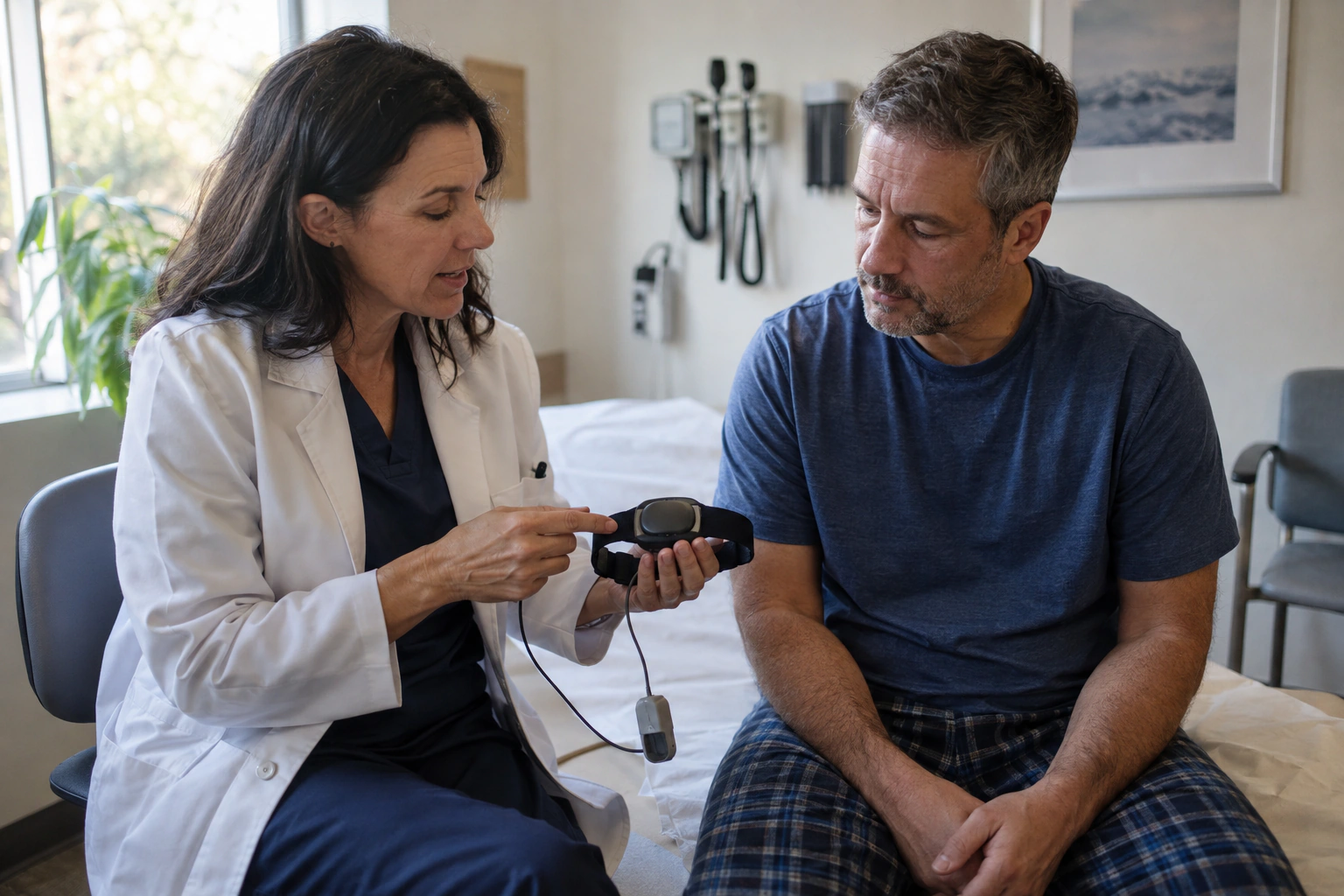
A medical home study generally measures several physiologic signals and is ordered for a specific clinical question. Depending on the device, sensors may record airflow, breathing effort, oxygen saturation, and pulse. It is more convenient and often less expensive than a night in a laboratory, but it also has limitations. It may estimate breathing events against recording time rather than confirmed sleep time, which can understate severity when someone lies awake. Poor sensor contact can make a study technically inadequate.
In-laboratory polysomnography
A laboratory study records additional signals, including brain activity used to identify sleep and wake, and can assess more complex sleep-related breathing and movement questions. It requires a facility, staff, and an unfamiliar sleeping environment, so it is not automatically needed for everyone. It is particularly important when a home test is unsuitable, inconclusive, or negative despite substantial clinical suspicion. The NHLBI sleep-study overview describes what these studies measure and why different tests answer different questions.
Who is a home test for?
The American Academy of Sleep Medicine diagnostic guideline supports home apnea testing in selected uncomplicated adults with signs and symptoms suggesting moderate to severe obstructive sleep apnea. It does not endorse replacing a full evaluation with an app or mailing a device to every tired person. Significant heart or lung disease, suspected hypoventilation, neuromuscular conditions, chronic opioid use, a history of stroke, severe insomnia, or another sleep disorder may change the test choice. The exact decision belongs to a clinician who can see the full history.
Children are a separate case; adult home-test criteria should not be copied into pediatric care. If a person has symptoms of a different disorder—such as unusual limb movements, episodes suggesting seizures, or profound sleepiness not explained by breathing—an apnea-only home study may miss the main issue. The most efficient test is the one that can answer the right question, even if it initially takes more planning.
How to make the result useful
- Document the reason for testing. Note snoring, witnessed pauses, gasping, daytime sleepiness, morning headaches, blood pressure, medicines, alcohol, and usual sleep schedule.
- Clarify the device pathway. Ask who orders the test, who scores and interprets it, and whether a qualified sleep clinician reviews the raw signals when needed.
- Follow setup instructions. Incorrect placement or a disconnected sensor can make the result unreliable. Call the provider if you cannot apply the equipment correctly.
- Ask about adequacy. A number on a PDF does not mean enough good-quality recording was obtained.
- Agree on a negative-result plan. If symptoms remain compelling, ask whether an in-lab study or another evaluation is appropriate.
- Ask what treatment decisions follow. A diagnosis should connect to discussion of options, tolerance, and monitoring, not end with a score.
A useful result is not simply “positive” or “negative.” It includes test quality, what kind of breathing events were counted, whether oxygen changes were observed, and whether the findings fit the symptoms. Home devices cannot measure every relevant sleep feature. If the report conflicts with severe sleepiness, do not treat the conflict as proof that the symptoms are imaginary.
The question people ask most: “What if my test is normal?”
A technically adequate negative home test may make obstructive apnea less likely in some settings, but it does not conclusively rule it out for everyone. The test may have missed events during particular sleep positions or stages, or may have underestimated events because sleep time was not measured directly. If clinical suspicion remains high, the AASM guideline recommends laboratory polysomnography after a negative, inconclusive, or technically inadequate home study. That step is not “extra testing for no reason”; it recognizes the limits of the first measurement.
If further testing still does not explain symptoms, widen the question. Insufficient sleep opportunity, insomnia, restless legs, mood disorders, sedating medicines, circadian misalignment, and other medical conditions can all contribute to fatigue or sleepiness. A clinician can distinguish those pathways better when you provide a short sleep history rather than only a device printout.
Consumer claims to read skeptically
“Medical-grade oxygen means a diagnosis.” Oxygen is one signal. It does not show all airflow, effort, arousals, or sleep stages. The presence of a sensor does not establish diagnostic performance for your circumstance.
“No appointment required.” Convenience is valuable, but someone still needs to judge whether the test is suitable, interpret results, and take responsibility for follow-up. Without those steps, the device may create false reassurance or unnecessary alarm.
“Your sleep score improved, so treatment worked.” Treatment follow-up considers symptoms, adherence, residual breathing events where relevant, side effects, and safety. A consumer sleep score is not a substitute for that review.
“Only people who are overweight need testing.” Weight is one risk factor, not an exclusion criterion. Persistent symptoms deserve attention in people of many body types. Equally, not every snore requires a diagnosis.
A concise appointment script
“I have been snoring for about [time], and [someone has noticed pauses / I wake gasping / I am sleepy during the day]. My typical sleep schedule is [times]. I take [medicines] and drink [amount if relevant]. A watch has shown [observation], but I know it is not diagnostic. Am I a candidate for a home apnea test, or would a laboratory study answer the question better? If the first test is normal, what is the next step?” This script lets the clinician assess both risk and test fit.
Do not wait for an online score to become dramatic before raising serious symptoms. Also do not buy repeated devices in search of certainty. A good diagnostic pathway has a defined question, a test suited to that question, an interpreter, and a follow-up decision. That is what turns a night of data into care.
What a test can and cannot settle about treatment
People sometimes ask for a home test because they want to know whether they will need a CPAP machine. A diagnosis does not automatically dictate one identical treatment for everyone. The clinician considers severity, symptoms, other health conditions, anatomy, preferences, and the availability of follow-up. Treatment may involve positive-airway-pressure therapy, a suitable oral appliance, position-related strategies, weight-related care where appropriate, or another pathway. Do not choose among these solely from a consumer apnea score.
If a prescribed treatment is uncomfortable, report the specific problem instead of abandoning it silently. Mask fit, dryness, pressure tolerance, travel, and sleep position can sometimes be addressed. Follow-up should ask whether symptoms and function improve, whether therapy is actually used, and whether residual events or side effects remain. Equally, do not assume every tired person needs an apnea treatment; an inconclusive test should return you to the diagnostic question. The test is the beginning of a plan, not the finish line.
Sources and evidence scope
Primary clinical sources are NHLBI sleep-apnea diagnosis, NHLBI sleep studies, and the AASM diagnostic-testing guideline. Suitability and interpretation depend on individual history; this article cannot diagnose apnea or decide which study you need. Evidence checked September 2026.