
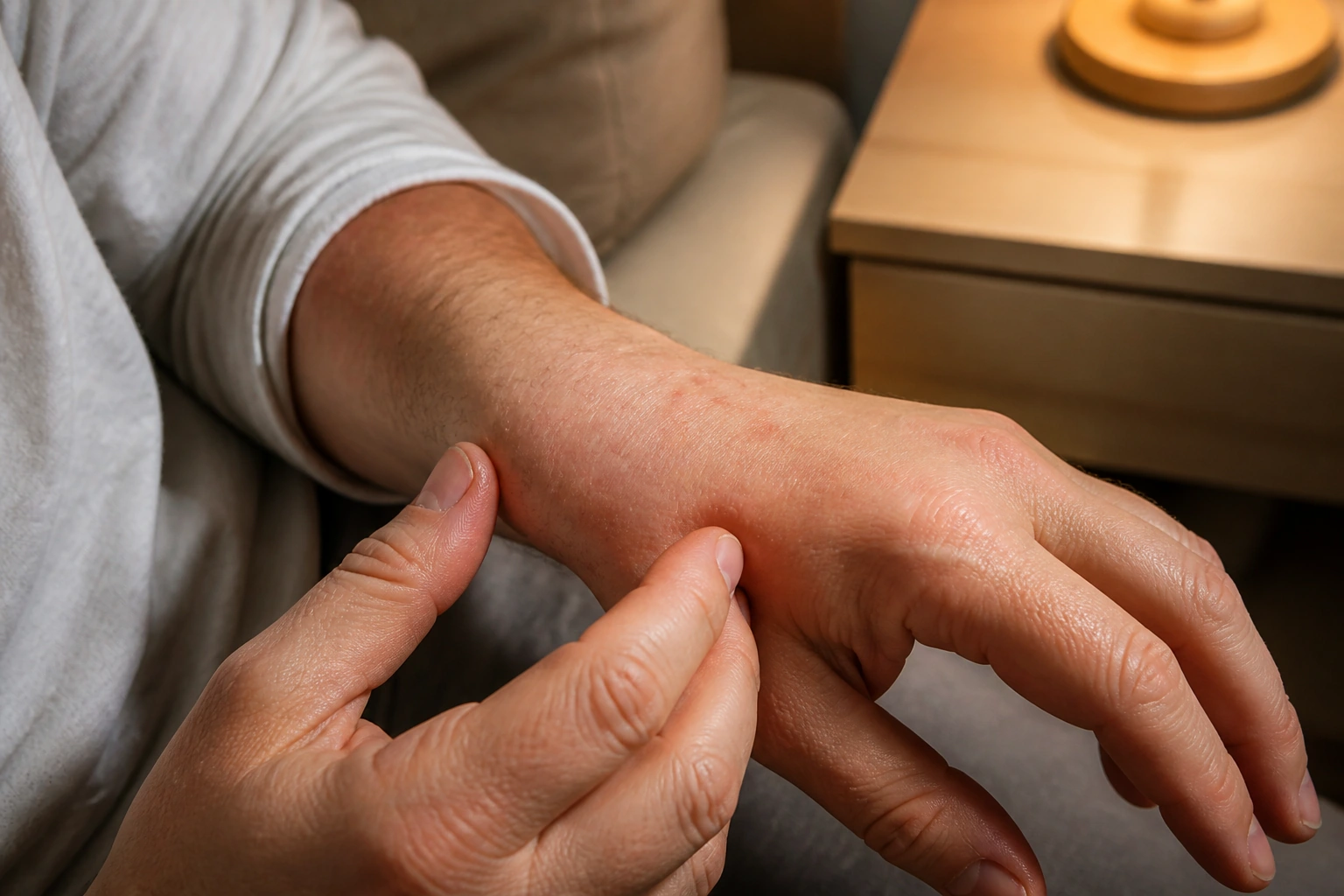
Scabies is a skin infestation caused by the human itch mite. It commonly produces intense night-time itching, small inflamed bumps, and thin burrows at characteristic sites. The mite spreads mainly through prolonged skin-to-skin contact, and symptoms can take weeks to appear. Successful control requires the affected person and close contacts to be treated at the same time.
Key points
- Anyone can get scabies; it is not a sign of poor hygiene.
- First-time symptoms may take four to eight weeks, while the person can still transmit mites.
- Household members, sexual partners, and other close skin contacts usually need synchronized treatment.
- Wash or isolate recently used clothing, bedding, and towels; do not fumigate the home.
- Itch can continue for several weeks after successful treatment, but new burrows or new crops of bumps need review.
What the mite does
The female Sarcoptes scabiei var. hominis mite burrows into the outer layer of human skin and lays eggs. The rash and itch are largely an immune reaction to mites, eggs, and waste rather than the mechanical damage of burrowing.
A healthy person with ordinary scabies may carry only a small number of mites, making them hard to find. In crusted scabies, thousands or millions can be present in thick scales, creating much greater transmission risk.
Human scabies mites do not establish a lasting infestation on pets. Animals can have related mites that cause temporary irritation in people, but treating a pet with a human scabies medicine—or treating a person with a veterinary product—is unsafe.
Typical symptoms and body sites
Intense itching, often worse at night, is the most common symptom. The rash can look like small red, brown, purple, or skin-coloured bumps, scratch marks, eczema, or tiny blisters. Nodules may occur on the genitals, buttocks, breasts, or armpits and can persist after mites are gone.
Burrows are thin, slightly raised, wavy or straight lines a few millimetres long. They may be subtle or obscured by scratching. Common sites include between the fingers, wrists, elbows, armpits, waist, buttocks, shoulder blades, nipples, and penis.
Infants and young children can have lesions on the scalp, face, neck, palms, and soles, areas usually spared in healthy adults. Older adults, immunocompromised people, and people unable to scratch may also have atypical distribution or less obvious itch.
When symptoms appear
During a first infestation, symptoms typically begin four to eight weeks after exposure because the immune response takes time. The person can spread mites before itch begins. After previous scabies, symptoms may appear within days because the immune system is already sensitized.
This delay explains why treating only the visibly itchy person often fails. A household contact may feel completely well, remain infested, and later pass mites back.
How scabies spreads
The main route is direct, prolonged skin-to-skin contact, such as sharing a bed, caregiving, holding a child, or sexual contact. A brief handshake or hug is less likely to transmit ordinary scabies. Crowding and hands-on care increase opportunity, which is why outbreaks occur in households, care homes, hospitals, shelters, detention facilities, dormitories, and childcare settings.
Clothing, bedding, and towels are a less common route in ordinary scabies but more important in crusted scabies because the mite burden is high. Mites usually survive only two to three days away from human skin.
Scabies is not exclusively sexually transmitted. After sexual exposure, a clinician may offer testing for other STIs based on history, but a scabies diagnosis does not prove how or from whom the infestation was acquired.
How scabies is diagnosed
A clinician combines the distribution, night itch, burrows, contact history, and whether close contacts are affected. Dermoscopy can visualize a mite at the end of a burrow. Skin scraping or adhesive sampling may identify mites, eggs, or faecal pellets under a microscope.
A negative scraping does not exclude ordinary scabies because so few mites may be present. Treatment may be based on a convincing clinical pattern and exposure. Conversely, generalized itch alone is not enough: eczema, contact allergy, hives, bedbugs, body lice, folliculitis, drug reactions, kidney or liver disease, and other causes can mimic it.
Treatment treats people, not just visible spots
Scabicides are prescription medicines that kill mites; some do not reliably kill every egg, so the regimen may include a planned repeat. Options include topical whole-body treatment and an oral medicine for selected people. Choice depends on age, weight, pregnancy, breastfeeding, immune status, skin condition, interactions, availability, and whether scabies is crusted.
This page deliberately does not provide a product, concentration, dose, application time, or repeat interval. Small differences matter. The prescribing instructions specify which body areas to cover, how long to leave treatment on, whether to reapply after handwashing, and when to repeat.
Many failures are application failures: treating only itchy spots, missing between fingers and toes, under nails, the groin, buttocks, navel, or soles, washing hands without reapplying, or not treating contacts. Infants and selected older or immunocompromised people may need scalp and face treatment, but products must be kept away from eyes and mouth and used exactly as instructed.
Who should be treated at the same time?
CDC advises simultaneous treatment for household members and close contacts who had direct skin contact or shared a bed, towels, or clothing. Sexual partners and close caregiving contacts are included. CDC suggests notifying people with direct skin-to-skin contact during the previous two months so they can seek treatment.
The exact contact definition and look-back period can differ during an institutional outbreak. Do not stagger treatment across a household if synchronized access can be arranged. One untreated contact can restart the cycle.
Contacts should not share the diagnosed person’s prescription. They need an age-, pregnancy-, and health-appropriate plan from a clinician or pharmacist under local rules.
A practical home plan
- Coordinate: choose the same treatment window for the affected person and contacts.
- Collect: identify clothing, towels, and bedding used next to skin during the three days before treatment.
- Heat: machine-wash hot and dry on a hot cycle, or use dry cleaning where suitable. CDC notes that exposure above 50°C (122°F) for 10 minutes kills mites and eggs.
- Bag: seal items that cannot be washed or dry-cleaned for at least 72 hours and up to one week according to local guidance.
- Clean normally: vacuum or sweep living spaces, with extra attention in crusted scabies.
- Avoid contact: pause close skin contact and sharing of fabrics until the treatment interval is complete.
Do not spray mattresses or furniture with pesticide, use a fogger, bleach the skin, or discard beds and sofas. Fumigation is unnecessary and can poison people or pets. Ordinary cleaning plus fabric management and synchronized treatment is the evidence-based approach.
Itching after treatment
Itch can persist or even feel worse for one to two weeks because the immune reaction takes time to settle. CDC notes it may continue for several weeks. Existing nodules and eczema can also remain. Persistent itch alone on the next day does not prove that treatment failed.
Ask about soothing skin care or an anti-itch treatment that is safe for age, pregnancy, and other conditions. Keep nails short and cover damaged areas to reduce scratching and bacterial infection.
Review is needed when new burrows appear, new pimple-like lesions continue to emerge, untreated contacts develop symptoms, instructions were not completed, or itch remains significant beyond the expected follow-up window. The clinician will distinguish post-scabetic itch, dermatitis from the treatment, reinfestation, misdiagnosis, and resistance or inadequate treatment.
Crusted scabies
Crusted scabies can produce thick scale and crusts on the hands, feet, scalp, or body, sometimes with surprisingly little itch. It is more likely with immune suppression, frailty, neurologic impairment, malnutrition, or inability to scratch, but it can occur outside those groups.
Management requires urgent specialist treatment, usually combining oral and topical approaches, repeated environmental measures, protective equipment, and public-health coordination. A single ordinary treatment is not sufficient. Staff and visitors may need assessment even after shorter contact because shed scales contain many mites.
School, work, and institutional settings
CDC says children and adults can usually return the day after treatment. UKHSA specifies at least 24 hours after the first treatment for younger children and those unable to follow precautions. Local school, healthcare, food-service, and care-home policies may differ.
Tell the relevant occupational-health or public-health team about suspected crusted scabies or multiple linked cases. Quietly treating one person while an outbreak continues delays control and increases stigma.
Questions people often ask
Can clean people get scabies?
Yes. Soap and ordinary hygiene do not prevent mites from spreading through prolonged skin contact.
Can scabies live in a mattress for months?
No. Ordinary scabies mites generally survive only two to three days away from skin. Bagging or heat-treating relevant fabrics is sufficient; mattress disposal is unnecessary.
Does itching after treatment mean mites are alive?
Not necessarily. Immune inflammation can persist for weeks. New burrows or new lesions are more concerning and should be reviewed.
Should only people who itch be treated?
No. Close contacts can transmit scabies before symptoms appear, so simultaneous contact treatment is central to control.
Sources and evidence scope
This guide was researched using CDC information on scabies and clinical care, the WHO scabies fact sheet, 2025 UKHSA management advice, and current UKHSA childcare guidance. Sources were checked on August 21, 2026. Prescriptions, contact definitions, exclusion rules, and outbreak procedures vary by country.