
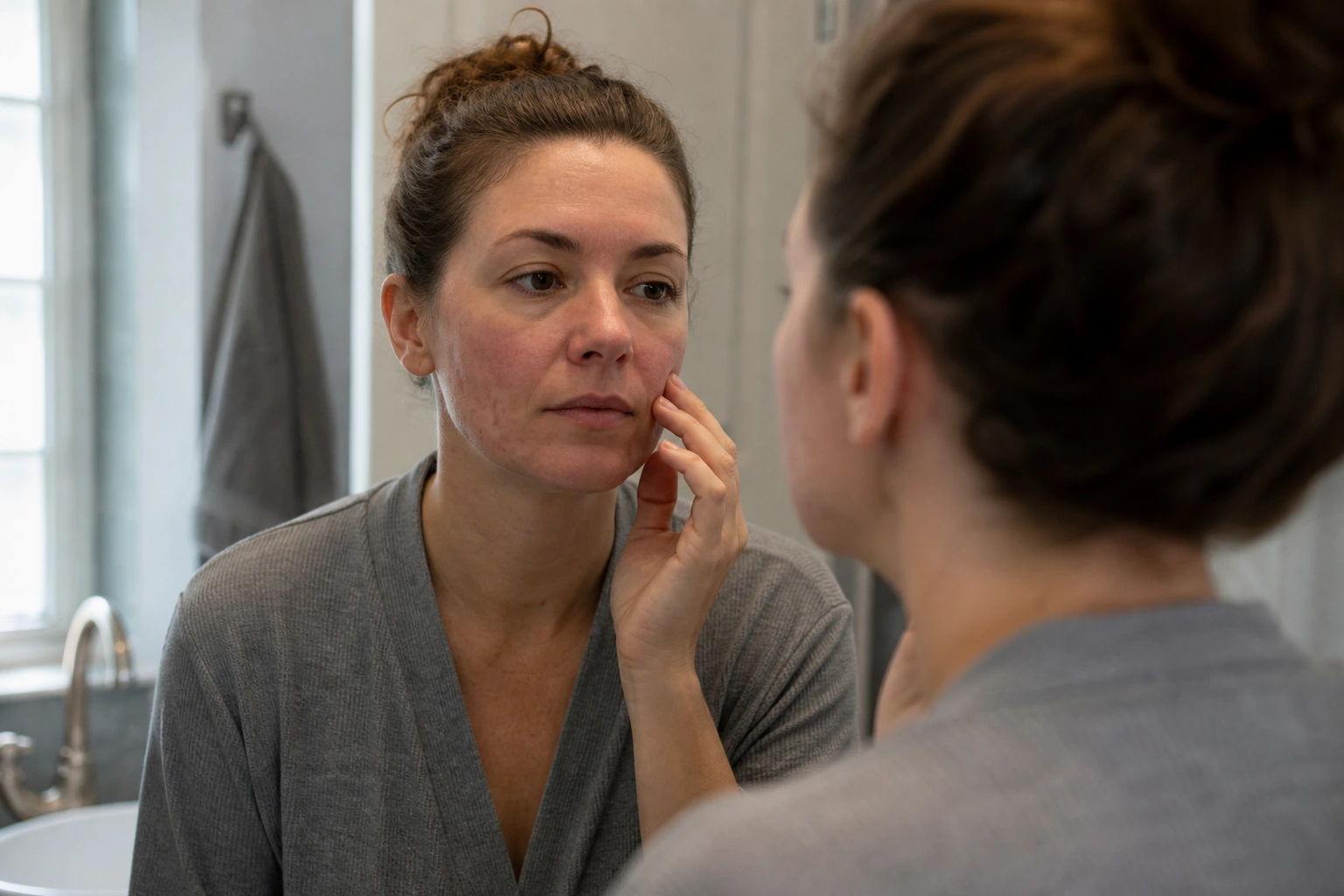
Acne and rosacea can both cause facial bumps and pustules, and a person can have both. Acne is defined by blocked follicles—blackheads and whiteheads—plus inflamed spots. Rosacea more often produces central facial flushing, persistent colour change, visible vessels, burning or stinging, and acne-like bumps without comedones. The distinction matters because an aggressive acne routine can irritate rosacea.
Key points
- Blackheads and whiteheads strongly support acne; they are not typical of rosacea.
- Flushing, heat, stinging, visible small vessels, and eye symptoms point toward rosacea.
- Acne often affects the face, chest, shoulders, and back; rosacea usually centres on the face.
- Gentle cleansing, moisturizer, and broad-spectrum sun protection support both conditions.
- Early review matters for painful nodules, scarring, eye disease, skin thickening, or major psychological distress.
What acne looks and feels like
Acne develops when follicles become blocked by oil and skin cells and inflammation follows. Open comedones appear as blackheads; the dark colour is oxidized material, not dirt. Closed comedones are white or skin-coloured bumps. Inflamed papules, pustules, deeper nodules, and cyst-like lesions can develop.
Acne commonly affects the forehead, cheeks, jawline, chest, shoulders, and back. Skin may feel oily, but acne also occurs in dry or sensitive skin. Picking and squeezing increase inflammation, dark marks, and scarring.
Post-inflammatory hyperpigmentation can be more prominent and persistent in deeper skin tones. It is a consequence of inflammation, not a different form of poor hygiene. Treating active acne early and minimizing irritation helps reduce new marks.
What rosacea looks and feels like
Rosacea usually affects the central face: cheeks, nose, chin, and forehead. Features include episodes of flushing, persistent colour change, visible small vessels, swelling, burning or stinging, dryness, and papules or pustules. Blackheads and whiteheads are absent unless acne coexists.
In deeper skin tones, redness may appear dusky, purple, brown, or subtle and visible vessels can be harder to see. Warmth, stinging, swelling, sensitivity to products, and a history of flushing may be more useful clues. Rosacea occurs in every skin type; under-recognition is a diagnostic problem, not evidence that the condition is rare in darker skin.
Over time, some people develop firm thickened skin, most visibly on the nose but potentially elsewhere. This is not caused by alcohol. Alcohol can trigger flushing for some people, but rosacea is a chronic inflammatory and vascular condition rather than a marker of drinking.
Eye involvement
Ocular rosacea can cause red or swollen eyelids, crusting at the lashes, bloodshot eyes, dryness, tearing, burning, a gritty sensation, recurrent styes, or light sensitivity. Eye symptoms can begin before obvious facial disease.
Mild eyelid disease may be managed with clinician-directed warm compresses, lid hygiene, lubricating drops, or prescription treatment. Do not put a skin antibiotic, essential oil, or face product in the eye. Pain, light sensitivity, or visual change needs urgent ophthalmic assessment because corneal inflammation can threaten vision.
A quick comparison
| Feature | Acne | Rosacea |
|---|---|---|
| Comedones | Blackheads and whiteheads are characteristic | Not typical |
| Distribution | Face, chest, shoulders, back | Usually central face; eyes may be involved |
| Flushing | Not a defining feature | Common, often triggered |
| Sensation | Tenderness with inflamed lesions | Burning, stinging, heat, sensitivity |
| Visible vessels | Not typical | Common but may be subtle in deeper skin |
| Scarring or thickening | Indented or raised scars can occur | Skin thickening can occur in longstanding disease |
Conditions that can mimic either
Perioral dermatitis, seborrheic dermatitis, folliculitis, keratosis pilaris, steroid-induced eruptions, contact dermatitis, lupus, and medication reactions can resemble acne or rosacea. Sudden acne-like lesions after a new medicine or supplement need a medication review.
Itchy uniform bumps after sweating may be folliculitis. Scale in the eyebrows and sides of the nose suggests seborrheic dermatitis. A rash around the mouth or eyes with a clear border next to the lips can fit periorificial dermatitis. A clinician may examine the skin and eyes, review products and medicines, and occasionally order a test or biopsy when the pattern is atypical.
A skin-care foundation for both
Cleanse gently twice daily and after heavy sweating with a mild, non-alkaline cleanser. Use fingertips rather than a scrub, brush, or rough cloth. Pat dry and apply a non-comedogenic, fragrance-free moisturizer if needed.
Use broad-spectrum sun protection daily. Sun can worsen rosacea and post-inflammatory pigmentation. A tinted mineral sunscreen may reduce the visible contrast of redness or dark marks, but comfort and consistent use matter more than marketing language.
Introduce one active product at a time and allow the barrier to recover after irritation. Burning is not proof that a product is “working.” Essential oils, harsh alcohol toners, abrasive scrubs, and at-home peels can worsen inflammation. Do not use a potent steroid cream on facial redness unless a clinician has diagnosed and prescribed for a specific condition; steroids can provoke acne-like eruptions and rosacea.
Acne treatment pathways
NICE and the American Academy of Dermatology support several topical classes that unclog follicles, reduce inflammation, or reduce acne-causing bacteria. Combination treatment often works better because it targets more than one mechanism. Results develop over weeks; NICE recommends reviewing a first-line course at about 12 weeks.
Topical retinoids can irritate initially and are not used during pregnancy. Benzoyl peroxide can dry skin and bleach fabric. Azelaic acid may help acne and post-inflammatory pigmentation and is also used in rosacea. A clinician or pharmacist can match the option and introduction schedule to skin sensitivity and pregnancy plans.
Moderate or severe inflammatory acne may require an oral antibiotic combined with a non-antibiotic topical treatment. NICE advises against topical antibiotic alone, oral antibiotic alone, or using both topical and oral antibiotics together. Courses should be limited and reviewed to reduce resistance.
Hormonal options can help selected people with cyclical or jawline acne, but clot risk, pregnancy, blood pressure, migraine, and other conditions matter. Isotretinoin is a specialist treatment for severe acne or acne at high risk of permanent scarring after adequate standard therapy. It causes severe fetal harm and requires strict pregnancy-prevention measures where pregnancy is possible, plus monitoring of mental health, sexual side effects, and other adverse effects under current regulation.
Rosacea treatment pathways
Rosacea treatment is matched to the feature causing the most trouble. Gentle care and sunscreen are universal. A trigger diary can identify individual patterns such as heat, sun, alcohol, spicy food, hot drinks, stress, exercise, or irritating products. The goal is not to avoid every normal activity; modify triggers that are consistent and worth the trade-off.
Prescription topical treatments can target inflammatory bumps, mites or inflammation, or persistent facial colour. Some acne ingredients are also used in rosacea, but vehicle, strength, and frequency affect tolerability. Starting several actives together makes it difficult to identify the irritant.
An oral anti-inflammatory antibiotic may be used for more inflammatory disease or ocular involvement. This is not the same as repeatedly treating rosacea as a skin infection. Duration and antimicrobial stewardship should be reviewed.
Laser, intense pulsed light, and vascular procedures can reduce visible vessels or persistent colour. Results and risk depend on device, settings, skin tone, and operator expertise. Burns, pigment change, and scars can occur; choose a clinician experienced with the relevant skin type. Thickened skin may need procedural or surgical care.
When to see a dermatologist
Seek early review for painful nodules, scarring, persistent dark marks, diagnostic uncertainty, treatment failure after an adequate course, or acne beginning very young or with other signs of hormonal change. Facial redness with eye symptoms, progressive skin thickening, or repeated flushing that affects daily life also warrants review.
NICE emphasizes acne’s psychological impact. Distress is not proportional to lesion count. Avoiding school, work, photographs, or relationships, compulsive skin picking, or symptoms of depression deserve support alongside skin treatment. Suicidal thoughts require urgent crisis or emergency help.
Questions people often ask
Can acne and rosacea occur together?
Yes. Comedones suggest acne even when flushing and visible vessels indicate rosacea. Treatment needs to control acne without overwhelming sensitive rosacea-prone skin.
Does diet cause acne or rosacea?
No single food explains either condition. Some people identify rosacea triggers, and limited acne research suggests dietary patterns may influence some cases, but restrictive diets are not a replacement for treatment.
Should I scrub blackheads away?
No. A blackhead is a blocked follicle, not embedded dirt. Scrubbing increases irritation and can worsen both acne and rosacea.
Will rosacea go away permanently?
Rosacea is usually long-term and fluctuating. Treatment can control features and reduce flares, but ongoing gentle care and maintenance may be needed.
Sources and evidence scope
This guide was researched using NICE guideline NG198 (updated April 2026), the American Academy of Dermatology acne guideline and guidance on rosacea diagnosis and treatment and symptoms, and British Association of Dermatologists leaflets on acne and rosacea. Sources were checked on August 21, 2026. Medicine licensing, isotretinoin safeguards, product availability, and referral pathways vary by country.