
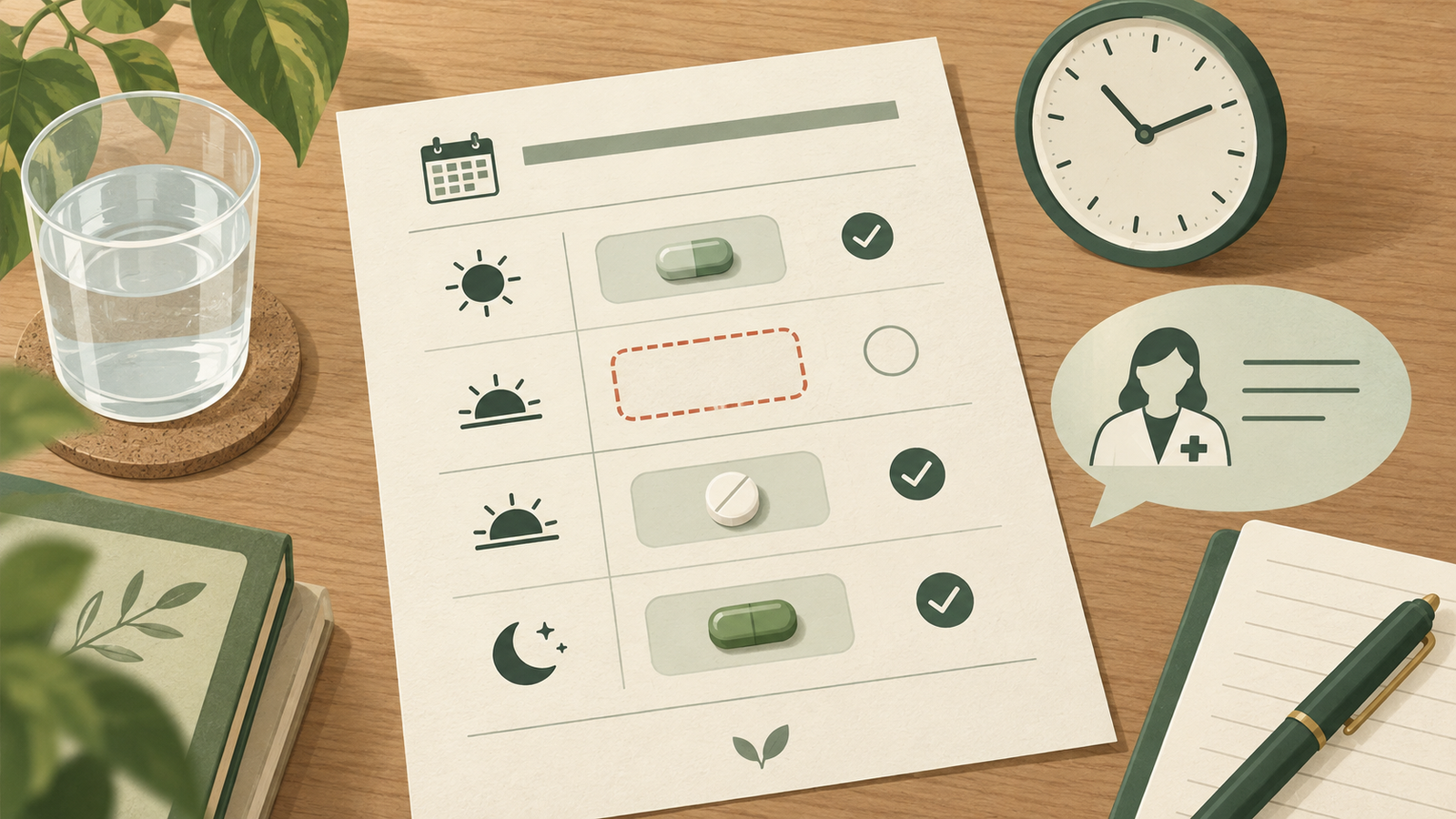
A forgotten tablet can trigger an immediate question: take it now, skip it, or double the next dose? There is no one schedule that fits every medicine. The safest answer is usually in the patient leaflet or a pharmacist’s advice—not a guess based on how many hours have passed.
Missing a dose happens for ordinary reasons: a disrupted morning, a late refill, travel, a change in routine, or uncertainty about whether a dose was already taken. The difficult part is that “missed dose” is not one medical situation. A medicine taken once a day may have different instructions from one taken several times a day. A tablet, liquid, inhaler, injection, and extended-release product can each have different directions. Even the same ingredient may come in different formulations.
Patient guidance from MedlinePlus says the right action depends on the medicine and advises people not to double a dose as a general catch-up strategy. NHS Specialist Pharmacy Service likewise cautions that decisions depend on the medicine and its schedule, and notes that some high-risk drugs need particular advice. These are useful guardrails, not a replacement for the instructions for your own prescription.
A safer decision path
- Pause before taking anything extra. If you are unsure whether you took the dose, avoid guessing or taking another “just in case.” A second dose may create a different risk from a late dose.
- Identify the exact medicine. Check the name, strength, formulation, and prescribed schedule on the label. “The blue pill” or “my morning medicine” is not specific enough when asking for advice.
- Read the missed-dose section. Use the leaflet supplied with the medicine or the official patient information for the exact product. Instructions may differ by formulation and indication.
- Check the time until the next dose. Some leaflets describe what to do if there is still a long interval; others specify a cut-off or a different schedule. Do not invent a universal “halfway point.”
- Call a pharmacist or prescriber if the instructions are missing or confusing. Tell them the medicine, dose, usual schedule, when the dose was due, and when the next one is scheduled.
Why advice online can seem contradictory
You may read one leaflet that says to take a missed dose when remembered, then skip it if the next dose is near. Another medicine may say to skip the missed dose altogether. Some drug-specific instructions permit a particular catch-up dose under tightly defined circumstances. Those differences are not necessarily errors: the timing, benefit, and risk depend on the medicine and treatment plan.
For example, MedlinePlus’s patient information for rivaroxaban describes different missed-dose instructions for different dosing schedules and treatment situations. That is exactly why a broad article should not tell every reader to “take it as soon as you remember.” The drug name, the reason it is prescribed, and the regimen all matter. Use the directions written for your own medicine, not an example copied from another person’s prescription.
| Your situation | What to do first | Why a generic answer may fail |
|---|---|---|
| You missed one scheduled dose | Read the exact product’s missed-dose instructions. | “Take it now” and “skip it” can both be correct for different medicines. |
| You are not sure whether you already took it | Check a dose log, organizer, or caregiver record before taking more. | A duplicate dose can be more harmful than a delayed one. |
| You missed more than one dose | Contact a pharmacist or prescriber for a restart plan. | Some medicines require a different schedule after repeated missed doses. |
| The medicine is time-sensitive or high-risk | Seek same-day advice from the prescriber, pharmacist, or clinic that manages it. | Delays can matter more for some treatments, while catch-up dosing can also be unsafe. |
| You may have taken an extra dose | Contact Poison Control or local urgent medical advice promptly. | The risk depends on the medicine, dose, timing, and person; do not wait for symptoms. |
Medicines where a missed dose deserves a quicker call
Ask promptly if the medicine is part of a treatment where timing is central, or if the leaflet warns against interruptions. Examples can include insulin and other diabetes medicines, seizure medicines, anticoagulants, transplant medicines, cancer treatment, some heart-rhythm medicines, and certain steroid or hormone regimens. This list is not a complete ranking and does not mean every missed dose is an emergency. It means that a pharmacist or specialist who knows the product should guide the next step rather than a generic search result.
Also seek specific advice if the medicine is for a child, the person is pregnant, has significant kidney or liver disease, takes several interacting medicines, or has symptoms that are new or severe. A child’s dose may depend on weight and formulation, and household measuring spoons are not a reliable substitute for the supplied dosing device.
If you might have taken a double dose
Do not wait for symptoms to decide whether it matters. Poison Control explains that the risk of a double dose varies by medication, amount, timing, age, and other circumstances. In the United States, call Poison Control at 1-800-222-1222 or use webPOISONCONTROL for guidance. Both are available around the clock. Outside the U.S., use your local poison center or emergency service. If the person is unconscious, having a seizure, struggling to breathe, or difficult to wake, call emergency services immediately.
When you call, have the package nearby and be ready to say the exact medicine and strength, how much may have been taken, when it happened, the person’s age and approximate weight, and any symptoms. Do not induce vomiting or use home remedies unless a qualified poison expert tells you to.
Make the next dose easier to manage
A simple routine can reduce both forgotten and duplicate doses. MedlinePlus suggests keeping medicines organized and checking with a clinician or pharmacist when missed-dose instructions are uncertain. Choose a tool that fits the prescription and your daily life:
- Use a written or phone-based dose log, marking a dose immediately after it is taken.
- Set a reminder that identifies the medicine without displaying private health information on a shared lock screen.
- Keep the medication in its original packaging when the label or safety directions need to stay visible.
- If using a pill organizer, check whether the medicine can safely be removed from its original container; some products need special storage.
- For a household with multiple caregivers, assign who gives each dose and record it in one shared place.
- Before travel, ask the pharmacy how to handle time-zone changes, missed doses, storage, and refill timing.
Do not reorganize medicines into an organizer if you are unsure about storage requirements, moisture sensitivity, or which products should remain in blister packaging. Your pharmacist can help build a routine that works without changing the prescribed regimen.
A short script for calling the pharmacy
“I take [medicine and strength] at [usual time or schedule]. I missed the dose that was due at [time], and my next dose is due at [time]. The package says [read the relevant instruction]. What should I do with this dose, and when should I take the next one?”
If you take more than one medicine, mention other prescriptions and over-the-counter products when asked. If the pharmacist cannot give a definitive answer because the prescription is managed by a specialist, ask who can advise you and how quickly you should contact them.
The bottom line
One missed dose does not automatically mean you should take it immediately, skip it, or double the next one. The right action depends on the exact product and schedule. Read the patient leaflet, use the pharmacy or prescriber for unclear or high-risk situations, and get prompt poison-center advice if an extra dose may have been taken. A dose log and a predictable routine can help prevent the same uncertainty next time.
For background on timing concepts, see our plain-language guides to medicine half-life and steady state during regular dosing.