
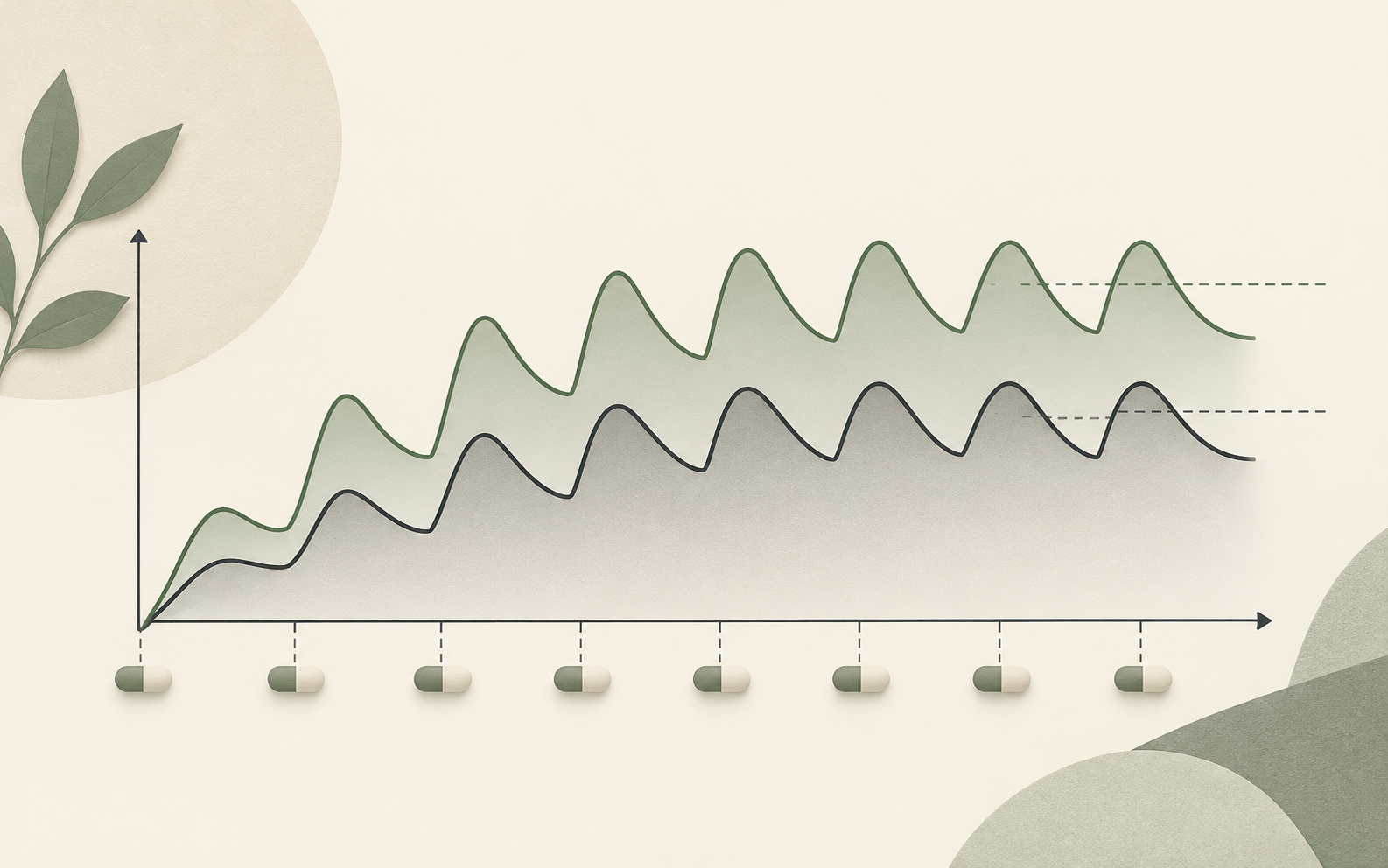
If you have just started a medicine or changed a dose, you may see the phrase steady state in a patient handout or a pharmacology explanation. It can sound like the drug suddenly switches on after a set number of days. That is not what it means. Steady state describes a repeating pattern of medicine entering and leaving the body during regular dosing—not a guarantee that symptoms are controlled, side effects are absent, or a dose is right for you.
A bathtub is a useful model—but only a model
Imagine water flowing into a tub while the drain stays open. At first, the water level rises. If the tap runs at a steady rate and the drain removes water at a matching average rate, the level begins to repeat within a predictable range. A medicine can behave similarly: each dose adds drug, and the body clears some before the next dose.
The concentration may rise after a dose and fall before the next one. “Steady” does not mean flat, motionless, or the same amount in every sample. It means the peaks and troughs have settled into a repeating pattern under a given regimen. This analogy also has limits: absorption, release formulation, metabolism, active metabolites, and non-linear elimination can make a real drug’s curve more complicated than water in a tub.
How half-life fits into the timing
For many medicines, half-life is a useful way to estimate how quickly concentration changes. In a simplified first-order model, the amount remaining from a dose halves during each half-life. With regular repeated dosing, the accumulation pattern approaches steady state over several half-lives. A pharmacology reference commonly describes the approach as roughly four to five half-lives for many drugs, but this is not a universal guarantee.
| Elapsed half-lives | Approximate approach to steady state in a simplified model | What not to conclude |
|---|---|---|
| 1 | About 50% | Not “half the treatment is working” |
| 2 | About 75% | Not a reason to increase the dose |
| 3 | About 87.5% | Not proof that symptoms should be resolved |
| 4 | About 94% | Still an approximation |
| 5 | About 97% | Not a clinical test result or a dosing recommendation |
The percentages describe a simplified mathematical approach to a modeled plateau. They do not describe symptom relief, safety, or the amount of medicine in a particular person’s blood. Some medicines have long half-lives; others have active metabolites or unusual elimination. The label and the prescriber’s plan take priority over a generic calculation.
Steady state is not the same as “I feel better”
How quickly a person notices a benefit depends on the medicine, condition, treatment goal, and the body process being affected. A drug concentration can approach a steady pattern before the full clinical benefit is apparent. Conversely, some medicines have an effect after a first dose even though repeated-dose concentrations have not yet accumulated to their eventual pattern.
Symptoms also fluctuate for reasons unrelated to drug concentration: the condition itself, sleep, meals, stress, other medicines, and measurement timing can all matter. A pharmacokinetic timeline cannot predict an individual’s response. If a medicine seems not to be helping, or a side effect concerns you, discuss it with the prescriber rather than adjusting the dose yourself.
Why clinicians may check a blood level
Not every medicine needs a blood test. MedlinePlus explains that therapeutic drug monitoring measures the amount of certain medicines in blood when the level can help clinicians balance effectiveness and safety. The test may be timed relative to a dose, and results are interpreted alongside the patient’s condition, treatment history, and other medicines.
For some drugs, a clinician may want a level after a stable regimen has been used long enough for the result to answer a particular question. In other situations, monitoring may begin earlier because waiting could be unsafe or because a dose has changed. The appropriate timing depends on the drug and the reason for testing; a generic “wait five half-lives” rule is not enough to decide when to draw a sample.
What can change the expected pattern?
- Different formulations: immediate-release and extended-release products can produce different peak-and-trough patterns.
- Dose timing: missed or irregular doses can make levels fluctuate differently from the planned schedule.
- Organ function: kidney or liver changes may affect elimination or metabolism for particular medicines.
- Other medicines: drug interactions can change how much is absorbed, metabolized, or cleared.
- Active metabolites: a breakdown product may contribute to effects even as the parent medicine changes.
- Non-linear pharmacokinetics: for some drugs, the relationship between dose and concentration is not a simple straight line.
These factors do not affect every medicine in the same way. Do not infer from a general article that your own drug will accumulate too quickly or too slowly. A pharmacist or prescriber can check the exact product and medication list.
Questions to ask when a dose changes
- When should I expect to notice a benefit, and what should I do if I do not?
- Does this medicine require a blood-level test, and how should its timing relate to my dose?
- What should I do if I miss a dose or take it late?
- Could a new prescription, over-the-counter medicine, or supplement affect it?
- Which symptoms require urgent care, and which should prompt a routine call?
Write down the name, strength, formulation, and the time you take it. That helps a clinician give advice specific to your regimen. Follow the package leaflet and prescription instructions. Never take extra doses to “reach steady state” faster or stop a medicine because a website estimated that the concentration has plateaued.
The takeaway
Steady state is a repeatable concentration pattern that can develop with regular dosing; it does not mean the medicine has reached a guaranteed therapeutic effect. For many drugs, several half-lives offer a rough timing estimate, but real medicines and real treatment decisions are more specific. Use the exact product information and ask the clinician who knows your situation before changing anything.
For the related concept, read our guide to medicine half-life and what “stays in your system” can mean.