
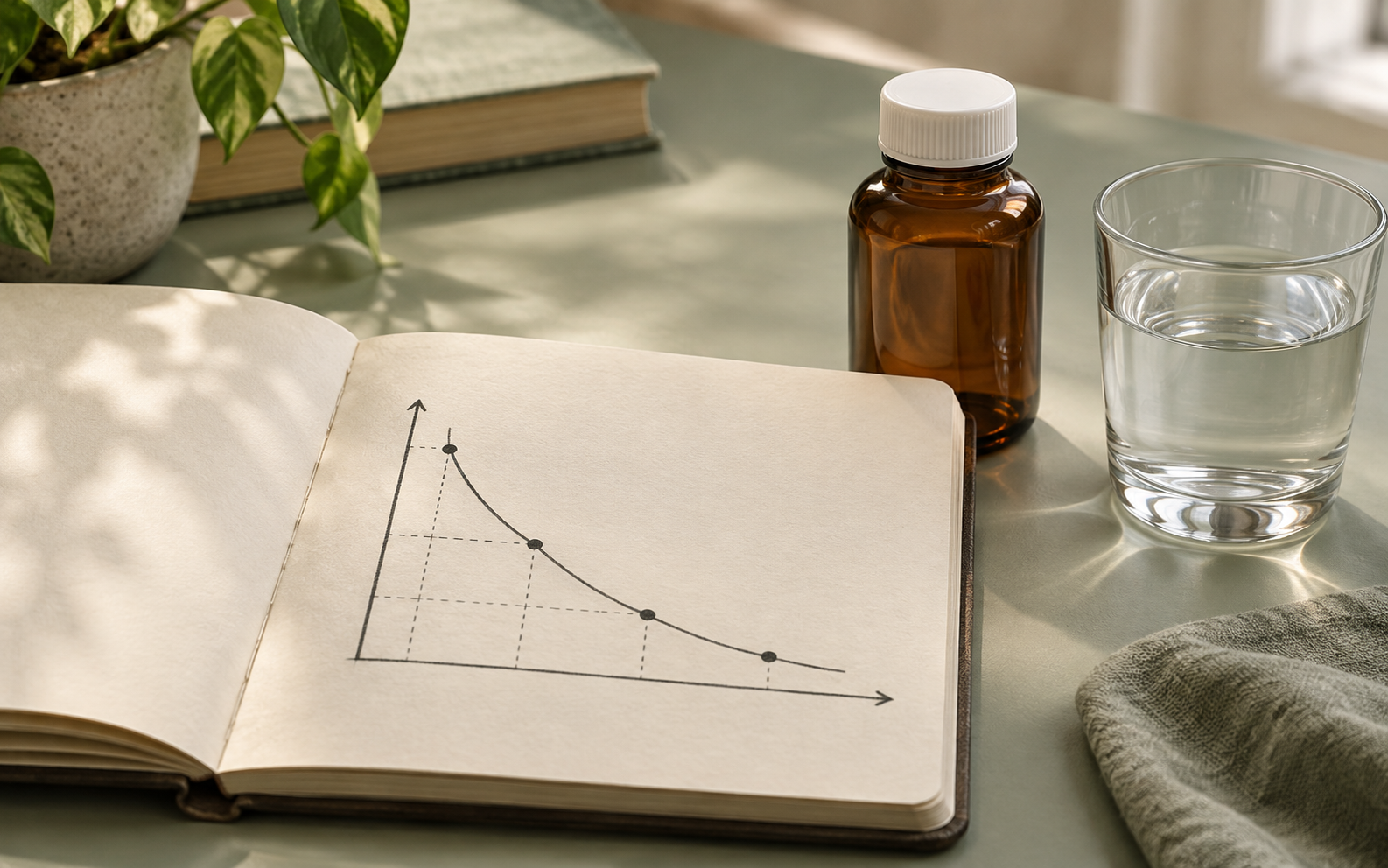
“How long does this medicine stay in my system?” sounds like a question with one clock-time answer. Usually it does not. A medicine’s concentration often falls over time, but the speed differs by drug, formulation, dose, repeated use, and the person taking it. The term half-life is a helpful starting point—not a personal countdown, a dosing rule, or a guarantee that effects or a test result end on a particular day.
What half-life actually means
Imagine—only as a simplified model—that a medicine’s concentration is 100 units and its half-life is eight hours. After one half-life, it would be about 50 units; after another, about 25; then roughly 12.5, 6.25, and 3.1. The decline is a series of halves, not a fixed amount removed every eight hours. This example is arithmetic, not a prediction for a real medicine or an individual.
| Elapsed time in the simplified example | Approximate amount remaining | How to read it |
|---|---|---|
| 0 half-lives | 100% | Starting reference point |
| 1 half-life | 50% | Half remains—not zero |
| 2 half-lives | 25% | A quarter remains |
| 3 half-lives | 12.5% | Still measurable in some circumstances |
| 5 half-lives | About 3% | A common rough rule of thumb, not a clinical clearance certificate |
Pharmacology references sometimes use five half-lives as a practical approximation for a large decline in concentration or the approach to a steady state. That shortcut assumes a simplified pattern. Some medicines have active metabolites, more than one relevant elimination phase, or a terminal half-life that does not describe the portion of exposure most tied to a clinical effect. FDA clinical-pharmacology materials distinguish pharmacokinetic measures such as half-life from the broader question of a drug’s exposure over time.
Why “in the system” can mean several different things
People may mean: “When will I stop feeling it?”, “When is it safe to take the next dose?”, “When will it be out of my blood?”, “Could it interact with something else?”, or “How long might a test detect it?” These questions do not have interchangeable answers.
- Blood concentration: a laboratory measure at a specific time and in a specific sample.
- Effect: depends on the medicine’s action, the target it affects, the dose, and individual response; an effect can fade before a trace is gone, or last after the concentration falls.
- Metabolites: the body may transform a medicine into other substances; some can remain relevant after the original drug level declines.
- Detection window: depends on the substance, test method, sample type, cutoff, timing, and laboratory. A half-life alone cannot reliably predict a drug-test result.
So a search result that gives one number for “how many days” can be misleading if it does not say which medicine, formulation, dose, sample, or outcome it means.
What can change how long a medicine lasts?
The specific medicine and its formulation
Different medicines are absorbed, distributed, metabolized, and eliminated differently. An immediate-release tablet and an extended-release version may produce different concentration curves even when they contain the same active ingredient. The label’s pharmacokinetics section is more useful than a generic chart; look for the exact product and formulation, not just a drug-name match.
Single dose versus repeated dosing
With repeated doses, the next dose may arrive before the previous one has been fully eliminated. That can lead to accumulation until input and elimination reach a repeating balance, often called steady state. The time to steady state is influenced by half-life, but the dosing schedule and the person’s specific treatment plan matter. Do not stop or re-time a prescription based on the rough five-half-life rule.
Liver and kidney function, age, and interactions
Many medicines are metabolized in the liver, eliminated by the kidneys, or handled through both routes. Changes in organ function can affect exposure for some medicines; age and other health factors may matter as well. Other prescription drugs, non-prescription products, and supplements can alter metabolism or add effects. The direction and size of the change depend on the exact combination, so a general calculator cannot replace a pharmacist’s or prescriber’s review.
Pregnancy, body composition, and individual variation
Distribution in the body and elimination can vary across people and life stages. This is one reason a published average does not automatically predict an individual’s result. A clinician may use symptoms, a blood concentration, kidney or liver tests, dose history, and the product label when deciding whether monitoring is useful.
Where to find a dependable number for a specific medicine
- Identify the exact medicine, strength, and release type on the package or prescription label.
- Read the “Clinical Pharmacology” or “Pharmacokinetics” section in the current official prescribing information.
- Check whether the number is a mean, range, single-dose result, or repeated-dose result—and whether it describes the parent drug or a metabolite.
- Ask a pharmacist or prescriber how the information applies to your dose, health conditions, and other medicines.
FDA’s drug-labeling resources explain where pharmacokinetic information is presented; Drugs@FDA provides access to approved labeling for many prescription products. Hospital therapeutic-drug-monitoring references can also show why values differ by drug and clinical context, but a table should not be used to adjust treatment on your own.
What not to infer from half-life
Half-life does not tell you when you should take another dose, whether it is safe to drink alcohol or drive, whether a side effect has ended, or whether a medicine will be detectable in a workplace or legal test. It also cannot tell you whether suddenly stopping a medicine is safe. For some treatments, a missed or changed dose can have consequences even when a person feels well.
Questions worth asking your pharmacist
- Does this label’s half-life describe the active medicine, an active metabolite, or both?
- Does my extended-release product behave differently from an immediate-release one?
- Could another medicine, supplement, or health condition change the expected exposure?
- Is a missed dose handled differently for this medicine?
- Do I need a specific monitoring test, and when should it be taken?
The practical takeaway
Half-life is a useful pharmacology concept: it describes a pattern of decline, not a precise “gone by” time. A five-half-life estimate leaves a small modeled fraction; it does not certify that a drug has no effect, cannot interact, or will not appear on a test. For an answer that matters to your treatment, use the exact product’s current label and get advice from a pharmacist or prescriber who knows your medication list and health context.