
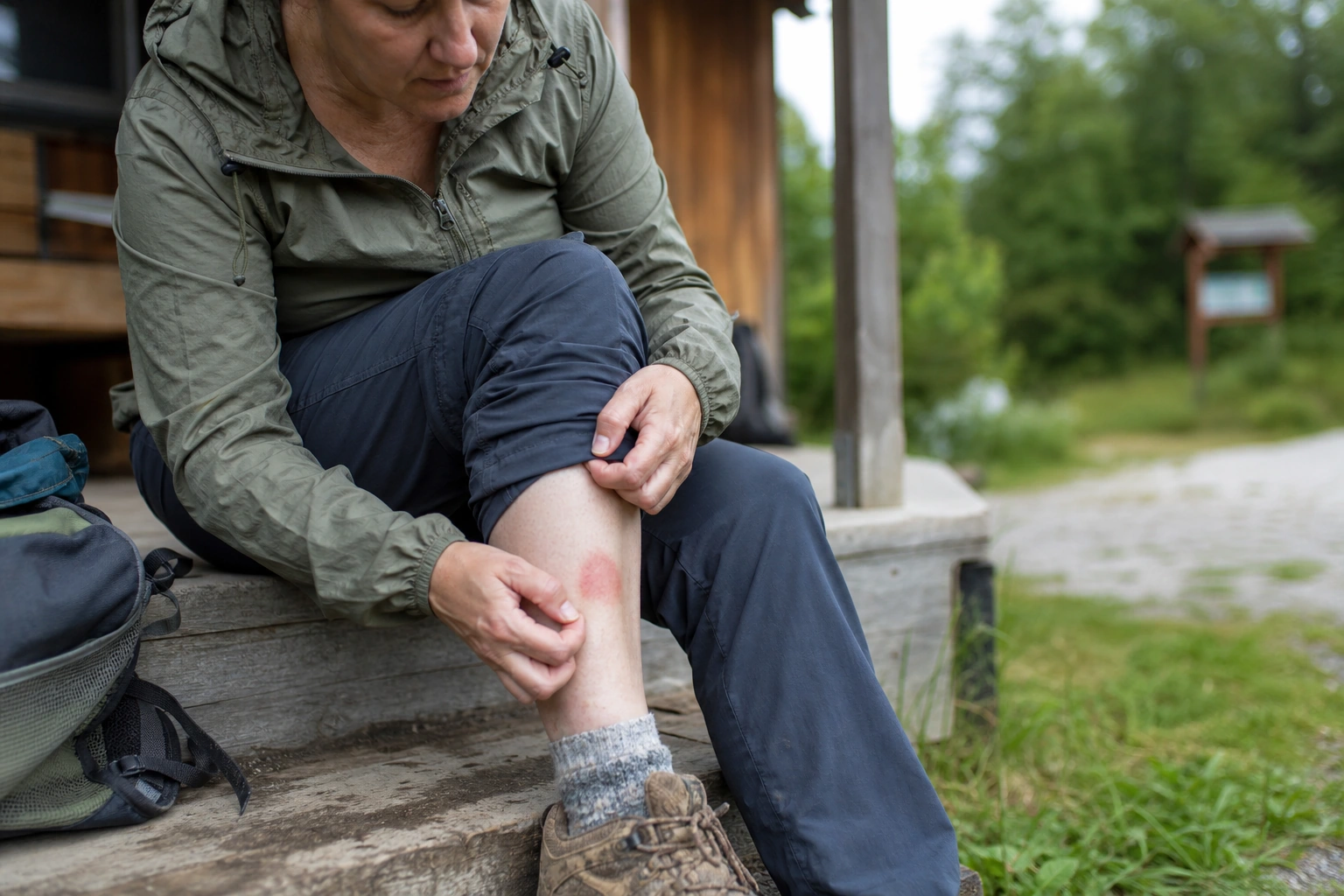
Lyme disease is a bacterial infection transmitted by infected Ixodes ticks in specific regions. Risk depends on where the bite occurred, the tick species, how long it was attached, and local infection rates. An expanding erythema migrans rash can establish the diagnosis before blood tests turn positive; nonspecific fatigue with no plausible exposure cannot.
Key points
- Remove an attached tick promptly with fine-tipped tweezers; do not burn, smother, or twist it.
- Erythema migrans expands over days and need not look like a bull’s-eye.
- Early antibody tests can be negative; later positive antibodies can remain for years after cure.
- Post-bite preventive antibiotics are used only for selected clearly high-risk bites within a short time window.
- Prolonged symptoms deserve care, but repeated long-term antibiotics have not been shown to help after recommended treatment.
Geography is part of the diagnosis
In the United States, Lyme disease is concentrated in the Northeast, mid-Atlantic, and upper Midwest, with a smaller focus along the Pacific coast. In Europe and parts of temperate Asia, other Ixodes ticks and Borrelia species cause Lyme borreliosis, with regional differences in skin, neurologic, and joint presentations.
Tick range changes over time, and risk can vary sharply within a state, county, or province. “I was outdoors” is less informative than the exact location, habitat, date, and whether a tick was attached. Local public-health maps and surveillance are the best source for current regional risk.
People can be bitten in gardens and parks as well as forests. Nymphal ticks are small and may go unnoticed, so not remembering a bite does not exclude Lyme disease when the geography and clinical presentation fit.
What to do after finding a tick
- Use clean fine-tipped tweezers to grasp the tick as close to the skin as possible.
- Pull upward with steady, even pressure. Do not twist or jerk.
- If mouthparts remain and do not lift easily, leave them; the skin usually expels them as it heals.
- Clean the bite and hands with soap and water or an appropriate antiseptic.
- Check the rest of the body and clothing for other ticks.
- Record the date, location, and a photo or description of the tick and attachment site.
Do not use petroleum jelly, nail polish, heat, essential oil, or another substance to force detachment. Delay increases risk. CDC also advises against commercial testing of the tick to make treatment decisions: a positive tick does not prove transmission, and a negative result can falsely reassure.
Is preventive treatment needed?
Most tick bites do not lead to Lyme disease and do not require antibiotics. The IDSA/AAN/ACR guideline reserves prophylaxis for a clearly high-risk bite: an identified Lyme-vector tick in a highly endemic area, attached long enough to create meaningful transmission risk, and evaluated within 72 hours of removal. If any part is uncertain, careful observation is often preferred.
Age, pregnancy, allergy, and other medical factors influence the decision. This page does not name a prophylactic medicine or dose. Contact a local clinician promptly because the window is short. Preventive treatment for Lyme does not prevent all other tick-borne infections.
Do not test blood immediately after an asymptomatic bite. Antibodies have not had time to develop, and a pre-existing positive result may reflect an old infection rather than the current bite. Monitor for an expanding rash, fever, headache, marked fatigue, facial weakness, or other new symptoms over the following weeks.
Erythema migrans is not always a bull’s-eye
Erythema migrans, or EM, usually begins three to 30 days after a bite and gradually expands over several days. It may be uniformly red, pink, purple, or blue-toned, oval or irregular, with or without central clearing. On deeper skin it may appear dusky or bruise-like and be easier to feel or compare in photographs than to see.
The rash is usually not very itchy, hot, or painful. A small red bump appearing immediately at the bite and fading within a day or two is more consistent with local irritation. An expanding lesion, especially beyond about 5 cm, is more concerning.
NICE advises diagnosing Lyme disease clinically when a typical EM rash is present and not waiting for a blood test. Early serology is often negative. Take dated photos beside a ruler and seek care; do not wait for the rash to form a target.
Other early and disseminated signs
Early infection can cause fever, chills, headache, fatigue, muscle and joint aches, and swollen lymph nodes, with or without a noticed rash. These symptoms are nonspecific, so geography and exposure determine how strongly Lyme should be considered.
Untreated infection can spread and cause multiple EM lesions, one- or two-sided facial palsy, meningitis, shooting nerve pain, numbness or weakness, heart inflammation and conduction block, or episodes of dizziness, palpitations, fainting, and breathlessness. Later Lyme arthritis usually causes obvious swelling and pain in one or a few large joints, often a knee.
European infection can also produce lymphocytoma or a slowly progressive bluish-red skin condition called acrodermatitis chronica atrophicans. Travel history matters because species and manifestations differ.
How Lyme testing works
Recommended laboratory diagnosis uses antibody tests in a two-step process. In the US, CDC advises FDA-cleared assays: either an initial immunoassay followed by an immunoblot when indicated, or two different immunoassays in a modified two-tier approach.
The immune system may need several weeks to make detectable antibodies. A negative test during early EM does not exclude Lyme disease. After four to six weeks, recommended tests are much more sensitive. A clinician may repeat a correctly timed test when suspicion remains and the first sample was early.
Antibodies can remain positive for months or years after successful treatment and do not prove active infection or immunity. Repeating serology is not a test of cure. A positive result in someone with no compatible exposure or manifestations may be a false positive or old infection.
Urine antigen tests, unvalidated “Lyme panels,” standalone IgM interpretation late in illness, CD57 counts, and tests from laboratories using non-standard criteria can lead to misdiagnosis. Ask whether the assay and interpretation follow the national two-tier standard.
Other tick-borne infections
The same tick can transmit other pathogens depending on region, and other tick species transmit different diseases. Persistent high fever, low blood counts, anemia, dark urine, severe headache, or illness that does not improve as expected may prompt testing for anaplasmosis, babesiosis, tick-borne encephalitis, rickettsial disease, or another infection.
Testing every possible “co-infection” without regional and clinical evidence creates false positives. CDC notes there is no evidence that ticks transmit Bartonella or Mycoplasma as commonly claimed by some commercial panels.
Treatment pathways
Lyme disease is treated with an antibiotic selected according to the manifestation, age, pregnancy, allergy, and severity. Uncomplicated EM is usually treated orally. Meningitis, significant carditis, eye disease, and selected neurologic presentations require urgent or specialist decisions and may need hospital monitoring or intravenous treatment.
This article does not provide drug names, doses, or durations. Different manifestations require different courses, and European and North American guidance is not identical. Early appropriate treatment usually leads to rapid and complete recovery.
A short-lived increase in symptoms soon after treatment can occur with spirochetal infections, but new hypotension, breathing difficulty, swelling, hives, severe vomiting, or another dangerous reaction needs urgent assessment rather than being labelled a benign “die-off.”
Symptoms that persist after treatment
Some people have prolonged fatigue, pain, or difficulty thinking after recommended therapy. CDC uses the term post-treatment Lyme disease syndrome, or PTLDS, because the mechanism is unknown. The symptoms are real and can be disabling.
Care should review the original diagnosis and treatment and evaluate sleep disorders, anemia, thyroid disease, autoimmune or neurologic conditions, mood, medication effects, deconditioning, and other infections. Symptom-focused rehabilitation and support may help function while recovery occurs.
Multiple controlled studies have found that prolonged or repeated antibiotics do not improve these nonspecific symptoms more than placebo and can cause line infections, C. diff, allergy, organ injury, and sepsis. Avoid clinics that guarantee a cure through months of intravenous antibiotics or proprietary tests.
Prevention outdoors and at home
Use an approved repellent according to the label, wear protective clothing, walk in the centre of trails, and treat clothing or gear with an appropriate product where recommended. After exposure, shower, check the scalp, behind ears, armpits, groin, waist, behind knees, and between toes, and check children and pets.
Tumble-drying clothes on suitable heat and checking gear can remove ticks. Landscaping measures reduce habitat near homes. No single method is complete; prompt tick detection and removal remain important.
Questions people often ask
Does every EM rash look like a bull’s-eye?
No. Many are uniformly coloured or irregular. Gradual expansion after plausible exposure is more important than a target shape.
Can an early Lyme test be negative?
Yes. Antibodies may be undetectable in the first weeks. A typical EM rash is diagnosed clinically.
Can a positive antibody test prove ongoing infection?
No. Antibodies can remain for years after cure. Interpretation requires compatible symptoms and exposure.
Should I have the tick tested?
No for treatment decisions. Tick testing is not quality-controlled like clinical testing and cannot show whether transmission occurred.
Sources and evidence scope
This guide was researched using current CDC guidance on tick removal, Lyme symptoms, testing, treatment, and post-treatment symptoms, NICE guideline NG95 (amended May 2026), the IDSA/AAN/ACR guideline, and the ECDC European borreliosis factsheet. Sources were checked on August 21, 2026. Tick species, endemic areas, tests, prophylaxis, and treatment vary by country.